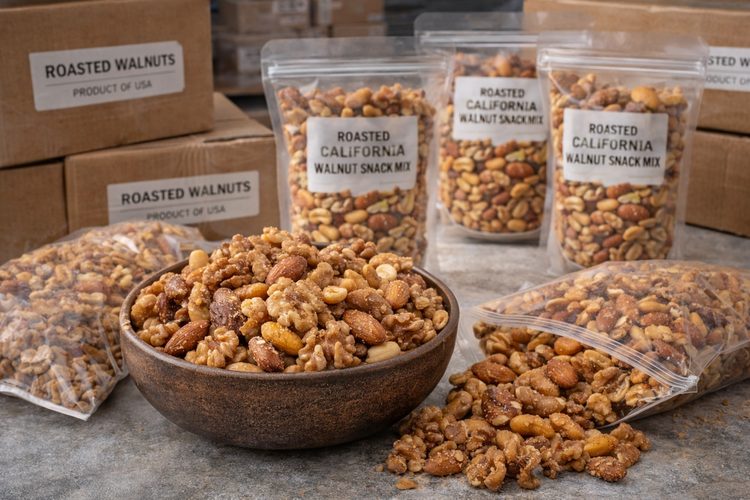
Snack mix walnuts are not simply another nut component dropped into a blend. In real commercial programs, the walnut has to do several jobs at once. It may need to contribute visible premium value, provide a softer or richer bite than harder nuts, carry seasoning effectively, stay intact through blending and bagging, and still fit the target cost of the finished mix. That is why California walnut snack mix programs are usually built around format and roast logic first, then refined around packaging, channel and replenishment timing.
For Atlas, snack mix sourcing is less about asking whether walnuts are available and more about defining how the walnut should behave inside the final mix. A walnut half, a medium roasted piece and a smaller seasoned cut may all be commercially valid, but they do not create the same sensory profile, visual balance, production yield or retail impression. The stronger commercial outcome usually comes from aligning roast style, piece size, mix composition, pack format and shipment cadence before the order is placed.
Why walnuts work well in snack mix systems
Walnuts bring a different character to snack mixes than almonds, peanuts, cashews or seeds. They usually contribute a richer nut note, a more irregular natural appearance and a more premium visual identity when the mix needs to look less uniform and more artisanal. In some formulations, walnuts also help soften the overall bite profile by balancing harder roasted components with a gentler crunch.
That said, those strengths only become commercially useful when the walnut format is chosen correctly. If the walnuts are too large, they may dominate the blend or break excessively during production. If they are too small, they may disappear visually, accumulate at the bottom of the pack or fail to justify their cost contribution. Snack mix buyers therefore tend to evaluate walnuts not as a standalone SKU, but as part of the total architecture of the mix.
Snack mix buyer view: the right walnut format is the one that supports the total blend. It must work visually, functionally and commercially with the other inclusions rather than simply look good on its own.
How this topic shows up in real buying decisions
In practice, buyers comparing walnut snack mix programs usually review several linked questions at once. They ask whether the walnuts should be raw, pasteurized, dry roasted or oil roasted. They consider whether the pieces need to remain more intact for premium appearance or be reduced for better blend distribution. They review whether the walnuts should be plain, salted, seasoned or incorporated into a broader flavor system. And they determine whether the finished program will be packed as a bulk industrial blend, a foodservice format, a consumer retail line or an export retail product.
For snack mix applications, the commercial logic also changes depending on whether the walnuts are being blended centrally by a manufacturer, added later by a co-packer or sold as part of a finished branded line. A walnut that is commercially suitable for a domestic industrial mix house may need a different roast approach, pack style or stability expectation in a finished export snack bag. The product route matters as much as the walnut itself.
Roasted walnut format options for snack mixes
Most snack mix programs focus on roasted walnuts because roast development improves flavor readiness, changes bite and makes the walnuts more compatible with seasoned savory blends. Even within roasted formats, however, there is no single answer. Buyers often compare:
- Dry roasted walnuts: often selected when the goal is clean walnut flavor, lower formulation complexity and a roast character that integrates well with other dry-seasoned inclusions.
- Oil roasted walnuts: sometimes considered where richer mouthfeel, stronger surface pickup or a particular snack-style flavor system is desired.
- Light roast profiles: chosen when buyers want a more natural walnut identity and lighter color in the finished mix.
- More developed roast profiles: considered when the mix needs stronger savory character, deeper aroma or a more robust snack note.
Each of these choices affects more than flavor. Roast style can influence color uniformity, bite, surface character, perceived freshness and how the walnuts visually sit beside other inclusions such as almonds, cashews, corn snacks, seeds, dried fruit or seasoned crackers.
Choosing kernel size and piece range for blend performance
In snack mix programs, size range is one of the most practical sourcing decisions because it affects appearance, distribution and pack economics all at once. Larger roasted walnut halves and large pieces create strong premium visual cues. They are often useful when the finished mix is sold in transparent or semi-transparent packaging and the brand wants high-value visual recognition. However, larger pieces can also be more fragile, more variable in pack distribution and more dominant relative to the rest of the mix.
Medium cuts or more controlled piece sizes are often the workhorse option in snack blending. They usually provide a better balance between visibility and blendability. They can reduce extreme variation from bag to bag and may help limit breakage during conveying, tumbling and filling. Smaller pieces can be useful in highly engineered snack blends or in cost-managed programs where broader distribution is more important than distinct walnut identity. The tradeoff is that smaller pieces may contribute less visible premium value.
For many buyers, the best format is not the largest available walnut, but the size that remains commercially stable from blend room to shelf. That is why snack mix inquiries should define whether the priority is premium visual identity, controlled distribution, seasoning carry, reduced breakage or price discipline.
Seasoning adhesion and flavor carry in walnut mixes
Walnuts play a different role in seasoning systems than some other snack ingredients. They can contribute their own rich base flavor, but the selected roast state and surface condition also affect how seasonings present in the finished mix. In some snack systems, the walnut is expected to carry savory flavors directly. In others, the walnut is included as a roasted nut component while the total mix seasoning comes primarily from other ingredients.
This distinction matters commercially. If the walnut is expected to participate actively in the flavor system, then roast style, oil level, surface character and handling become more important. A buyer may need to discuss whether the format should remain cleaner and more natural or whether it should support stronger seasoning pickup. That, in turn, can affect processing route and total delivered cost.
Snack brands should also consider flavor balance. Walnuts have a recognizable nut profile of their own, so the finished mix should not assume the walnut is a neutral carrier. In premium savory programs, that can be a strength. In sweeter or more aggressively flavored systems, it means the walnut should be chosen so it complements rather than conflicts with the broader seasoning direction.
Flavor planning point: when a walnut is included in a seasoned snack mix, buyers should specify whether the walnut is mainly a visible roasted nut component or whether it also needs to support the seasoning system directly. Those are related but different sourcing decisions.
Mix balance, breakage and line handling
Snack mix formulation is not only about taste. It is also about what happens during blending, transfer, weighing and bagging. Walnuts that are too delicate for the process route may generate excessive fines or create inconsistency across the packed product. Walnuts that are too large relative to the mix may segregate visually or mechanically. Pieces that are too small may settle or make the mix look less premium than intended.
This is why buyers often test walnuts not only in bench samples but in real handling conditions. The correct walnut for a snack program should survive the chosen production route with acceptable integrity. It should also contribute to balanced pack appearance. A premium trail-style mix may intentionally show more visual irregularity, while a mainstream snacking SKU may require more controlled piece distribution. Both are valid, but they require different format choices.
Pack planning is part of the walnut decision
In snack mix programs, pack planning is inseparable from walnut selection because the packaging influences product protection, shelf presentation, portion strategy and commercial channel fit. A walnut that works in a bulk industrial mix may not translate directly into a finished retail pouch unless pack structure, oxygen control, bag size and retail presentation are also aligned. Export routes add still more complexity because longer transit and storage windows may affect the practical choice of roast style and pack configuration.
Typical commercial pack routes include:
- Industrial bulk: for manufacturers blending further or packing later in their own system.
- Foodservice packs: for hospitality, catering or back-of-house snack programs.
- Retail-ready branded packs: where consumer appearance, shelf presentation and portion logic matter.
- Private label packs: where retailer specification, label review and repeat consistency become central.
- Export-oriented retail packs: where transit, documentation, labeling and channel requirements may all shape the program.
For buyers, this means the walnut quote should reflect the real commercial route. “Snack mix walnuts” is not yet a complete quote request unless the packaging model is also clear.
How retail strategy changes the walnut program
Retail snack mix lines often need walnuts to do more than contribute flavor. They may also need to support a premium message, healthier perception, California sourcing story or differentiated visual. In these cases, the walnut format becomes part of product positioning. Larger visible pieces may justify a more upscale pack and merchandising story. More controlled medium cuts may suit mainstream packs where pack fill consistency and cost management are stronger priorities.
Retail strategy also changes how buyers think about shelf-life planning and inventory rhythm. A domestic quick-turn snack line may have one set of constraints, while an export retail pack may require more conservative timing, pack protection and documentation discipline. These differences are why pack planning should be addressed at the same time as walnut format rather than later in the process.
What Atlas would ask before quoting
For walnut snack mix projects, Atlas recommends translating the product idea into a quote request with a few concrete points. That usually produces a more comparable quote and reduces avoidable back-and-forth with processors and packers. Atlas would typically want to know:
- the target walnut format: halves, large pieces, medium cuts or smaller roasted pieces,
- the roast preference: raw for further processing, pasteurized, dry roasted or oil roasted,
- whether the walnuts need to remain plain, salted or be part of a stronger seasoning system,
- the style of snack mix: premium nut-forward, trail-style, savory blend, cereal-snack crossover or cost-managed mainstream mix,
- the pack format: industrial bulk, foodservice, retail-ready, private label or export-oriented retail,
- the destination market and likely shipment timing,
- the estimated volume pattern: trial, validation run, monthly demand, seasonal demand or container program,
- any special quality expectations related to color, breakage tolerance, shelf presentation or labeling.
These inputs help Atlas discuss realistic California partner options rather than frame the project as a generic price inquiry. They also help determine whether the walnut should be positioned mainly as a premium visual inclusion, a seasoning-supporting roasted nut or a balanced component inside a broader snack architecture.
Typical commercial development path for snack mix walnut programs
Commercially, snack mix walnut projects often develop in stages. The first phase is usually a format and roast review, where the buyer compares sensory and visual fit. The second phase is a validation run or line test to confirm blend performance, breakage tolerance and bag appearance. The third phase is launch volume, where pack selection and shipment cadence become more important. Repeat replenishment follows once the brand or manufacturer is comfortable with both product fit and commercial flow.
This staged approach is practical because snack mixes are highly presentation-driven. A walnut that looks strong in a bowl may behave differently when blended at scale, conveyed through equipment and presented inside a finished retail pack. A short validation cycle can therefore save significant cost later.
Commercial planning points
From a trading standpoint, the best snack mix programs are built around repeatability rather than one-off opportunistic buying. Clear format definition, agreed roast style, sensible packaging, realistic forecast windows and consistent shipment timing all improve continuity. That matters especially when the walnut is a visible premium component of the finished SKU, because substitution late in the program may alter both the look and perceived value of the mix.
When relevant, the brief should also mention whether the business is industrial bulk, foodservice, retail-ready, private label or export-oriented. That single clarification often changes packaging, documentation and timing assumptions. A domestic industrial snack mix program may allow one operating model, while export retail may require tighter pack planning, clearer documentation and more deliberate timing.
Buyers should also compare total delivered program value, not just walnut price in isolation. The correct roasted format may reduce waste, improve blend consistency, support a stronger retail look and simplify pack planning. Those gains can matter more than a narrow nominal raw material difference.
Buyer planning note
Atlas Global Trading Co. uses topics like this to move conversations from broad interest to a specification-minded inquiry. If you are evaluating California walnut supply for snack mixes, the most useful first step is to define the roast style, target format, seasoning role, pack structure, destination and expected volume. With those inputs, the next discussion can be grounded in a real snack program rather than a generic walnut category request.
Whether the need is for nut-forward premium mixes, mainstream savory blends, private-label snack packs or export-oriented retail programs, the same principle applies: the right walnut is the one that works in the full system of flavor, blend performance, packaging and commercial timing.
Need help sourcing walnuts for a snack mix program?
Use the contact form to turn this article topic into a practical quote request for Atlas and its California supply partners.
- State the exact roasted walnut format
- Add target monthly or trial volume
- Include destination market, pack style and timing
Frequently Asked Questions
What is the main buyer takeaway from “California Walnut Snack Mix Programs: Roasted Formats and Pack Planning”?
The main buyer takeaway is that walnut snack mix programs work best when roast style, format, seasoning behavior, pack configuration and commercial timing are defined together rather than purchased as a generic nut component.
Which walnut format usually works best in snack mixes?
There is no single best format for every snack mix. Buyers usually choose between halves and pieces, medium cuts, or smaller roasted pieces depending on visual goals, mix balance, seasoning carry, breakage tolerance and target selling price.
Can this topic be applied to both U.S. and export snack programs?
Yes. The same format and roast logic applies to domestic and export snack mixes, although packaging, transit time, labeling and retail channel requirements may differ by destination.