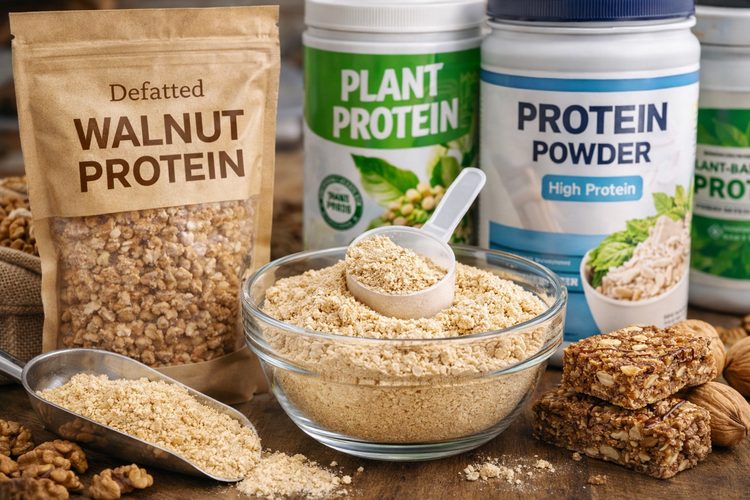
Defatted walnut protein sits in a different commercial category than whole kernels, diced cuts, meal or butter because the buyer is usually not purchasing it for conventional walnut identity alone. The ingredient is typically being considered for protein contribution, nutrition-forward positioning, dry blending logic, texture adjustment or formulation differentiation inside products that compete in more technical categories such as bars, powders, baked systems, plant-based mixes or functional foods. That means industrial nut buying here is rarely only about nominal price. The stronger commercial outcome usually comes from aligning specification, process route, packaging and shipment timing before the order is placed.
For Atlas, the starting question is not simply whether a customer wants a walnut-derived protein ingredient. The more useful question is what the ingredient needs to do in the finished system. Is the goal to raise protein density, broaden the source mix in a protein blend, create a more premium nut-based story, reduce oil load versus conventional walnut meal, or build a distinctive formulation around a less common nut protein stream? The answer changes the most suitable ingredient route, the practical specification language and the real commercial expectations.
What defatted walnut protein means in a commercial context
In buyer formulation work, defatted walnut protein is typically discussed as a more protein-forward walnut-derived ingredient that has had a significant portion of its oil removed relative to conventional walnut material. Commercially, this usually places it somewhere between mainstream walnut meal and more specialized plant protein ingredients. It is relevant less as a direct consumer-facing walnut format and more as a technical input for nutrition-oriented products where protein positioning, solids contribution and nut-origin differentiation matter.
This distinction is important because buyers should not assume the ingredient will behave exactly like walnut flour, walnut meal or whole-kernel-derived applications. Once an ingredient is positioned as defatted and protein-focused, the conversation shifts toward blend behavior, particle profile, flavor impact, texture effect, color, packaging stability and how the ingredient will sit beside other proteins or dry bases in the formulation.
Buyer framing: defatted walnut protein should be specified by formulation role, not only by ingredient name. The real commercial question is whether it is acting as a protein contributor, a blending component, a texture modifier, a marketing differentiator or some combination of these.
How this topic shows up in real buying decisions
For walnuts, the quote should reflect the real format and route. Whole or kernel material is different from diced, meal, extra fine flour, butter or oil. Defatted walnut protein belongs even further along the processing spectrum, so it usually requires a more precise quote request than standard walnut ingredients. In practice, buyers considering this category often compare it with other plant-forward dry ingredients rather than with snack-ready walnut formats.
Commercially, the ingredient may be evaluated for inclusion in powders, bars, baked systems, nutritional blends, better-for-you snacks, plant-based formulations or premium specialty foods where protein positioning matters. Which use case makes sense depends on the formulation target, whether the customer is manufacturing further, packing retail finished goods, supplying foodservice or planning export distribution. The product menu for a walnut-focused business may still include raw walnuts, pasteurized walnuts, dry roasted walnuts, meal, butter and oil, but a protein-focused walnut ingredient is usually sourced through a narrower and more specification-minded discussion.
Where defatted walnut protein may fit in nutrition-focused formulations
From a product-development standpoint, defatted walnut protein is usually relevant where a formulator wants a nut-derived protein component without relying on the full oil load associated with more traditional walnut formats. This can be commercially interesting in formulations where protein density, blendability, calorie structure, dry mix behavior or specific macro-positioning influence the final product concept.
Possible commercial use cases may include:
- Nutrition powders and dry blends: where the ingredient may act as part of a broader protein system rather than a standalone base.
- Protein bars and functional snacks: where it may contribute solids, protein content and a differentiated nut-origin positioning.
- Specialty bakery or better-for-you baked goods: where protein-oriented walnut ingredients may support both nutritional framing and ingredient story.
- Plant-based and hybrid formulations: where buyers may be seeking diversity beyond more conventional protein inputs.
- Premium niche formulations: where the ingredient is part of a higher-value positioning rather than a commodity protein strategy.
The best fit depends on whether the product is being built around function, label story, premium differentiation or technical balance inside a broader blend.
Protein contribution versus sensory compromise
One of the central buying questions in nutrition-focused ingredients is whether the protein contribution is worth the sensory and processing tradeoffs. Defatted walnut protein may be attractive because it can support a more distinctive nut-based protein narrative, but buyers still need to consider how it influences taste, texture, color, powder flow or finished product mouthfeel. That is especially important in categories like bars, powders and baked goods where consumer acceptance depends on more than nutrient positioning.
This is why commercial evaluation usually involves more than reviewing a data point or ingredient name. Buyers often need to know whether the ingredient fits a blend smoothly, whether it carries recognizable walnut notes, whether it darkens the finished product more than desired, whether it contributes dryness or density, and whether it is being used as a minor supporting input or as a visible protein story driver. The right commercial decision depends on how much formulation compromise the brand is willing to accept in return for its protein and ingredient-positioning benefits.
Blend logic and multi-protein formulation strategy
In many nutrition-oriented programs, the buyer is not using a single protein source. Defatted walnut protein may instead sit inside a multi-ingredient architecture where its role is to complement other proteins, broaden the ingredient story or help shape the sensory profile of the overall blend. This is one reason why specification-minded quoting matters. The commercial value of the ingredient may change significantly depending on whether it is a lead protein source, a secondary protein contributor or a niche premium differentiator inside a blended system.
Atlas generally encourages buyers to describe whether the ingredient is intended to stand alone or be used alongside other proteins and dry ingredients. That affects not only how the quote is framed, but also whether the conversation should focus more on technical performance, supply continuity, premium positioning or cost control.
Blend planning point: if defatted walnut protein is intended for a blended protein system, say so early. A protein ingredient quoted as a lead component may be evaluated differently than one used as a supporting component for sensory or marketing differentiation.
Particle size, flow and handling considerations
In nutrition-focused dry systems, particle behavior matters. Buyers may need to think about whether the ingredient should behave like a finer powder, a more substantial meal-like material or a controlled intermediate particle profile. That choice can influence blending, dust behavior, packing, hydration characteristics and finished texture. In bar or baked systems, it may also affect density, bite and processing consistency.
From a buyer standpoint, this means the quote request should not stop at the term “walnut protein.” If the customer expects a certain flow behavior, mouthfeel or blend appearance, those details should be part of the commercial conversation. A product that is technically available but too coarse, too dense or too flavor-forward for the intended application may not be the right commercial fit even if the nominal protein story is attractive.
Flavor profile and product-positioning implications
Walnut-derived ingredients are not sensory-neutral in the way some commodity dry inputs are often expected to be. Even in more processed forms, a walnut-oriented protein ingredient may bring a distinct nut identity, toasted or earthy notes, or a broader flavor presence that can support or complicate the final formulation depending on the application. This can be an advantage in products that want a nut-origin narrative. It can be more challenging where the formula depends on a highly neutral base.
Commercially, this means the buyer should consider whether the walnut identity is a feature or a limitation. In premium, plant-forward or specialty nutrition categories, it can help the product stand out. In more mainstream systems aiming for minimal flavor interference, it may need to be used more selectively or in a supporting role. The correct answer depends on the brand’s final positioning, not just on the ingredient itself.
Color, visual profile and finished-product expectations
Nutrition-focused formulations are often sensitive to color because color affects consumer perception of both flavor and quality. A walnut-derived protein input may influence finished product appearance more noticeably than a highly refined neutral ingredient. In bars, powders and baked systems, this can alter whether the product reads as natural, indulgent, rustic, premium or overly dark for the intended market.
This is not inherently negative. In fact, some brands may value a more natural and recognizable plant-based look. The commercial question is whether that color and visual impact support the final product position. Buyers should therefore think about appearance as part of specification planning rather than only as a lab-stage afterthought.
Packaging and shelf-life logic
Packaging matters because more processed walnut-derived ingredients can require different protection and handling logic than conventional whole or snack-ready walnuts. In protein-oriented dry formulations, pack integrity, storage discipline and usage pattern often affect whether the ingredient remains commercially practical through the real warehouse and production cycle. A fast-turn industrial program may support one pack configuration, while a slower specialty or export route may require another.
When relevant, the brief should mention whether the program is industrial bulk, foodservice, retail-ready ingredient pack, private label or export-oriented. That single clarification often changes packaging, documentation and timing assumptions. The ingredient may still be technically the same, but the commercial packaging and logistics route may differ substantially.
What Atlas would ask before quoting
Atlas encourages buyers to define intended use, pack style, destination, timeline and quality expectations early. For defatted walnut protein and similar nutrition-focused ingredients, the conversation usually needs to be even more structured. Before quoting, Atlas would typically want to know:
- the target application: powder blend, nutrition bar, baked product, plant-based system or another defined formulation,
- whether the ingredient is intended as a lead protein source or a supporting component in a broader blend,
- the preferred particle profile or texture behavior in the finished system,
- whether walnut identity should be prominent, moderate or minimal in the final sensory profile,
- the pack style and handling requirement,
- the destination market and regulatory or labeling context,
- the estimated commercial rhythm: sample, bench trial, pilot run, launch volume or repeat replenishment,
- any specific expectations around color, flavor, blendability or macro-positioning.
Those inputs help reduce avoidable back-and-forth and improve comparability across California supply options or processing routes. They also help determine whether the ingredient is being bought primarily for nutritional functionality, marketing differentiation or a balanced mix of both.
Commercial planning points
From a trading standpoint, the best programs are built around repeatability rather than emergency spot buying. That means clear documentation, agreed packaging, sensible shipment cadence and a commercial structure that supports continuity as the formulation develops from trials to real volume. Nutrition-focused ingredients often pass through several stages: early R&D review, pilot blend, validation run, launch quantity and repeat replenishment. Atlas generally uses that logic to guide pack and shipment planning so that the sourcing discussion matches the buyer’s true development stage.
When relevant, the brief should also mention whether the program is industrial bulk, foodservice, retail-ready ingredient line, private label or export-oriented. That single clarification often changes packaging, documentation and timing assumptions. A pilot-stage ingredient trial has very different commercial requirements than a recurring export program built around a finished retail nutrition line.
Buyers should also compare total delivered value rather than isolating nominal input price. The right walnut protein ingredient may improve differentiation, help support a better plant-based story, broaden a protein blend strategy and create premium positioning that a lower-cost generic protein may not support. Those commercial gains can matter just as much as the ingredient cost itself.
Buyer planning note
Atlas Global Trading Co. uses topics like this to move conversations from broad interest to a specification-minded inquiry. If you are evaluating defatted walnut protein or related walnut-derived ingredients for nutrition-focused formulations, share the target application, blend role, pack style, estimated volume and destination using the floating contact form. That gives the next step a real commercial foundation.
Whether the requirement is for protein-oriented blends, bars, better-for-you bakery, plant-based systems or specialty premium formulations, the same principle applies: walnut sourcing works better when product form, intended application, packaging and commercial timing are defined together.
Need help sourcing around this walnut protein topic?
Use the contact form to share your product, packaging, destination and timing requirements for a practical quotation.
- State the exact protein-oriented walnut format
- Add target monthly or trial volume
- Include destination market, pack style and target timing
Frequently Asked Questions
What is the main buyer takeaway from “Defatted Walnut Protein in Nutrition-Focused Formulations”?
The main buyer takeaway is that defatted walnut protein programs work best when protein format, intended application, sensory expectations, packaging and commercial timing are defined together instead of being treated as a generic high-protein ingredient purchase.
What should buyers define before requesting a quote for walnut protein ingredients?
Buyers should define the target application, expected protein role in the formulation, preferred particle profile, flavor and color expectations, blend ratio, packaging format, destination market and expected commercial volume.
Can walnut protein ingredients be relevant for both domestic and export programs?
Yes. The same product-development and sourcing logic can apply to both domestic and export programs, although packaging, shelf-life expectations, labeling, documentation and route-to-market requirements may vary by destination.