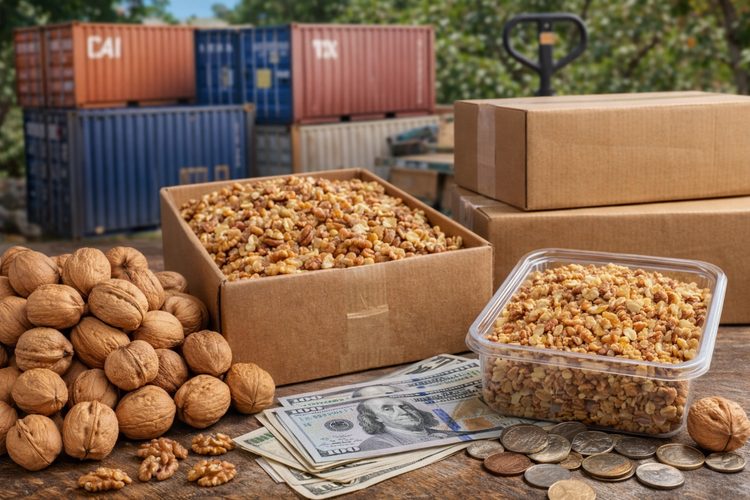
Major price drivers in California walnut trading matter because industrial nut buying is rarely only about a simple commodity number. Buyers often ask for a “walnut price,” but the real market conversation usually starts only after the product has been defined properly. The same origin can produce very different quote levels depending on format, grade, color, processing route, pack style, shipment timing and destination. The stronger commercial outcome usually comes from aligning specification, process route, packaging and shipment timing before the order is placed.
For Atlas, the most practical way to approach walnut pricing is to treat it as a structured commercial result rather than as a stand-alone number. A quote is not just a statement about current market tone. It is also a statement about what the supplier believes the buyer is actually asking for, what risk sits inside the order, how demanding the specification is and how easy or difficult the product is to source, process, pack and move. That is why two buyers can ask for California walnuts in the same month and receive very different pricing.
Buyer framing: walnut price is usually an output, not the starting point. Format, grade, processing, pack style, logistics and timing all shape the number that finally appears on the quote.
Why “California walnuts” is too broad to price accurately
One of the most common commercial problems in walnut trading is that the product inquiry is broader than the intended use. “California walnuts” may refer to raw kernels, halves and pieces, diced material, meal, roasted product, in-shell lines, foodservice packs, retail-ready items or export-oriented programs. Each of those routes has a different cost structure. Some require more sorting, some require more processing, some require more protective packaging and some create more operational or commercial risk for the seller.
This is why a low-information price request often produces a less useful answer. Suppliers may either quote conservatively to cover uncertainty or respond with a general range that is hard to compare. A buyer who defines the product more clearly usually gets a quote that is more commercially relevant and, in many cases, more competitive because the supplier does not need to build as much assumption-related risk into the offer.
How this topic shows up in real buying decisions
For walnuts, the quote should reflect the real format and route. Whole or kernel material is different from diced, meal, extra fine flour, butter or oil. The commercial logic also changes when the material is raw, pasteurized, dry roasted or oil roasted. A quote for a raw industrial kernel stream is not directly comparable with a quote for a processed, sized, roasted or retail-packed line.
For walnut buyers, the usable product menu usually includes in-shell walnuts, raw walnuts, pasteurized walnuts, dry roasted walnuts and more processed formats depending on the application. Which of those makes sense depends on the end use, whether the customer is manufacturing further, packing for retail or planning export distribution. That is why the best pricing conversations start with the real application, not just a broad product name.
Crop size and supply availability
At the broadest market level, crop availability remains one of the main price drivers. If the overall supply picture is tighter, pricing generally becomes firmer, especially in the formats or grades that multiple buyer groups compete for. When supply is more comfortable, buyers may see broader quoting flexibility, particularly in less restricted categories. However, crop size alone does not fully determine price. Even in better supply years, some grades, sizes or processed formats can remain relatively firm if demand for those specific streams is strong.
Commercially, buyers should think of crop size as a market backdrop rather than a complete explanation. The crop influences the general tone, but the final quoted number is still shaped by the exact line item being requested.
Grade, color and visual quality
Visual quality is a direct price driver because not all walnut material has the same end-market suitability. In many programs, appearance matters commercially. Cleaner, more consistent, more visually attractive product usually supports higher value because it can serve more premium or more demanding applications. Material with tighter visual requirements may require more selection or more limited availability, which can further influence price.
This is especially true where the product is consumer-facing or visually exposed in the finished use. Retail, premium bakery, confectionery and certain foodservice lines often require stronger appearance than industrial systems where the walnut is blended or processed further. Buyers who do not need premium visual standards can sometimes lower cost by aligning the grade more closely with the actual end use instead of over-buying appearance.
Commercial insight: some buyers pay more than necessary because they ask for a broadly “best-looking” walnut when the product will actually be chopped, ground, blended or otherwise hidden in use.
Format is one of the largest price drivers
Format often changes pricing more than buyers expect because it determines how much handling, yield management, sizing or secondary processing is required. A whole kernel stream is not economically identical to diced cuts, fine granulations, meal, butter or oil. As the walnut moves further from its basic kernel form, the cost structure usually becomes more specialized. The supplier may need additional processing, more lot control, different packaging or more technical handling to produce the requested format consistently.
This means buyers should not compare prices across formats without context. A lower price for a less suitable basic format may not actually be the cheaper commercial option once conversion, yield loss, internal handling or process inefficiency is considered. The most useful quote is the one tied to the real production need.
Raw versus pasteurized versus roasted
Processing route is another major price driver. Raw walnuts, pasteurized walnuts, dry roasted walnuts and oil roasted walnuts do not carry the same cost logic. Each route adds a different combination of process time, operational control, packaging assumptions and potential shelf-life or handling considerations. Roasted product, in particular, is not simply raw product plus a small process step. The roast route affects flavor, color, texture, handling and sometimes packout assumptions, which all influence how the product should be quoted.
For buyers, this means the quote should reflect the exact route that will be used commercially. Requesting a raw walnut price when the real program requires pasteurization or roasting may make early pricing appear attractive but lead to a less accurate commercial comparison later.
Pack style and packaging materials
Packaging is a meaningful price driver because it influences material cost, labor, handling efficiency, protection level and suitability for the destination market. Industrial bulk packs, foodservice packs, retail-ready units, private label formats and export-oriented configurations all create different cost profiles. Packaging also affects pallet density, case handling and how the product moves through the warehouse and transport network.
For example, a walnut line sold in industrial bulk may be quoted very differently from the same walnut sold in finished retail pouches or private label cases. Export-oriented programs may introduce stronger protective requirements, destination-specific labeling or more complex secondary packing. Buyers should therefore treat packaging as part of the product, not as a small add-on after the walnut is priced.
Timing, seasonality and urgency
Timing affects price because the ease of supply changes across the commercial calendar. Buyers who plan with a realistic lead time and clear replenishment structure often create a better buying environment than those who enter the market late, uncertain or under urgent timing pressure. A rush order, a narrow ship window or a last-minute packaging change can all add commercial friction even when the underlying product is not unusual.
Seasonality also matters in market behavior. Certain periods may see heavier buying interest tied to harvest cycles, retail program launches, gifting seasons or export shipment windows. Even when the product itself is standard, market competition for available supply or packout capacity can influence price tone. That is why buyers often benefit from sharing target timing early rather than only asking what the current number is.
Planning point: in walnut trading, timing risk frequently becomes pricing risk. A clearer ship window and more disciplined forecast can improve quote quality.
Logistics, destination and Incoterm structure
Destination affects quoted price because walnut trading is not only about the product leaving California. It is also about what the supplier is expected to do after that point. Freight exposure, inland handling, export documentation, port coordination, transit risk and route complexity can all change the commercial structure of the quote. Even when the same walnut is involved, a domestic shipment and an export-oriented shipment may not be economically comparable.
This is especially true when buyers compare offers without normalizing the logistics terms. A quote basis that includes more commercial responsibility will naturally look different from one that leaves more tasks or risk with the buyer. That is why destination and trade structure should be clear before price comparison becomes meaningful.
Volume, frequency and program structure
Volume affects price, but frequency and structure often matter just as much. A recurring program with a predictable rhythm is commercially different from a one-time opportunistic purchase. Suppliers generally price risk, complexity and planning visibility along with product. A buyer who can communicate repeat demand, realistic call-off timing or a stable replenishment pattern may create a stronger commercial basis than a buyer asking only for an isolated spot quantity.
This does not mean every larger inquiry automatically receives better pricing. The volume must still match a workable operational model. However, a structured program usually provides more planning value than uncertain one-off demand, and that often improves the quality of the commercial conversation.
Application fit and over-specification
One of the quietest but most important price drivers is whether the buyer is asking for more than the application actually needs. Many walnut programs become more expensive because the specification is written for a more demanding product than the real end use requires. A buyer may request stronger visual quality, tighter sizing, more advanced packout or more processed format than the application actually justifies. When that happens, price rises without necessarily creating proportionate value in the finished product.
Atlas often encourages buyers to frame the inquiry around the real use case precisely because it helps avoid this problem. A bakery, sauce, filling, bar, granola, snack mix, foodservice or export retail program does not always require the same product quality priorities. Matching specification to use is one of the most practical ways to improve commercial efficiency.
What Atlas would ask before quoting
Atlas encourages buyers to define intended use, pack style, destination, timeline and quality expectations early. Those inputs help reduce avoidable back-and-forth and improve comparability across California supply options. For pricing conversations specifically, Atlas would typically want to understand:
- the exact walnut format required,
- whether the product is raw, pasteurized, roasted or otherwise processed,
- the intended application and whether appearance or performance is the main priority,
- the pack style: industrial bulk, foodservice, retail-ready, private label or export-oriented,
- the destination market and shipment basis,
- the estimated volume pattern: sample, spot buy, monthly demand or program volume,
- the timing: immediate, scheduled launch, seasonal window or ongoing replenishment,
- any specific expectations around grade, color, size or label requirements.
Those details help turn a broad pricing question into a comparable commercial request. In many cases, a better-defined inquiry leads to a more accurate and sometimes more efficient quote because the supplier does not need to cover as much uncertainty.
Commercial planning points
From a trading standpoint, the best programs are built around repeatability. That means clear documentation, agreed packaging, sensible shipment cadence and a commercial structure that supports continuity rather than one-off emergency buying. Buyers who want stronger price discipline over time often benefit from thinking in stages: sample or trial quantity, validation run, launch volume and repeat replenishment. That approach helps the quote evolve with the actual program instead of forcing every conversation into a spot-buy framework.
When relevant, the brief should also mention whether the program is industrial bulk, foodservice, retail-ready, private label or export-oriented. That single clarification often changes packaging, documentation and timing assumptions. A domestic industrial kernel program may have one cost logic, while an export retail line may have a very different one even when the source walnuts are otherwise similar.
Commercially, the most useful price is not always the lowest nominal number on the table. It is the quote that accurately reflects the real product, the real route and the real operating requirement. Buyers usually make stronger decisions when they compare total delivered suitability rather than raw headline price alone.
Buyer planning note
Atlas Global Trading Co. uses topics like this to move conversations from broad interest to a specification-minded inquiry. If you are evaluating walnut supply and want a quote that reflects the actual commercial requirement, share the format, pack style, estimated volume and destination using the floating contact form so the next step can be grounded in a real need.
Whether the project is bakery, confectionery, sauces and fillings, snacks, granola, retail, foodservice or export, the same principle applies: walnut pricing becomes more useful when product form, intended application, packaging and commercial timing are defined together.
Need help sourcing around this walnut pricing topic?
Use the contact form to share your product, packaging, destination and timing requirements for a practical quotation.
- State the exact walnut format and route
- Add target monthly or trial volume
- Include destination market and target timing
Frequently Asked Questions
What is the main buyer takeaway from “Major Price Drivers in California Walnut Trading”?
The main buyer takeaway is that walnut pricing is not driven by crop volume alone. Final price usually reflects format, grade, color, processing route, packaging, shipment timing, destination and program structure together.
Why can two walnut quotes differ even when both say “California walnuts”?
Two quotes can differ because one may cover a more demanding specification, different cut or kernel style, different roast or pasteurization route, stronger packaging, tighter shipment timing or a different commercial volume pattern.
Does price usually improve when buyers share more detail up front?
Yes. A clearer quote request often improves quote quality because suppliers can align the offer with the actual application, package style, destination and timing instead of pricing an overly broad or risk-heavy assumption.