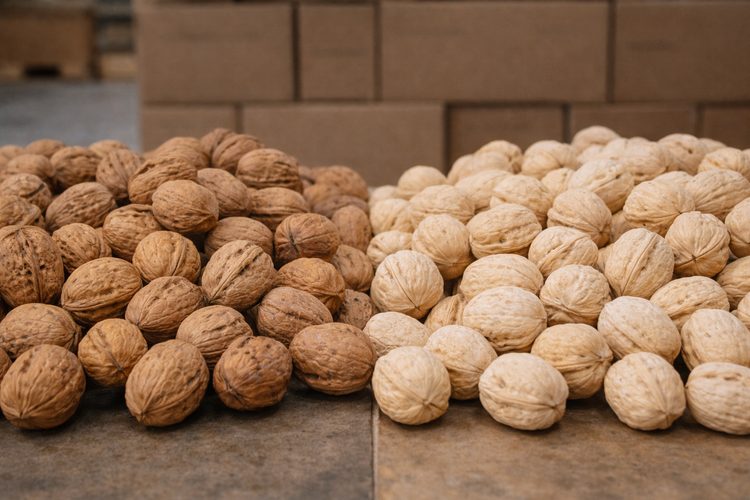
In-shell walnuts are one of the few nut categories where visual appearance can influence buying decisions as much as internal quality. The distinction between natural and bleached in-shell walnuts is not primarily about kernel composition or nutritional value. It is about presentation, market expectations, distribution strategy and how the product will be perceived at the point of sale. For that reason, buyers who treat this as a simple cosmetic difference often miss the broader commercial implications.
Natural and bleached in-shell walnuts represent two different commercial pathways. One emphasizes minimal intervention and natural appearance. The other emphasizes uniformity and visual brightness. Both can be correct depending on the destination market, the retail environment and the buyer’s positioning strategy. The key is not to ask which is better in absolute terms, but which is more suitable for the intended channel.
Main buyer takeaway: the natural vs. bleached decision is a market-facing specification. It should be defined alongside destination, packaging, retail positioning and shipment timing, not after pricing discussions begin.
What “natural” in-shell walnuts mean in trade
Natural in-shell walnuts are sold with their original shell appearance, typically showing variations in color from light tan to darker brown tones. These variations are normal and reflect growing conditions, drying processes and handling rather than quality differences in the kernel. In many markets, natural appearance is associated with authenticity, minimal processing and a more traditional product identity.
Natural in-shell walnuts are often preferred in markets where consumers are accustomed to cracking nuts at home and where visual uniformity is less important than perceived naturalness. They are also relevant in channels where buyers want to emphasize less intervention or where pricing sensitivity makes additional processing steps less attractive.
What “bleached” in-shell walnuts mean in trade
Bleached in-shell walnuts have undergone a shell-lightening process to achieve a more uniform and brighter external appearance. This does not change the internal kernel composition but affects how the product is perceived visually. In many retail environments, especially where walnuts are sold loose, in bags or in visible packaging, this lighter appearance can create a more premium or cleaner impression to consumers.
Bleached walnuts are commonly selected in export retail markets where visual consistency is critical for shelf appeal. In these markets, buyers may prefer a uniform light shell because it signals cleanliness, sorting control and product standardization, even though the kernel quality is governed by separate grading criteria.
How this difference shows up in real buying decisions
The natural versus bleached choice often emerges at the intersection of marketing and logistics. A buyer sourcing for bulk redistribution or price-sensitive markets may prioritize natural walnuts because they are closer to the original product and may involve fewer processing steps. A buyer sourcing for branded retail or export programs may prioritize bleached walnuts because they perform better in visual merchandising and consumer perception.
For example, a wholesale distributor supplying traditional markets may find natural walnuts more commercially appropriate. A private-label retail brand targeting supermarket shelves may find bleached walnuts more aligned with consumer expectations. Both are correct decisions when matched to the right channel.
Kernel quality versus shell appearance
One of the most important clarifications for buyers is that shell appearance does not define kernel quality. The internal walnut kernel is evaluated based on grade, size, color, condition and handling, not whether the shell has been bleached. Buyers should therefore separate visual shell preference from kernel specification.
Confusion can arise when buyers assume that a lighter shell automatically means better walnuts. In practice, the relationship is indirect. A well-specified natural walnut can outperform a poorly handled bleached product, and vice versa. The correct approach is to define both shell appearance preference and kernel quality parameters explicitly.
Market preferences by region
Market preference for natural versus bleached walnuts is often regional. Some Middle Eastern and Asian markets historically favor bleached walnuts due to strong visual expectations at retail. Certain European markets may accept both formats depending on positioning and packaging. Domestic U.S. usage can vary by channel, with less emphasis on shell color in industrial or foodservice contexts.
This means that export buyers should always specify the destination market early. A product suitable for one region may require adjustment for another, even if the walnut origin and grade remain the same.
Packaging considerations for in-shell walnuts
Packaging plays a significant role in how natural and bleached walnuts perform commercially. For natural walnuts, packaging may focus on protection and efficient transport, especially in bulk or foodservice channels. For bleached walnuts, packaging often needs to preserve visual presentation and prevent discoloration during transit and storage.
Retail packaging adds another layer of complexity. Transparent or partially transparent packaging may highlight shell appearance, making uniformity more important. Opaque packaging may reduce visual differences but shift focus to branding and labeling. Export programs may require stronger outer packaging to protect against humidity, handling and longer transit times.
Commercial implications of choosing natural vs. bleached
The choice affects more than product appearance. It influences pricing structure, processing route, lead time, supplier selection and market positioning. Bleached walnuts may involve additional processing steps and tighter sorting expectations. Natural walnuts may offer simpler supply chains but require alignment with market expectations.
From a commercial standpoint, the strongest programs are those where the shell appearance choice supports the final sales environment. A mismatch can lead to slower sell-through, customer hesitation or unnecessary discounting.
What Atlas would ask before quoting
Atlas would typically ask whether the buyer prefers natural or bleached in-shell walnuts, the target size grade, the intended market, packaging format, volume and shipment timing. We would also ask whether the product is for bulk redistribution, foodservice, retail or export, and whether visual uniformity is a key requirement.
These inputs help ensure that the quote reflects the correct commercial pathway rather than a generic walnut offering.
Commercial planning points
Successful in-shell walnut programs are built around repeatability. That means consistent supply, agreed specifications, suitable packaging and realistic shipment cadence. Buyers should consider whether their program is a one-time purchase, a seasonal campaign or a repeat supply arrangement.
It is also useful to define whether the walnuts will be sold loose, repacked, or distributed in consumer-ready formats. This affects not only packaging but also how important shell appearance becomes in the overall value proposition.
Buyer planning note
Atlas Global Trading Co. uses topics like this to help buyers move from general interest to a specification-driven inquiry. If you are evaluating in-shell walnut supply, the most useful next step is to define shell preference (natural or bleached), size, packaging, volume and destination market.
Natural and bleached walnuts are not competing products in a technical sense. They are different commercial tools. The right choice is the one that aligns with how the product will be sold, displayed and consumed.
Need help sourcing in-shell walnuts?
Use the contact form to share your product, packaging, destination and timing requirements for a practical quotation.
- State natural or bleached preference
- Add size grade and volume
- Include destination market and timing
Frequently Asked Questions
Why do some markets prefer bleached in-shell walnuts?
Certain markets prefer bleached walnuts because of their lighter, more uniform shell appearance, which can enhance retail presentation and consumer perception of quality.
Are natural walnuts lower quality?
No. Natural walnuts retain their original shell appearance, and kernel quality depends on grading and handling rather than shell color.
How should buyers specify in-shell walnuts?
Buyers should specify natural or bleached preference, size grade, packaging, volume, destination and intended use to receive accurate quotations.