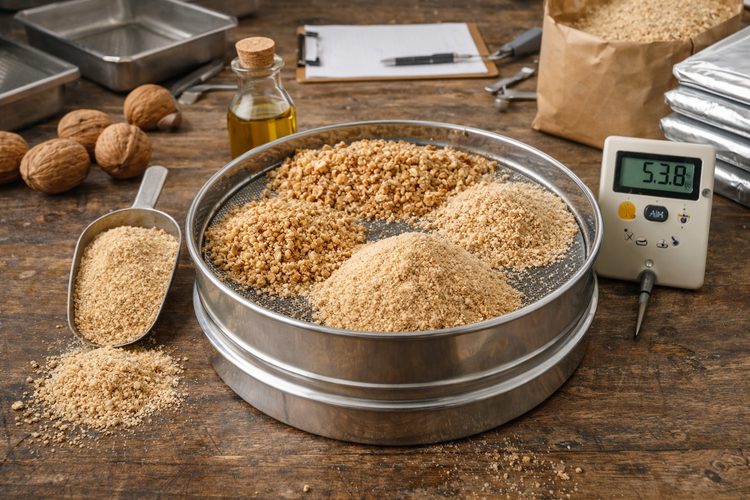
Walnut meal sits in an important middle ground between visible walnut pieces and finer walnut flour or paste-like systems. It is often chosen when buyers want nut content, nut flavor and blendability without the pronounced visual identity or handling profile of large cuts. Because of that, walnut meal is rarely a generic commodity. In commercial practice, performance depends on the exact particle-size range, the amount of natural oil expression that the meal carries into the process, the way the meal will be handled on line and the amount of shelf-life control required after packing and after opening.
That is why industrial walnut buying is rarely only about nominal price. A walnut meal quote becomes more useful when specification, process route, packaging format and shipment timing are aligned before the order is placed. A coarse meal, a medium meal and a fine meal may all be called “walnut meal” in conversation, but they can behave very differently in bakery, confectionery, fillings, dry blends, snack systems, sauces and foodservice preparations. The stronger commercial result comes from defining the intended use first and then sourcing the meal that fits that use.
Main buyer takeaway: walnut meal works best when particle size, expected oil behavior, packaging format, application method and inventory rhythm are defined together. A broad “walnut meal” request is often too vague for an accurate and comparable quotation.
What buyers usually mean by walnut meal
Commercially, walnut meal usually refers to ground walnut material that remains more textured than flour but more reduced than chopped or diced walnut cuts. It may be used where the buyer wants nut body, flavor contribution and some particulate character without the larger visual footprint of pieces. In practical terms, walnut meal can function as a texture contributor, flavor base, filling component, blend ingredient or partial flour alternative depending on the formulation.
That said, “meal” can still cover a wide range of commercial realities. One supplier may interpret it as a relatively coarse, free-flowing particulate grind. Another may interpret it as a denser, finer and more oil-expressive material. A third may have multiple standard screens or custom grind targets. This is why meal should not be treated as a self-explanatory item name. It should be specified in a way that reflects the actual process and product outcome required by the buyer.
Why particle size is the first serious specification question
Particle size is often the most important specification point because it directly affects how walnut meal behaves in mixing, depositing, spreading, forming and finished-product eating quality. Coarser meal can preserve more visible nut identity and may be preferable where texture needs to remain noticeable. Finer meal can integrate more uniformly into doughs, crusts, fillings, bars, coatings or compound systems, but it may also change oil release, density, flow and visual appearance in the finished product.
For a buyer, the practical question is not “fine or coarse” in the abstract. The real question is how the meal must perform in the application. Does the formula need a consistent granular look? Does it need smoother dispersion? Is the meal replacing part of another dry ingredient? Is the goal to build nut flavor into a filling without leaving large discernible pieces? Is the material going into a snack coating, a bakery inclusion, a cookie base, a crust system or a savory blend? Particle size influences each of those outcomes differently.
Coarse, medium and fine walnut meal: how the commercial logic changes
Coarser walnut meal generally makes sense where the buyer wants more visible texture, a stronger sense of nut identity and less flour-like integration. It may be used in bakery toppings, premium crust systems, granola-style blends, fillings with discernible particulate structure or snack applications where some bite is part of the target. Medium meal often works as a compromise format, giving the buyer blendability without completely losing texture character. Fine walnut meal tends to be favored where smoother distribution, more even incorporation and less visible particulate contrast are important.
None of these is automatically superior. A fine meal that looks attractive in a specification sheet may be the wrong choice if the customer actually wants a textured filling or a more rustic bakery effect. Likewise, a coarser meal may be difficult in systems that need tighter depositing consistency or smoother sheeting behavior. The strongest quote comes from describing what the finished product should look and feel like, not from choosing grind language without context.
Oil level and natural oil expression: why buyers need to think about it early
Walnut meal is not only a particle-size discussion. It is also an oil-behavior discussion. Because walnuts carry natural oil, the meal format can show different handling characteristics depending on grind, source material, process and packing conditions. More naturally expressive meal can contribute richness, flavor intensity and a fuller mouthfeel in some formulas. At the same time, it can also influence flowability, tendency to clump, open-pack handling and the way the meal behaves in dry blends or high-speed batching environments.
That does not mean higher apparent oil expression is a problem. In some applications it is exactly the point. The issue is whether the buyer expects it and whether the process can handle it. A meal selected for bakery fillings or rich snack bars may perform well with more natural oil character. A meal intended for dry seasoning bases, predictable industrial batching or long open-hold conditions may need tighter attention to handling behavior and packaging format. In short, oil level is not only a technical note; it shapes the practical use case.
How oil behavior changes by application
In bakery systems, natural oil release may help deliver richness, tenderness or nut perception, especially in fillings, cookies, bars and crust-style applications. In confectionery and sweet paste systems, walnut meal may be selected to support nut flavor while controlling texture and cost relative to larger cuts. In savory coatings, seasoning systems or dry blend applications, the same oil behavior may need to be managed more carefully so the product remains workable on line and stable in pack. For sauces and fillings, oil character may be useful if the goal is a more rounded mouthfeel and a stronger walnut note.
The real lesson for buyers is that oil behavior should be evaluated through the target application, not judged as a standalone virtue or flaw. The right walnut meal is the one whose natural oil characteristics support the formula rather than working against it.
Specification rule of thumb: particle size affects texture and distribution, while oil behavior affects flow, richness, blendability and storage discipline. Buyers should define both, not just one.
How walnut meal differs from chopped walnuts and walnut flour
Walnut meal occupies a different commercial space from both chopped cuts and flour. Chopped walnuts and pieces are more visible, more structural and often selected when appearance matters. Walnut flour is usually finer, more uniform and more fully integrated into dry systems. Walnut meal sits between them. It gives the buyer a middle-format solution where nut solids can be built into the formula without fully losing texture, yet without retaining the large-piece handling profile of diced or chopped formats.
This makes walnut meal especially useful in applications where the buyer wants more than flavor but less than obvious particulate identity. It can help bridge the gap between appearance-driven ingredients and fully fine-milled ingredients. That is also why specifying the material correctly matters so much. A meal that is too fine begins to behave more like flour. A meal that is too coarse may behave more like chopped walnut than intended.
Use cases where walnut meal often makes commercial sense
Common commercial uses include bakery mixes, cookies, bars, fillings, pastry systems, cereal and granola blends, confectionery centers, coatings, savory formulations, crust systems and certain foodservice preparations. Walnut meal is also relevant when a buyer wants to reduce the visual dominance of nut pieces while preserving genuine walnut content in the formula. In some products, it can contribute body and nut character more efficiently than larger inclusions. In others, it may help create a more uniform bite across the finished product.
The main point is that the product brief should always name the actual application. A walnut meal for a soft bakery filling is not the same commercial requirement as a walnut meal for a crunchy bar system or a dry savory blend. The closer the buyer stays to real use conditions, the more accurate the sourcing discussion becomes.
How shelf-life and stability thinking change with meal formats
Meal formats usually present more exposed surface than larger walnut cuts, and that changes the commercial importance of packaging, handling and turnover. A walnut meal that performs well in a fast-turn plant may require more disciplined storage in a slower-turn environment. As particle size becomes finer and more surface is exposed, the buyer generally needs to think more carefully about pack barrier, open-pack time, storage temperature, lot rotation and whether the meal will sit partially used between production runs.
This is one reason the cheapest walnut meal is not always the best commercial choice. If the format, oil behavior and packaging combination do not fit the buyer’s actual usage rhythm, the apparent savings may be offset by lower usable yield, more difficult handling or reduced sensory consistency later in the product cycle. In commercial terms, shelf-life planning should begin at the quotation stage, not after the first complaint or reformulation issue.
Packaging is part of the walnut meal specification
Packaging matters more with meal formats than some buyers expect. Bulk industrial users may prefer large-format cartons or lined cases for cost efficiency, but only if the meal is consumed quickly and consistently after opening. A fine or more oil-expressive meal may need a packaging approach that better supports storage discipline and manageable usage increments. Foodservice or smaller-batch manufacturers may be better served by unit sizes that reduce the time a partially opened pack remains in storage.
Retail-ready or export-oriented walnut meal programs introduce additional packaging concerns. The pack may need to support shelf presentation, stronger barrier logic, label space and longer route-to-market timing. Even when the meal itself is technically acceptable, the wrong packaging format can reduce practical performance by making it harder to store, portion or protect. For this reason, Atlas encourages buyers to define pack style early, not after the product has already been quoted.
Domestic, export and channel differences
Domestic industrial users usually focus on line performance, repeatability, pack efficiency and replenishment rhythm. Foodservice users may care more about manageable packs, practical handling and enough texture clarity for culinary use. Retail and private-label programs often add presentation, consumer labeling and smaller-unit economics. Export programs add transit time, more handling points, destination-market requirements and tighter attention to packaging and turnover planning.
Because walnut meal is often used in more processed or formulation-driven applications, buyers sometimes underestimate how much channel choice still matters. It does. The same meal may be commercially strong in a domestic bakery system and less suitable in a slower-turn export retail pack unless the packaging and volume structure are adjusted accordingly.
How this topic shows up in real buying decisions
In practical procurement, buyers rarely reject walnut meal because the ingredient category itself is wrong. They run into trouble because the selected meal is mismatched to the production reality. The grind may be too coarse for the depositor, too fine for the target texture, too expressive in oil for the intended blend, or packed in a format that is too large for actual usage speed. These are not abstract quality failures. They are specification failures. The commercial fix is usually not to abandon walnut meal, but to define the meal more accurately from the start.
That is why the quote should reflect the real format and route. Walnut meal should be discussed differently from whole kernels, diced cuts, flour, butter or oil. It is its own commercial format with its own handling profile and application logic.
What Atlas would ask before quoting
Atlas would usually begin by asking the buyer how the walnut meal will be used: bakery, confectionery, snack, crust system, filling, sauce, savory blend, granola, foodservice or another defined application. We would then ask what type of meal texture is desired, whether the meal needs to be coarse, medium or fine, and whether the process benefits from more visible nut identity or smoother integration. Next, we would clarify whether natural oil behavior is desirable, manageable or a potential concern in the buyer’s system.
We would also ask about packaging preference, volume cadence, destination market, storage conditions after opening and whether the program is industrial bulk, foodservice, retail-ready, private label or export-oriented. These details reduce avoidable back-and-forth and make the resulting quotation much more commercially useful.
Commercial planning points buyers often overlook
One common oversight is assuming that a target particle size can be decided without thinking about the rest of the formula. In practice, grind range affects throughput, hydration behavior, particulate visibility, mouthfeel and even how the product is perceived by the end customer. Another oversight is ignoring open-pack handling. A walnut meal may look perfect on the initial COA and still create problems if the user opens too much product for the actual batch schedule. Buyers also sometimes underestimate how quickly a pilot-friendly format can become awkward at scale if the packaging unit no longer matches production rhythm.
Another important planning point is transition from trial to repeat supply. During development, buyers may accept a broader range of meal behavior because volumes are small and attention is high. Once the program is commercial, consistency matters more. That is why Atlas often encourages customers to think in stages: sample and bench review, plant trial, validation run, launch and repeat replenishment. Each stage clarifies whether the particle size and pack system are truly sustainable.
How to compare walnut meal quotes more intelligently
Buyers should compare walnut meal offers only after confirming that the products are genuinely equivalent in grind expectation, oil behavior, packaging basis, process route and intended commercial use. A lower-priced meal may not be a better option if it changes formula performance, handling time or finished-product appearance. Likewise, a more expensive meal may justify itself if it simplifies production, improves eating quality or better supports the customer’s shelf-life and pack logic.
Better comparisons come from matched specifications. Once the particle-size target, oil expectations, packaging and use case are aligned, price becomes much more meaningful and supplier evaluation becomes more practical.
Buyer planning note
Atlas Global Trading Co. uses academy topics like this to move conversations from broad interest to specification-minded inquiries. If you are evaluating walnut meal, the strongest next step is to share the intended application, target particle size, desired oil behavior, pack style, estimated volume cadence and destination market. That helps Atlas discuss California supply options in a way that reflects your real production need rather than a broad ingredient label.
Walnut meal can be a very effective format when the buyer wants nut solids, flavor contribution and manageable texture in one ingredient. But it works best when the specification is built around the real formula, the real plant and the real commercial channel. That is the difference between a meal that merely exists on paper and a meal that performs in an actual program.
Need help sourcing the right walnut meal format?
Use the contact form to turn this research topic into a practical quote request for Atlas based on grind range, oil behavior, pack style and application fit.
- State the target walnut meal particle size
- Add application, pack format and volume
- Include destination market and target timing
Specification points that improve walnut meal inquiries
Atlas encourages buyers to define intended use, meal texture target, expected oil behavior, pack style, destination, shelf-life expectations and handling rhythm early. Those inputs help reduce avoidable back-and-forth and improve comparability across California supply options. Typical walnut meal use cases on this website include bakery, confectionery, sauces and fillings, snacks, granola and foodservice-oriented systems. The product brief should always match one of those concrete uses.
How this topic becomes a real purchasing issue
In actual programs, walnut meal specification issues usually surface when the product reaches plant trial. The lesson is usually not that walnut meal was the wrong category, but that the requested grind or pack format was too broad. Defining these points earlier makes commercial sourcing faster and more useful.
Frequently Asked Questions
Why should buyers specify walnut meal particle size instead of asking for a general walnut meal quote?
Particle size directly affects blendability, visible texture, oil release, deposit behavior, batching consistency and finished product appearance. A fine walnut meal may work well in fillings, crust systems and bakery formulas, while a coarser meal may be preferred where more nut identity and texture are desired. A general walnut meal quote is often too broad to compare accurately.
How does oil level change the commercial use of walnut meal?
Oil level affects flowability, mouthfeel, flavor richness, tendency to clump, pack behavior and shelf-life planning. Higher natural oil expression can be useful in some formulations where richness matters, while lower-oil or more controlled meal formats may be easier to handle in dry blends or consistent industrial systems.
What should be defined before requesting a walnut meal quotation?
Buyers should define target particle size, intended application, expected oil behavior, packaging format, volume cadence, destination market, shelf-life expectations and whether the program is for industrial manufacturing, foodservice, retail-ready or export use. These inputs improve quote relevance and comparability.