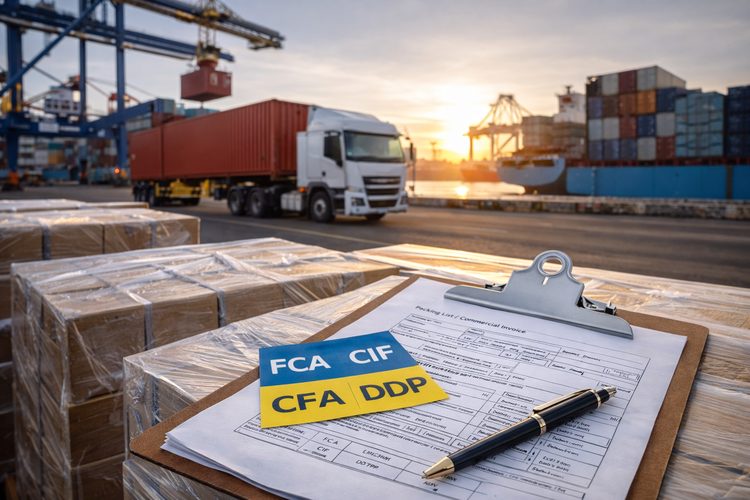
Walnut buying is not finished when the product specification is agreed. In many programs, the more important commercial question is how the product will actually move from supplier to buyer, who controls each stage of the shipment, and how timing risk is managed along the way. This is why freight planning and Incoterms matter so much in walnut trade. A nominally attractive product price can become a weak commercial outcome if freight responsibility, delivery basis, pallet structure, shipment size and documentation flow are not aligned from the start.
For walnuts, this matters across in-shell trade, kernel trade, industrial ingredient programs, foodservice supply, retail-ready packs and export distribution. The product itself may be technically correct, but if the freight model is poorly structured, the buyer can still face delays, cost overruns, repacking issues, customs friction or inventory gaps. The stronger outcome usually comes from aligning product form, packaging, destination and timing before the quote is finalized.
Why freight planning matters before quotation
One of the most common commercial mistakes in nut buying is comparing offers that are not actually built on the same delivery basis. Two suppliers may appear to quote the same walnut product, but one offer may stop at an origin point while another includes deeper freight or delivery responsibility. The product price may look different, but the real difference is often in logistics responsibility, risk transfer and cost visibility rather than in the walnut value alone.
That is why freight planning should not be treated as a later administrative step. It should be part of the initial quote request. When buyers clarify destination market, shipment size, pack style and target delivery basis early, supplier offers become more comparable and landed-cost planning becomes more realistic.
Commercial takeaway: walnut quotations are much easier to compare when product format, pack structure, destination, shipment rhythm and Incoterm are defined together instead of handled as separate conversations.
How this topic shows up in real walnut buying decisions
In practice, freight planning becomes critical as soon as a buyer moves beyond simple product interest and starts asking how the order will be delivered. That happens in several common situations: when comparing domestic and export options, when deciding between trial shipments and repeat container programs, when planning retail or private label launches, or when trying to convert a spot-buy into a more repeatable sourcing structure.
Walnut buyers also face different freight logic depending on product form. In-shell walnuts are physically different from kernel supply. Raw kernels, pasteurized kernels, roasted product, chopped walnuts and retail-packed walnuts each behave differently in transport, handling and packaging. A freight plan that suits bulk raw kernel supply may not be right for retail-ready pouches or premium export cartons. That is why the logistics conversation must stay tied to the actual product being sold.
Why Incoterms matter in walnut trade
Incoterms help clarify where responsibility and risk sit in the supply chain. For walnut buyers, they are not only legal or logistics shorthand. They are a practical tool for building comparable quotations and deciding how much of the transport chain the buyer wants to manage directly. An Incoterm affects who arranges transport, where risk changes hands, how freight costs appear in the quote and how much coordination is expected from the buyer’s side.
From a commercial perspective, this matters because a lower nominal product price is not necessarily a better buying outcome if it pushes more freight coordination, risk or downstream cost onto the buyer. By contrast, a higher quoted figure can still be commercially efficient if it reflects broader delivery responsibility, smoother coordination or clearer cost visibility for the actual route to market.
Incoterms as a comparison discipline
The most practical value of Incoterms is that they prevent false comparisons. If one walnut offer is quoted on a more origin-based basis and another includes a deeper delivery commitment, those two numbers do not represent the same commercial promise. A disciplined buyer normalizes that difference before deciding which offer is truly more competitive.
This becomes especially important in export or multi-country programs where freight can materially change the final economics. Even in domestic U.S. programs, the principle still matters. Freight cost layers, appointment requirements, warehouse handling and inland delivery structure can all alter the real delivered cost of the walnuts.
Common freight structures in walnut programs
Without turning the topic into a legal summary, most walnut buyers are effectively choosing between three commercial approaches:
- Origin-led supply: useful when the buyer has strong logistics capabilities and prefers direct freight control.
- Shared responsibility structures: useful when both sides manage the stages they know best and the cost basis remains transparent.
- Deeper seller-managed delivery: useful when the buyer wants a simpler delivery structure, less internal logistics coordination or a more complete landed-cost view from the start.
The correct choice depends on the buyer’s importer capability, freight resources, urgency, shipment size and destination complexity. A mature food ingredient importer may prefer a different delivery basis than a first-time private label buyer launching walnuts into a new market.
Freight planning starts with the walnut format
Freight should always be discussed in the context of product form. For walnuts, that usually means defining whether the program involves in-shell walnuts, raw kernels, pasteurized kernels, roasted kernels, chopped product or further processed formats. Each route changes packaging assumptions, pallet behavior, container efficiency and how much protection is needed during transport.
In-shell walnuts often have different case and volume logic than kernel shipments. Kernel supply may require more careful protection against quality loss, packaging damage or compression issues, especially in premium retail or export programs. Chopped or industrial ingredient formats may allow for more cost-efficient freight structures, but still require disciplined packaging if the buyer needs good handling performance and stable shelf-life planning.
Packaging and freight are inseparable
Walnut freight performance depends heavily on packaging discipline. Carton design, liner quality, case dimensions, pallet pattern and stretch-wrap consistency all influence whether the goods arrive in usable condition and whether the shipment is cost-efficient to move. Buyers often focus on the walnuts themselves while underestimating how much damage risk and freight inefficiency can come from weak packaging design.
Useful freight-related packaging questions usually include:
- What is the net weight per case?
- What outer carton strength is used?
- Does the liner and seal protect the product correctly?
- What pallet footprint and stack height are planned?
- How does the pack style affect container or truck utilization?
- Is the packaging route appropriate for domestic, export, foodservice or retail-ready sale?
These details materially affect landed cost. A walnut shipment that uses space poorly or suffers repeated handling issues may look acceptable on a product-only quote but become less attractive once freight efficiency is considered.
Atlas logistics note: in walnut programs, strong packaging is not only a protection issue. It is a freight-efficiency issue, a warehouse issue and a landed-cost issue at the same time.
Timing is a commercial variable, not just a shipping detail
Freight planning is closely connected to timing. Walnut buyers may need product for production schedules, holiday packs, retail resets, private label launches, promotional windows or export commitments. In these cases, the meaningful date is not just when the supplier can ship. It is when the product needs to be commercially usable for the buyer’s next stage.
That difference matters because a shipment can appear “on time” under one interpretation while still arriving too late for the buyer’s real use case. This is especially important where the agreed delivery basis ends before final inward delivery, customs clearance or warehouse appointment. A buyer who understands this will build timing buffers and delivery terms into the quote request rather than relying on a nominal ship date alone.
Domestic versus export walnut programs
Domestic U.S. walnut freight usually focuses on trucking, warehouse delivery, pallet consistency, appointment scheduling and replenishment rhythm. Export walnut freight introduces more variables: port handling, booking windows, customs flow, destination-side coordination, longer transit timelines and additional document alignment. The product can be the same, but the logistics burden is different.
This is why Atlas typically encourages buyers to clarify whether the program is domestic, export-oriented, retail-ready, industrial or foodservice from the first inquiry. A walnut program designed for simple domestic replenishment may need different packaging, booking rhythm and document planning once it moves into export channels.
Trial lots, regular shipments and container programs
Shipment size changes the commercial logic. Trial lots often have high relative freight cost because they do not benefit from full transport efficiency. That is normal, but buyers should distinguish clearly between trial economics and repeat program economics. Otherwise, the product may appear less competitive than it actually would be in steady supply.
Once a walnut program scales into regular replenishment or container-style movement, the priorities shift toward pallet efficiency, predictable booking cadence, repeatable paperwork, consistent delivery basis and stable inventory planning. In these programs, the freight conversation is less about one shipment price and more about building a sustainable logistics model.
Key freight cost layers walnut buyers should think about
Professional buyers typically think beyond the invoice line for the walnuts themselves. Depending on the delivery basis, the true cost structure may include origin handling, inland transport, booking charges, port-related costs, ocean freight where relevant, customs clearance, destination handling, warehouse transfer and final inland delivery. Which of these costs belong in the supplier quote depends on the chosen delivery basis.
The practical lesson is simple: “price per pound” or “price per kilogram” only tells part of the story. The real commercial number is the delivered, usable cost of the walnuts in the buyer’s system. That is the number that freight planning and Incoterms help clarify.
What Atlas would ask before quoting
Atlas generally encourages buyers to provide a freight-aware quote request. Useful inputs typically include:
- the exact walnut format and process state,
- whether the program is industrial, foodservice, retail-ready, private label or export,
- pack style and pallet preference,
- destination city, port or market,
- whether the order is a trial, repeat monthly flow or larger program,
- the buyer’s preferred delivery basis or Incoterm,
- the needed-by date in real commercial terms, and
- any customs, importer, warehouse or routing constraints.
These details help convert a broad walnut inquiry into a practical delivered-cost discussion rather than a price-only exchange.
How this topic shows up in real RFQs
A weak RFQ says: “Please quote walnuts for export.” A stronger RFQ says: “Please quote raw walnut kernels in export-ready cartons for retail repacking, destination UAE, monthly replenishment expected, target launch window in Q4, please advise delivery basis options and freight assumptions.” That second brief gives the supplier enough information to respond with a structure that reflects the actual program.
The same principle applies domestically. If the buyer wants regular industrial deliveries into a production facility, that should be stated. If the program is foodservice or retail-ready and the shipment timing is tied to a seasonal or promotional need, that should also be stated. Freight planning works best when the supplier understands the commercial use case behind the movement.
Commercial planning points
From a trading standpoint, the best walnut programs are built around repeatability. That means consistent pack design, clear handover points, sensible shipment rhythm and an agreed delivery basis that remains stable across repeat orders. This structure helps buyers forecast landed cost more accurately and reduces confusion across purchasing, logistics and receiving teams.
In many cases, a staged approach works best:
- Trial shipment: validate routing, packaging and document flow.
- Validation replenishment: confirm repeat handling and timing under live conditions.
- Launch volume: align final delivery basis, pack structure and commercial timing.
- Repeat supply: stabilize freight rhythm, landed-cost visibility and replenishment planning.
This phased model is especially useful in export or private label walnut programs, where timing and coordination complexity tend to be higher than in simple domestic bulk ingredient supply.
Buyer planning note
Atlas Global Trading Co. uses freight and Incoterms discussions to help walnut buyers move from broad product interest to a more complete and commercially realistic quote request. In practice, the strongest results usually come when the buyer defines the walnut format, packaging route, destination, delivery basis and timing together. That structure improves quotation clarity, comparison quality and shipment readiness.
If you are evaluating domestic deliveries, export freight, trial shipments or repeat supply programs for walnuts, Atlas can use the same framework described here to help turn the topic into a more specification-minded commercial inquiry.
What to include in a freight-focused walnut inquiry
A more useful freight brief usually includes:
- the exact walnut format and process state,
- industrial, foodservice, retail-ready or export program type,
- pack style and pallet expectation,
- destination city, port or market,
- trial, monthly or larger program volume,
- preferred Incoterm or delivery basis,
- target ship window and real needed-by date, and
- any customs, importer, warehouse or documentation constraints.
These inputs usually make delivered-cost comparisons far more practical.
Need help sourcing around this walnut freight topic?
Use the contact form to turn freight, timing and Incoterms planning into a practical quote request for Atlas.
- State the exact walnut format and pack style
- Add destination, shipment size and delivery basis
- Include target timing and market route
Frequently Asked Questions
What is the main buyer takeaway from “Freight, Timing and Incoterms for Walnut Buyers”?
The main buyer takeaway is that walnut freight planning works best when product format, pack style, destination, Incoterms and commercial timing are defined together before quotation.
Why do Incoterms matter so much in walnut sourcing?
Incoterms determine where cost responsibility, logistics coordination and risk transfer sit. Two walnut offers are not directly comparable if they are quoted on different delivery bases.
What should buyers include in a freight-focused walnut inquiry?
A practical freight-focused walnut inquiry should include product format, pack style, shipment size, destination market, preferred Incoterm, target timing and whether the program is domestic, export, industrial or retail-ready.