Define timing
Clarify whether you are positioning pre-harvest, during harvest or post-harvest.
Buyer guidance on crop cycles, harvest timing, market behavior and contract strategy for California walnut sourcing programs.
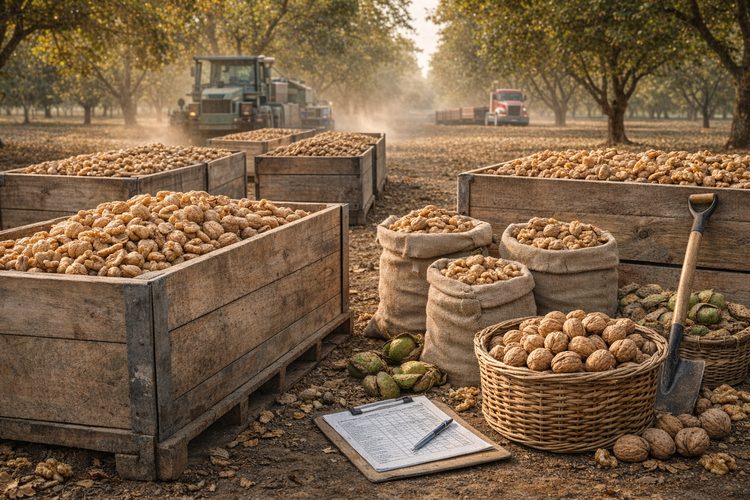
Walnut harvest timing is one of the most important but often misunderstood variables in commercial nut sourcing. Buyers frequently focus on specification, price and packaging, but crop timing and contracting strategy can have an equal or greater impact on supply continuity, cost stability and program reliability.
California walnuts follow a seasonal agricultural cycle. That cycle influences availability, processing capacity, pricing sentiment and shipment timing. Understanding how harvest windows translate into commercial decisions allows buyers to move from reactive spot purchasing to structured sourcing programs.
The California walnut crop typically follows a predictable annual rhythm. Orchards move from dormancy through bloom, development and maturation before harvest begins in the fall. Harvest generally starts in early autumn and continues through several weeks depending on variety, region and weather conditions.
However, the commercial market does not operate only during harvest. Once walnuts are harvested, they enter processing, grading, packing and storage cycles that extend supply availability throughout the year. This means buyers are not only purchasing “harvest walnuts,” but also walnuts that have been processed, stored and released into the market over time.
Harvest windows represent the point where new supply enters the market. This period often brings increased availability, more active pricing discussions and initial quality assessments for the new crop. However, it also introduces uncertainty because final crop size, quality distribution and market direction are still being established.
From a commercial standpoint, harvest windows create several decision paths:
Each approach carries different risk and opportunity profiles. Early commitments may secure supply but carry uncertainty. Later purchases may reduce uncertainty but limit flexibility or price advantage.
Timing note: harvest timing affects not only price but also logistics, processing schedules and the ability to secure consistent specification across shipments.
Crop size is one of the main drivers of walnut market behavior. A larger crop usually increases supply flexibility, supports broader availability across formats and can moderate pricing pressure. A tighter crop typically requires earlier commitments and more disciplined planning to secure volume.
Quality distribution also matters. Even within the same crop year, different quality tiers, kernel styles and processing outputs may not be evenly available. Buyers targeting specific cuts, sizes or applications may need to align earlier to ensure access to the desired specification.
This is particularly important for programs requiring consistency across multiple shipments or across multiple markets.
Buyers typically operate across two main commercial approaches: spot purchasing and structured contracts.
Spot buying focuses on short-term availability and pricing. It can be useful for opportunistic purchases, trial runs or flexible programs. However, it may expose buyers to variability in pricing, specification availability and shipment timing.
Contract programs align volume, timing and pricing over a longer horizon. These programs often support better planning for manufacturing, retail or export distribution. They also allow for clearer coordination on packaging, documentation and logistics.
The right approach depends on the buyer’s business model. Many industrial programs combine both approaches: securing a base volume through contracts while maintaining some flexibility through spot purchases.
Before structuring a walnut contract discussion, Atlas typically asks buyers to define:
These inputs allow for a more structured conversation about contract timing, rather than treating walnut supply as a purely price-driven transaction.
Harvest timing does not automatically translate into immediate shipment readiness. After harvest, walnuts move through drying, processing, sorting and packing stages. This creates a lag between harvest and export-ready inventory.
Buyers should consider:
Export programs in particular require alignment between harvest timing, documentation preparation and logistics planning. Delays in any of these areas can affect delivery schedules even when product is available.
Successful walnut programs often follow a structured planning cycle:
This staged approach helps balance risk and opportunity while supporting continuity.
Common issues in walnut sourcing include:
Most of these challenges can be reduced by aligning technical specification with commercial timing early in the process.
Atlas Global Trading Co. uses harvest and crop timing discussions to move buyers from reactive purchasing toward structured sourcing programs. Whether the requirement is industrial bulk, foodservice or export retail, aligning crop timing, specification and commercial planning creates more reliable outcomes.
If you are evaluating walnut supply, share your expected volume, timeline, destination and product format. This allows Atlas to align harvest timing and contract strategy with your actual business needs rather than a generic market position.
Clarify whether you are positioning pre-harvest, during harvest or post-harvest.
Estimate trial, monthly or container-level requirements.
Kernel, diced, meal or processed derivatives affect supply planning.
Domestic versus export programs require different logistics and documentation.
Use the contact form to align crop timing, volume and shipment planning with your sourcing requirements.
Most walnut programs benefit from early alignment before or during harvest windows, especially for structured volume programs. Timing depends on risk tolerance, storage expectations and price strategy.
Harvest timing affects supply visibility, quality variation, processing throughput and market sentiment, all of which influence pricing and availability.
Spot buying focuses on short-term availability and pricing, while contract programs align volume, timing and pricing over a longer horizon, improving continuity and planning stability.
Larger crops typically create more flexible supply and pricing conditions, while tighter crops require earlier commitments and more structured planning to secure volume.