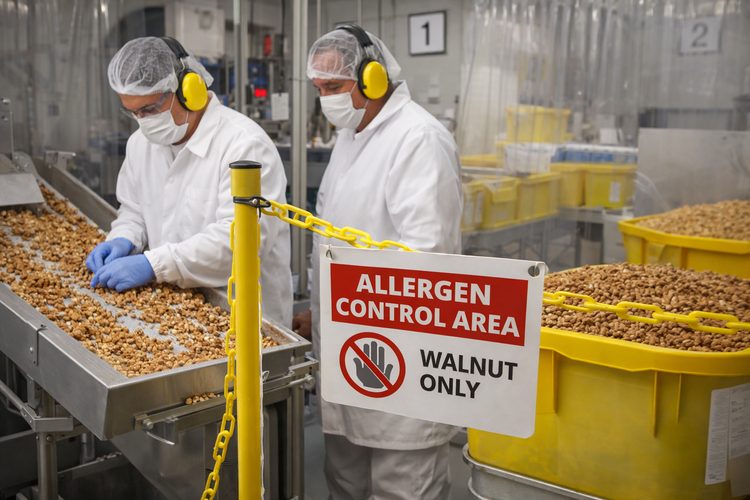
Allergen control in walnut programs is not a side topic handled only by quality teams after price is agreed. In practice, it shapes supplier qualification, line selection, customer claim language, pack design, production scheduling, export documentation and the overall commercial viability of a program. A buyer may like a walnut size, color range and price level, but if the allergen-control model does not align with the intended application and the customer’s internal approval standard, the program can stall long before the first shipment moves.
That is why experienced walnut procurement teams review allergen management as an operational system rather than a single statement on a specification sheet. The practical questions are broader: What other allergens enter the site? How are raw and finished materials identified? How are shared tools, rework, totes, conveyors and packaging components managed? Does the supplier run mixed nut programs, flavoring systems or private-label packaging for different customers? What evidence can be shared during onboarding, and what parts of the control plan are only described at a high level? Those questions directly affect whether a supplier fits a bakery line, snack blending room, cereal plant, confectionery operation, foodservice packer or export retail program.
Why walnut buyers treat allergen control as a program design issue
Walnuts are themselves a tree nut allergen ingredient, so the commercial question is rarely whether walnut handling requires allergen awareness. It does. The more relevant issue is how the walnut program interfaces with other allergens handled in the same supply chain. A manufacturer using walnut halves in a premium brownie inclusion may have one risk profile; a brand buying chopped walnuts for a seasoned snack mix may have another; a customer seeking a tight claim environment for export retail may have a stricter approval matrix still.
From a sourcing standpoint, walnut programs often sit inside a broader ingredient environment where almonds, pecans, cashews, pistachios, peanuts, sesame, dairy powders, chocolate compounds, seasoning systems or flavor carriers may also be present upstream or downstream. Even when all those materials are legally manageable within a controlled food environment, they do not all fit the same commercial need. Some buyers are comfortable with well-managed shared facilities. Others require very narrow co-handling rules, documented zoning, stricter label review discipline or a facility profile that excludes certain allergens altogether.
The main point is simple: allergen control affects suitability, not just compliance language. The same walnut product can be fully acceptable for one customer and commercially unusable for another depending on customer policy, end-use claims, risk tolerance, audit expectations and export destination requirements.
Buyer framing: the real question is not “Does the supplier have allergen controls?” Nearly every serious food supplier will say yes. The better question is “What exact control model is used, what allergens are in scope at site level, and does that model fit our product, packaging and customer-approval requirements?”
How this topic shows up in real buying decisions
In walnut trade, allergen controls become visible at multiple decision points. They show up when a new supplier is first screened, when a customer asks for a site questionnaire, when artwork or ingredient statements are reviewed, when the commercial team tries to lock a shipment window, and when operations teams decide whether a dedicated production run is needed or whether a normal shared-facility schedule is sufficient.
They also show up differently depending on walnut format. In-shell walnuts and bulk raw kernels generally raise a different handling profile than diced walnuts, walnut meal, fine walnut flour, walnut butter or seasoned roasted walnut items. The more processed the product becomes, the more touchpoints, equipment surfaces, transfer steps, intermediate containers and packaging interfaces usually need to be reviewed. A simple raw kernel packing program may be commercially straightforward in one facility configuration, while a flavored retail walnut line may require deeper review because seasoning systems, oil application, rework controls, packaging-film segregation and label verification become much more important.
For buyer buyers, this means the quote request should not stop at “walnuts, 25 lb case” or “light halves and pieces.” A better inquiry defines the product form, target application, process expectation, pack style, claim sensitivity, destination market and approximate risk posture. That gives the supplier room to indicate whether a standard walnut program is suitable or whether a more tightly segregated production path should be explored.
What facility segregation can mean in practical walnut operations
Facility segregation is often discussed as if it were a single yes-or-no condition, but in practice it operates on several levels. A supplier may separate allergens by building, by room, by production zone, by line, by day, by sanitation break or by packaging sequence. Different combinations can be effective, and buyers should understand which model is being offered rather than assume all “segregated” programs are equivalent.
A practical walnut program may involve:
- separate receiving or staging areas for incoming walnut material and other allergen ingredients,
- clearly identified storage locations and lot-status controls,
- dedicated or strongly controlled bins, totes, scoops and utensils,
- line clearance procedures between products,
- documented sanitation verification before release to the next run,
- production sequencing that places lower-risk or claim-sensitive items before more complex runs,
- distinct packaging-material storage and label version control,
- restricted rework practices, especially where finished-goods identity must remain exact,
- release review by quality personnel before finished goods are packed or shipped.
None of those points alone guarantees fit. The commercial question is how they work together. For example, a shared warehouse with strong pallet identification and controlled movement may be acceptable for one industrial ingredient buyer, while another buyer may require clearer physical separation or a narrower co-handling profile. Similarly, a shared packing room can be workable if scheduling, sanitation and label controls are robust, but that may still be too permissive for a customer whose retail program depends on stricter precautionary labeling standards or customer-specific audit language.
Shared facilities versus dedicated environments
Some buyers initially assume they must source only from dedicated walnut facilities. In reality, the answer depends on the product brief and the end market. Dedicated environments can simplify approval because they narrow the conversation and reduce the number of variables quality teams must review. They can also support stronger internal messaging where customer claims, retailer expectations or private-label approval criteria are tight.
However, dedicated-only sourcing is not automatically the best commercial solution. It can reduce supplier options, increase lead times, tighten minimum production quantities and limit flexibility during high-demand periods. Many walnut programs run successfully in shared facilities where the supplier has disciplined allergen zoning, validated cleaning, effective scheduling logic and transparent documentation. For industrial buyers, that model can provide a better balance of control, capacity and cost.
The right decision is usually a risk-calibrated one. If the end use is internal manufacturing with established allergen labeling, a well-controlled shared facility may be perfectly suitable. If the program supports a branded retail launch into sensitive channels or export markets where customer review is especially strict, a narrower facility profile may be worth the reduced flexibility and potentially higher cost.
Walnut product forms and why processing depth changes the control discussion
Walnut allergen programs should be assessed in the context of the specific form being purchased. Raw kernels, halves, pieces and combo grades may involve simpler process paths than further-processed formats. Once the program moves into chopping, granulation, meal production, fine flour, paste, butter, oil roasting, seasoning application or consumer packing, the number of process steps usually increases. That tends to expand the review scope for equipment contact surfaces, intermediate storage, work-in-process identification and packaging verification.
Examples of common commercial formats where the allergen-control conversation may differ include:
- Raw walnut kernels: more emphasis on receipt integrity, storage segregation, line identification, kernel size/grade integrity and packout controls.
- Chopped or diced walnuts: more emphasis on cutting equipment, fines management, dust control, sifter housekeeping and lot separation.
- Walnut meal or flour: more emphasis on air handling, transfer systems, dust accumulation, bin turnover and cleaning validation between runs.
- Roasted walnuts: more emphasis on oven sequencing, oil systems where used, seasoning rooms, tumbler sanitation and packaging-line label control.
- Walnut butter or paste: more emphasis on batch identification, hose and pump sanitation, container filling controls and rework restrictions.
- Retail-ready or private-label packs: more emphasis on packaging-material segregation, print control, allergen declaration review and finished-goods release.
This is why buyers should avoid generic quote requests. The exact walnut form changes what “good allergen control” looks like in practice.
What Atlas would ask before quoting
Atlas generally encourages buyers to frame walnut allergen discussions as part of the total specification brief rather than as a late-stage exception request. That makes pricing more realistic and reduces avoidable back-and-forth during supplier qualification. A strong inquiry usually includes the intended walnut format, process condition, packaging requirement, destination market, expected commercial volume and any known facility or co-handling restrictions.
Before building a commercial response, Atlas would normally want to understand:
- the precise walnut format needed: halves, pieces, light halves and pieces, diced, meal, flour, paste, butter or finished retail pack,
- whether the item is raw, pasteurized, roasted, flavored or otherwise further processed,
- the intended application such as bakery, confectionery, cereal, snack mix, sauces, fillings or foodservice finishing,
- whether the buyer is requesting a broad industrial ingredient program or a narrower customer-specific approval path,
- which allergens at site level are acceptable or not acceptable under the buyer’s policy,
- whether precautionary label language or customer-specific statements are restricted,
- the target pack style: bulk carton, poly-lined carton, vacuum pack, pouch, foodservice bag, retail pouch, private-label format or export-ready configuration,
- expected trial volume, monthly drawdown and whether the program is spot, seasonal or contractual,
- destination market and any destination-linked documentation expectations,
- the approval timeline and whether questionnaires, specifications, COAs, facility overviews or audit summaries will be required before first shipment.
Those inputs materially improve quote quality. Without them, suppliers may quote a walnut item that is technically available but operationally unsuitable for the buyer’s risk profile.
Specification tip: if the buyer already knows that certain co-handled allergens are excluded by internal policy, that should be stated in the first inquiry. It is commercially more efficient to narrow the supplier pool early than to spend time reviewing options that will fail approval later.
Key documentation buyers often review in walnut approval workflows
Commercial walnut buying increasingly involves structured documentation review, especially for larger industrial accounts, chain customers, co-manufacturing programs and export retail projects. The precise document set varies by customer and destination, but the approval process commonly extends beyond a basic product specification.
Depending on program type, buyers may request or discuss:
- product specifications defining form, grade, moisture or physical expectations where applicable,
- allergen statements and facility disclosure summaries,
- site questionnaires covering receipt, storage, handling, sanitation and label review practices,
- process-flow descriptions at a high level,
- packaging specifications and labeling artwork review workflows,
- certificate of analysis format or standard release documentation,
- lot coding and traceability expectations,
- shelf-life or storage guidance tied to the walnut format and pack style,
- quality-system summaries or customer audit responses where commercially appropriate,
- export documentation expectations for destination-specific shipments.
The important commercial point is that documentation depth affects lead time. A buyer who requires questionnaire review, approval meetings and label signoff before ordering should expect the onboarding cycle to be longer than for a straightforward bulk industrial replenishment. This does not mean the program is difficult; it means timeline planning needs to match the approval workload.
Label control and packaging review are often the hidden failure points
Many walnut buyers focus heavily on raw-material segregation but underestimate the importance of packaging and label control. In reality, mix-ups in label version, claim wording, allergen declarations, destination-language variants or private-label artwork can create greater commercial disruption than the core walnut product itself. This is especially true for retail and foodservice programs where finished-pack statements are customer-facing and shipment release may depend on artwork approval.
Good suppliers manage packaging control as part of the allergen program. That means packaging materials are identified, version-controlled and checked at issue and at line startup. Obsolete material should be removed from active use, and final pack verification should not be treated as a casual warehouse step. For export, the label review process often becomes even more important because declaration language, importer details, unit declarations, date coding format and destination-market conventions can all interact with the customer’s allergen expectations.
For buyers, the commercial lesson is clear: when the walnut program includes consumer-facing packs, treat label governance as a core sourcing topic, not just a graphics exercise.
Production scheduling, changeovers and why timing affects risk
Allergen control is also a scheduling issue. The same facility may look different on paper depending on how production is sequenced. A supplier that manages products by logical run order, sanitation breaks and release checks may present a much stronger operational fit than one that simply states allergens are “controlled” without explaining how line transitions are handled.
For example, walnut runs that need tighter control may be placed in protected production windows, after full line clearance, with dedicated packaging issue and enhanced review at release. In other cases, a shared facility may rely on a standard schedule that is fully acceptable for broad industrial use but less suitable for narrow retail-claim programs. Production cadence, therefore, can influence whether the supplier is appropriate for the specific account.
Scheduling also affects lead times. Special sequencing or dedicated run expectations can reduce flexibility and may require buyers to order earlier, accept firmer forecast commitments or consolidate volume into more efficient production lots. That can be a reasonable trade-off when the program demands it, but it should be visible in commercial planning from the start.
Commercial impact on price, MOQ and supplier pool
Allergen requirements do not always increase price, but they frequently influence the economic structure of a walnut program. Tighter facility restrictions can shrink the number of eligible suppliers. More selective supplier pools may have less spot flexibility, more structured production calendars or higher documentation overhead. Those factors can affect minimum order quantity, run size, quote validity, lead time and freight planning even when the walnut product specification itself remains unchanged.
Buyers should also remember that a narrow risk profile can create indirect costs. If only a limited number of facilities can support the required control model, the program may become more exposed to seasonal capacity pressure, holiday production compression or sudden demand shifts. Conversely, a broader but well-governed shared-facility approach may preserve more continuity and better support ongoing replenishment.
That is why walnut sourcing should balance risk discipline with commercial practicality. The strongest program is not automatically the one with the narrowest possible facility profile. It is the one that matches the product’s real market need and can be repeated reliably.
Domestic versus export considerations
The same walnut allergen framework can support both U.S. and export programs, but export projects often add layers of review. Destination markets may require different pack configurations, importer labeling details, language considerations, shipping marks, document sets or pre-shipment coordination steps. Private-label export programs may also involve longer approval cycles because the buyer, importer and sometimes retailer all review specification and packaging details.
In those cases, facility segregation questions should be addressed early. If the export customer has a narrow co-handling expectation or specific statement requirement, that should be translated into the quote request before artwork work, production booking and logistics planning advance too far. Export changes are rarely impossible; they are simply more expensive when discovered late.
Applications where the discussion becomes especially important
On this website, walnut use cases commonly include bakery, confectionery, sauces and fillings, snacks and granola. Allergen-control sensitivity can differ across those categories.
- Bakery: industrial bakeries may accept controlled shared-facility walnut ingredients if internal allergen labeling is already established, but premium retail bakery launches may require deeper facility review.
- Confectionery: multi-allergen environments are common, so the key question is usually fit with the plant’s specific claim and labeling model.
- Sauces and fillings: more processed walnut formats such as meal, paste or butter often create extra interest in transfer systems, batch identification and sanitation validation.
- Snacks: flavored or consumer-packed snack programs commonly raise packaging and seasoning-room review requirements.
- Granola and cereal: chopped walnut formats may be operationally straightforward, but customer questionnaires and label claims can still make supplier-profile fit decisive.
The product brief should therefore connect the walnut item to a real application, not just a commodity description.
Risk questions buyers can include in a quote request
To move faster from research to quotation, buyers can include a short risk-and-operations summary with the inquiry. A practical brief might state:
- the exact walnut format and whether it is raw or further processed,
- the end use and whether the product will be further manufactured or packed as sold,
- whether the buyer can accept a shared facility with documented controls or prefers a narrower facility profile,
- which co-handled allergens are disallowed by policy if any,
- whether a facility questionnaire or customer onboarding pack is required before first order,
- whether retail labeling or private-label packaging is part of scope,
- target trial quantity, regular monthly volume and desired first-ship window,
- destination market and any special documentation expectations.
That level of clarity usually improves supplier matching and makes commercial comparisons more meaningful.
Common mistakes in walnut allergen sourcing
Several avoidable mistakes appear repeatedly in buyer workflows:
- treating allergen control as a generic compliance box rather than a specific operating model,
- requesting quotes before defining the intended customer claim environment,
- focusing on raw product specifications while ignoring packaging and label-control risk,
- asking for “segregated” supply without explaining whether that means dedicated line, dedicated room, restricted co-handling or simply documented shared controls,
- waiting until final approval to disclose that certain site-level allergens are excluded by internal policy,
- assuming a retail or export program can use the same approval logic as a simple industrial bulk replenishment.
Correcting those mistakes early saves time for both the buyer and the supplier.
Commercial planning points
From a trading standpoint, repeatability matters more than impressive language. A walnut supplier relationship works best when both sides understand the operational boundaries of the program and can maintain them consistently over time. That means the buyer should know whether the program is spot, seasonal, launch-phase or long-term replenishment, and the supplier should know whether the risk model is broad industrial, retail-claim sensitive, export-structured or customer-audit driven.
When relevant, the inquiry should also state whether the business is industrial bulk, foodservice, retail-ready, private label or export-oriented. That single clarification often changes packaging, artwork approval, lead-time assumptions and documentation scope. In some cases it also determines whether the supplier can offer a standard lane or whether a more protected production path is needed.
A useful commercial sequence often looks like this: initial risk-fit screening, specification and facility-profile review, trial quantity or validation run, packaging and label confirmation where relevant, then repeat replenishment under a forecasted schedule. That staged approach is often more effective than trying to solve every question through one large initial purchase order.
Atlas trade view: the best walnut programs are built around clarity. Define the real application, the real packaging, the real risk tolerance and the real ordering rhythm. Once those are clear, supplier options become easier to evaluate on both technical fit and commercial practicality.
Buyer planning note
Atlas Global Trading Co. uses academy topics like this to help buyers move from broad interest to a specification-minded walnut inquiry. In allergen-sensitive programs, the most useful first step is to share the exact walnut format, intended use, package style, destination market, expected volume and any known restrictions on facility profile or co-handled allergens. With that information, the commercial discussion can be grounded in realistic supply options rather than generic assumptions.
If you are evaluating California walnut supply for bakery, confectionery, snacks, granola, sauces, fillings, foodservice or export retail, Use the contact form to outline the operating requirement as clearly as possible. That gives Atlas a better basis for matching the right processing route, packaging approach and supplier profile to the program you are actually trying to build.
Need help sourcing around this walnut allergen topic?
Turn this article into a practical walnut inquiry by sharing your format, facility-risk expectations, packaging requirement and target ship window.
- State the exact walnut format and process condition
- Identify any facility or co-handling restrictions
- Include destination market, volume rhythm and timeline
A practical walnut allergen review checklist for purchasing teams
When comparing suppliers, many buyers find it useful to review the same basic points in a consistent sequence. That keeps the discussion commercial and operational rather than abstract.
- Define the walnut item clearly. Specify format, cut, process state, pack style and application.
- Define the risk environment. Clarify whether the program is broad industrial, customer-audit driven, retail-claim sensitive or export-specific.
- Ask which allergens are handled at site level. This narrows fit quickly.
- Ask how segregation works in practice. Building, room, line, schedule, sanitation and packaging control are not interchangeable.
- Review changeover and label controls. Finished-pack programs depend heavily on these steps.
- Confirm documentation path. Determine what can be supplied during qualification and before release.
- Match the timeline to the approval workload. Quotes move faster than customer onboarding.
- Compare total program fit, not only price. Reliability and approval success often matter more than a nominal price gap.
Frequently Asked Questions
What should buyers ask for when reviewing allergen controls in a walnut supply program?
Buyers should ask how walnut materials are received, identified, stored, scheduled, processed, packed and released; whether the site runs other tree nuts, peanuts, sesame, dairy or other allergens; how changeovers are managed; what label review controls are in place; and what supporting documentation can be shared with the quote or supplier approval package.
Does facility segregation mean the plant is dedicated only to walnuts?
Not necessarily. A walnut program can be commercially workable in a shared facility if the supplier has clear zoning, validated sanitation, production sequencing, identification controls, packaging review discipline and transparent documentation. The right fit depends on the buyer's own risk policy, customer claims and regulatory obligations.
Why does allergen control affect pricing and lead times?
Stronger segregation requirements can limit available production windows, narrow the supplier pool, increase documentation work, affect packaging choices and sometimes require special scheduling or dedicated runs. Those factors may influence minimum order quantities, quote validity, production lead time and total delivered cost.