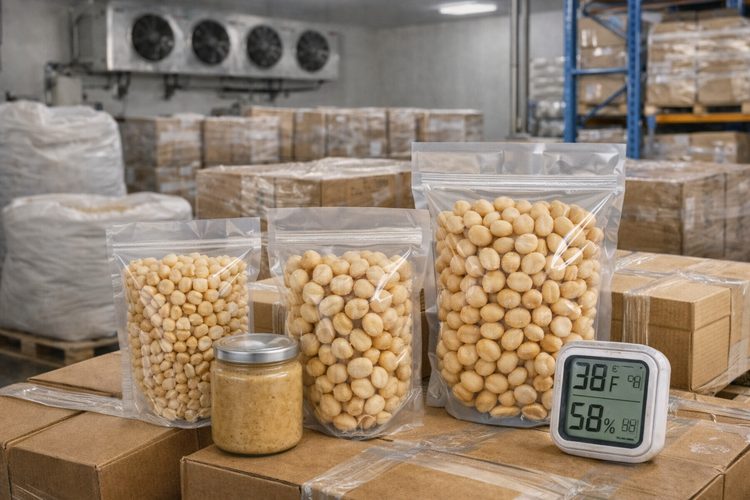
Storage and oxidation control for macadamia ingredients matters because macadamias are a premium, high-value nut category in which flavor retention, texture stability and clean appearance strongly influence commercial value. Buyers do not only purchase a nominal macadamia item. They purchase a product that must still perform well after warehousing, handling, transit, repacking or conversion into another finished product. In practice, that means storage conditions and oxidation control are part of the specification, not an afterthought after shipment.
For industrial buyers, the strongest supply outcome usually comes from aligning product form, process state, packaging system, inventory turnover and shipping route before purchase orders are finalized. Macadamias that are technically acceptable at pack-off can still create problems if the packaging barrier is too weak, the warehouse environment is unstable, the product is held too long, or the selected format is too fragile for the actual commercial route.
Why oxidation control matters more in macadamia programs than many buyers expect
Macadamias are valued for their creamy, rich and clean flavor profile, but that premium sensory profile can be vulnerable when exposure to oxygen, heat, light and handling is not managed well. Oxidative deterioration does not always appear immediately as a dramatic defect. In many commercial settings, it shows up first as flavor flattening, reduced freshness, stale or tired nut notes, oily aroma drift, or shorter useful warehouse life than the buyer expected.
from a buyer's perspective, oxidation control is not only about avoiding a quality complaint. It is also about protecting commercial consistency. When a manufacturer is producing cookies, confectionery, nut butter, frozen dessert inclusions or premium snack packs, the ingredient needs to remain stable through the full production and distribution window. If the ingredient degrades too early, the buyer does not only lose product quality. They may lose production efficiency, customer confidence and margin.
For macadamias, the practical shelf-life conversation usually starts with four linked questions: what exact format is being purchased, how processed is it, how will it be packed, and how long will it realistically sit in storage or transit before final use? Those four variables often matter more than a generic shelf-life assumption.
How product form changes oxidation risk
Different macadamia formats do not carry the same storage profile. Whole kernels generally offer better natural protection than smaller or more highly processed forms because less surface area is exposed. Once the product is cut, diced, sliced, ground or converted into meal, flour or butter, more surface area becomes exposed to air and handling, and storage sensitivity typically increases. This does not mean those forms are commercially weak. It means they require more deliberate planning.
Buyers should not treat all of the following as if they have identical storage behavior:
- Whole or large-style kernels: often preferred where visual quality and lower exposed surface area support a stronger storage position.
- Diced, chopped or granulated macadamias: useful for bakery, confectionery, toppings and inclusions, but often more sensitive because of increased exposed surface area and fines generation.
- Macadamia meal or flour: may perform well in bakery and blending applications, but usually needs tighter packaging and faster rotation than whole kernels.
- Roasted macadamias: commercially attractive for flavor development, yet often requiring careful barrier packaging and cleaner inventory control because the product is already processed toward its final use state.
- Macadamia butter, paste or smooth ground product: particularly dependent on packaging, fill conditions and storage discipline because oil separation, aroma change or sensory drift can affect usability.
That is why a serious quote request should identify the specific form and not simply state “macadamias.” The right packaging and storage plan for whole raw kernel is not necessarily right for roasted diced product or fine meal.
Raw, pasteurized and roasted material do not behave the same way
Commercial risk also changes with process condition. Raw macadamias, pasteurized macadamias and roasted macadamias should not be grouped together without qualification. Roasting often improves flavor and direct edibility, but it can also move the ingredient closer to its final state, which means the product may require more disciplined protection after processing. A roasted item intended for premium snacking or as a visible inclusion may need a more protective packaging system and tighter use-by planning than a raw ingredient intended for further manufacturing.
Buyers should therefore clarify whether the material is:
- raw and intended for further processing
- pasteurized but otherwise not roasted
- dry roasted for flavor development
- oil roasted for a different surface finish or flavor profile
- seasoned or otherwise value-added after roasting
Each state has its own commercial logic. The more finished the product becomes, the more important it is to control oxygen exposure, handling time and warehouse conditions.
What storage conditions buyers should think about before asking for a quote
When storage and oxidation control are important, Atlas would encourage buyers to describe not only the product but also the expected storage environment. This includes whether the product will remain in a controlled warehouse, whether it may move through multiple handling points, whether it is intended for export transit, and whether it will be opened and partially used in production over time.
Typical storage-planning questions include:
- Will the product be used quickly after arrival, or held in inventory for an extended period?
- Will it remain in sealed original packaging until use, or be repeatedly opened?
- Will it ship domestically, or spend longer time in export transit and port handling?
- Is the warehouse environment relatively cool, dry and stable, or variable?
- Does the buyer need full industrial bulk, smaller foodservice packs or retail-ready presentation?
- Will the product be repacked, blended or further processed after receipt?
These questions matter because oxidation risk is shaped by the full route, not only the moment the product leaves the packing line.
Packaging is one of the most important oxidation-control decisions
For macadamia ingredients, packaging is not just a shipping container. It is one of the main control points protecting quality in storage. In commercial terms, packaging choice affects oxygen exposure, moisture management, light protection, stack performance, damage risk, freight efficiency and warehouse handling behavior. In other words, packaging can either support the shelf-life strategy or quietly undermine it.
A buyer evaluating packaging should consider:
- barrier performance appropriate to the product form
- whether the pack is for one-time industrial dump use or repeated opening
- target fill weight and headspace implications
- inner liner strength and seal integrity
- how the package will behave in pallet storage and transport
- whether the pack format is suited to domestic or export conditions
- whether consumer-facing presentation is required in addition to protective function
For example, industrial bulk programs may prioritize protection, pallet efficiency and faster plant use. Retail-ready programs may require more appearance-driven packaging but still need adequate barrier properties. Export programs often add another layer of commercial consideration because longer transit and multiple handling points make packaging performance more important.
Whole kernels versus diced and ground ingredients in warehouse planning
From a commercial handling standpoint, whole kernels are often the most forgiving format. They typically retain visual identity better and may tolerate routine movement more comfortably than smaller processed forms. Diced or chopped macadamias can be very effective in bakery, chocolate and topping applications, but buyers should expect more sensitivity to fines, breakage, exposed oil and faster sensory drift if the product is not packaged and rotated carefully.
Ground formats add another layer of planning. Meal, flour and butter-style products often need closer attention because their exposed surface area and physical behavior can change how quickly the ingredient moves from peak freshness to merely acceptable quality. This is why smart buyers usually pair ground formats with stronger packaging assumptions and faster inventory discipline rather than treating them like a warehouse-friendly whole kernel item.
How oxidation control shows up in real application decisions
Storage and oxidation control influence application performance in practical ways. In bakery, less stable material can lose aroma impact or create variability in flavor delivery from lot to lot. In confectionery, staler or oxidized notes can interfere with premium positioning. In snack mixes, perceived freshness is directly tied to repeat purchase behavior. In frozen desserts, inclusions that were already compromised before production may not improve later. In macadamia butter, storage issues can affect not just flavor but also visual presentation, oiling behavior and consumer acceptance.
This is why application context matters. A manufacturer using macadamias as a minor blended component may tolerate a different storage profile than a premium retail program where the nut is the featured ingredient. The more visible and flavor-critical the macadamia component is, the more important oxidation control becomes commercially.
What buyers should specify in a storage-sensitive macadamia brief
When storage performance matters, the quote request should move beyond basic product naming. Atlas would typically encourage buyers to include:
- exact product form: whole, halves, diced, meal, flour, butter or other processed format
- process state: raw, pasteurized, roasted, seasoned or further converted
- intended application: bakery, snack, confectionery, dairy alternative, sauce, frozen dessert or retail pack
- target packaging format: industrial bulk, foodservice, retail-ready, private label or export-oriented
- estimated inventory dwell time before use
- whether the product will be held in original sealed packs or opened repeatedly
- destination market and likely shipment timing
- volume pattern: trial, validation run, launch volume or repeat replenishment
The reason to define these points early is simple: storage risk is a function of the actual commercial system. Two buyers may ask for the same macadamia ingredient but require different packaging and shelf-life planning because their routes are different.
Handling discipline after arrival is part of the quality outcome
Storage performance does not depend only on the supplier or processor. Customer-side handling can materially affect the outcome as well. Once sealed packaging is opened, the ingredient becomes more exposed to air, ambient moisture, repeated contact and warehouse variability. If usage rhythm is slow, even a well-packed product can become less commercially attractive over time after opening.
This is why buyers should think about practical handling habits, not only original shelf-life expectations. If the plant consumes the ingredient quickly after opening, one packaging logic may work well. If the ingredient will be opened, reclosed and used intermittently, a different pack size or packaging approach may be more sensible. Matching pack size to actual consumption pattern often improves real quality performance more than trying to solve every issue at the supplier end.
Inventory rotation matters as much as initial freshness
In premium nut programs, inventory discipline often determines whether a technically acceptable product still performs like a premium product by the time it reaches use. Good commercial practice typically favors realistic purchase volumes, scheduled replenishment and a warehouse rotation rhythm that matches actual consumption. Oversized purchases may look attractive on unit cost, but if they create slower rotation and more storage exposure, the final economic outcome may be weaker.
For that reason, some buyers benefit from planning in stages: trial quantity, validation run, launch volume and then repeat replenishment. This approach reduces exposure, improves forecast accuracy and gives both buyer and supplier a better basis for aligning packaging and delivery cadence to real demand.
Domestic versus export storage considerations
Export-oriented macadamia programs often need more deliberate storage and oxidation planning because transit can be longer and handling conditions less predictable. The commercial question is not only whether the product leaves California in good condition. It is whether it reaches the destination, clears onward movement and remains commercially strong through the buyer’s own storage and production window.
That can change the preferred packaging logic, labeling assumptions, master-case structure and shipment timing strategy. A domestic buyer with rapid inventory turnover may choose one route. An export customer serving distributors or retail channels in multiple climates may require a more conservative packaging and inventory approach. The destination market therefore belongs in the first quote discussion, not only in the shipping stage.
How quality and commercial teams usually view oxidation differently
One useful buyer observation is that technical and commercial teams sometimes look at oxidation control from different angles. Quality teams may focus on freshness retention, sensory stability and protective packaging. Purchasing teams may focus on price, lead time, pack efficiency and inventory economics. The best macadamia programs balance both views. A lower-priced format that shortens usable inventory life may not be the better buy. Equally, a highly protective packaging setup only makes sense if it fits the customer’s actual handling and market requirements.
The most practical supply conversations happen when quality and purchasing are aligned around the real use case. That is exactly where a specification-minded quote request becomes valuable.
Commercial planning points that are often overlooked
In day-to-day trading, several storage-related points are frequently underestimated. One is the effect of particle size on shelf-life expectations. Another is the difference between sealed storage and partially used storage. Another is the commercial effect of packaging changeovers across multiple SKUs. Buyers also sometimes overlook how much transit time and warehouse dwell time compress the useful life remaining for the final production or retail window.
For that reason, the best planning usually considers the full chain:
- processing date or pack-off timing
- packaging type and barrier level
- freight and transit duration
- destination warehouse conditions
- time until opening
- rate of use after opening
- end-product shelf-life expectations
Seeing the chain as a whole helps buyers make better decisions about format, volume and replenishment cadence.
What Atlas would ask before quoting a storage-sensitive program
Atlas would usually ask practical questions such as: What exact macadamia format do you need? Will it be used as a primary visible ingredient or a blended component? Do you need raw, pasteurized or roasted material? How long do you expect to store it before use? Will the packs be opened once or multiple times? Is the program domestic or export? Do you need industrial bulk, foodservice packs or retail-ready packing? What are the likely order sizes and replenishment rhythm?
These questions help convert a broad discussion about “freshness” into a more commercial and actionable program design. In many cases, the best outcome is not only selecting a better ingredient. It is selecting a better combination of form, pack style and inventory flow.
Buyer planning note
Atlas Global Trading Co. uses topics like this to help buyers move from general product interest to a more precise specification and supply conversation. For macadamia ingredients, storage and oxidation control should be considered part of the quote request from the beginning, especially when the product is roasted, diced, ground, packed for retail or shipped for export.
If you are evaluating macadamias for bakery, confectionery, snack mixes, dairy alternatives, sauces, dips or private-label packing, share the exact format, packaging target, destination and expected inventory rhythm. The more closely the supply brief reflects the real commercial route, the easier it is to evaluate fit, continuity and practical quotation structure.
Need help planning storage-sensitive macadamia supply?
Use the contact form to turn this research topic into a practical quote request that includes product form, packaging needs, destination and expected inventory timing.
- State the exact macadamia format and process condition
- Add pack style, volume rhythm and storage expectations
- Include destination market and target timing
Frequently Asked Questions
What should buyers define first when discussing storage and oxidation control for macadamia ingredients?
Buyers should define the exact macadamia format, processing condition, target shelf-life expectation, packaging style, warehouse conditions and destination market. Oxidation control is not only a product issue; it is also a packaging, handling and logistics issue.
Why do roasted, diced and ground macadamia ingredients usually need different storage planning?
Different forms expose different amounts of surface area and react differently during storage. Whole kernels generally tolerate handling better than diced or finely ground product, while roasted and butter-style formats may need tighter packaging and faster inventory rotation to maintain flavor and commercial quality.
Can packaging choice change the commercial outcome of a macadamia ingredient program?
Yes. Packaging affects oxygen exposure, moisture protection, freight stability, pallet efficiency, warehouse life, and suitability for domestic or export shipment. The same ingredient can perform very differently depending on whether it is packed for bulk industrial use, foodservice, retail or export distribution.