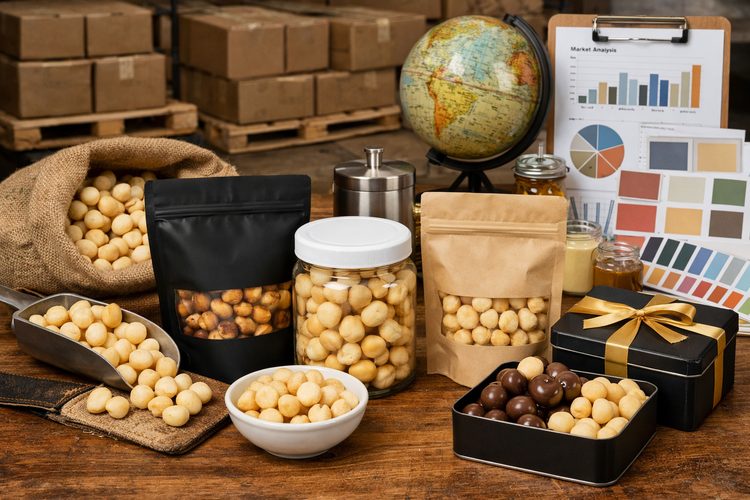
Private label macadamia programs matter because industrial nut buying is rarely only about nominal price. The stronger commercial outcome usually comes from aligning specification, process route, packaging, channel strategy and shipment timing before the order is placed. In private label, that alignment matters even more because the buyer is not only sourcing product. They are building a branded promise that has to hold up on shelf, in distribution and in repeat replenishment.
Macadamias are a premium nut category, so private label programs are typically judged by a higher commercial standard than mainstream snack nuts. Buyers usually need the product to deliver premium appearance, a clear value story, stable quality, reliable fill logic and pack architecture that supports both brand identity and freight practicality. That makes the private label brief more specification-driven than a generic bulk inquiry.
Why private label macadamias require a different sourcing approach
Private label programs differ from spot product buying because the inquiry must reflect the full route to market. The same macadamia product may be workable in industrial bulk, but not ideal in retail-ready private label if kernel style, breakage, roast consistency, packaging finish, case configuration or label treatment do not support the intended shelf position. Private label buyers are usually purchasing a finished commercial system rather than only a raw nut item.
This is why the best private label programs start by defining the market position clearly. Is the line meant to be premium everyday snacking, specialty retail, gourmet gifting, hotel and minibar use, travel retail, regional supermarket private label or export-oriented premium grocery? Each of those routes can justify a different product format, packaging strategy and price architecture.
In private label, the commercial question is not only “What macadamia product can be packed?” It is “What macadamia product can be packed, branded, shipped and replenished in a way that supports the retailer’s promise and the buyer’s margin structure?”
How this topic shows up in real buying decisions
For macadamias, the quote should reflect the real format and route. Whole or kernel material is different from diced, meal, extra fine flour, butter or oil. The commercial logic also changes when the material is raw, pasteurized, dry roasted or oil roasted. In private label, the usable product menu often includes raw macadamias for customer-managed downstream processing, dry roasted macadamias for clean premium snack programs, oil roasted macadamias for richer flavor profiles, flavored roasted macadamias for more developed retail lines, and style-selected pieces or snack blends for specific price points.
Which format makes sense depends on whether the customer is building a single-SKU premium nut line, a broader flavored assortment, a gift box program, a private label mixed nut range or an export retail assortment. Product choice, packaging choice and brand position should be treated as one combined decision.
Typical private label formats for macadamia programs
Private label macadamia programs are commonly built around several core formats:
- Plain roasted whole kernels: often used for clean premium snack lines where the pack must signal quality through the nut itself.
- Salted or seasoned roasted kernels: relevant when the line needs stronger snack appeal or broader market accessibility.
- Oil roasted kernels: useful in indulgence-led concepts where richness and familiar snack texture matter.
- Style-selected halves or mixed styles: sometimes used to manage price architecture while retaining a premium category identity.
- Macadamia snack mixes: used where the private label line needs a broader assortment strategy rather than a single premium nut offer.
- Gift-oriented or seasonal pack assortments: relevant in holiday, hospitality and higher-value channels.
The right choice depends on the brand tier, the retailer’s shopper profile and the intended retail price ladder.
Brand position should shape format selection
Private label works best when the retailer or brand owner knows exactly what shelf job the product is meant to do. Some programs need to signal pure luxury. Others need to sit inside a premium-but-accessible snack range. Others need to widen a retailer’s assortment with one standout macadamia SKU that pulls up the rest of the line. Some export programs may prioritize gifting appeal and presentation over everyday repeat purchase pricing.
That is why Atlas would usually encourage buyers to define whether the macadamia line should read as everyday premium, gourmet, specialty health-forward, indulgent snack, seasonal gift or channel-exclusive. Once that role is clear, the product and pack decisions become much easier to evaluate commercially.
Packaging strategy is part of the private label product
In private label programs, packaging is not only protective. It is part of the product itself. Flexible pouches, stand-up pouches, jars, canisters, tins, cartons and multi-pack configurations each carry different cost, shelf and logistics implications. A premium macadamia program packed in a basic commodity-style pouch may technically function, but it may not support the shelf story the retailer wants. On the other hand, overbuilt packaging may weaken the commercial case if the price tier cannot support it.
Buyers should therefore define whether the private label pack needs to emphasize visibility, resealability, gifting value, travel convenience, premium tactile cues, strong shelf blocking or freight efficiency. These decisions materially affect unit economics and final presentation.
Pack size and fill weight determine the price ladder
Macadamias usually sit in a higher value tier than many standard nuts, so fill weight is one of the most important commercial controls in private label development. A smaller pack may keep the absolute price approachable while preserving premium perception. A larger pack may improve perceived value for repeat buyers but can also push the product into a narrower shopper segment. The right answer depends on channel and consumer behavior.
For example, specialty retail and gifting may support smaller high-impact units with stronger packaging presentation. Mainstream premium grocery may require a more disciplined mid-size pack to maintain accessibility. Export markets may need different unit sizing depending on local buying patterns, freight density and retail shelf conventions.
Label architecture and brand consistency
Because this is private label, label execution is commercially important. The product specification may be strong, but if the label architecture is unclear, crowded or inconsistent with the retailer’s wider assortment, the line can still struggle. Buyers should think about how the macadamia pack fits into the overall private label family: premium house brand, value-premium tier, regional gourmet line or travel retail collection.
This is not only a design issue. Label space, ingredient declaration, front-of-pack hierarchy, origin language, pack coding and case marking all affect operational readiness. A better sourcing discussion will usually note whether the buyer is still in concept stage, has an existing brand system or needs a pack route built around export or multi-market labeling assumptions.
Quality presentation matters more in macadamias than in many categories
Macadamias are visually sensitive as a premium category. Kernel size consistency, breakage, appearance, roast uniformity and overall fill presentation directly affect perceived quality. That is especially true when the packaging uses windows, transparent materials or premium minimalist branding where the product itself has to carry the story. A private label macadamia line that looks inconsistent can lose consumer confidence quickly, even if the product is technically safe and commercially compliant.
This is why format selection and presentation quality should be defined early. The private label quote should reflect the real visual standard expected by the buyer’s brand position.
Roast strategy and flavor direction
Private label macadamia programs can be built around clean, simple premium profiles or more developed snack-style flavor profiles. Dry roasted formats often support minimalist premium positioning and cleaner label logic. Oil roasted or flavored formats may be better suited to broader snack lines, seasonal assortments or more indulgent market positions. Neither route is automatically better. The correct route depends on what the line is meant to signal and what competitive set it will face on shelf.
A retailer with a gourmet house brand may want plain roasted whole kernels in a refined pouch or jar. A broader private label snack brand may benefit from a small flavored range that includes macadamias as a premium step-up SKU.
Private label for domestic versus export channels
Domestic and export private label programs are often structurally different even when the product concept is similar. Export can change packaging durability needs, master-case structure, pallet logic, coding requirements, labeling assumptions and documentation flow. In some markets, smaller units perform better. In others, gifting or multi-pack formats may be more commercially attractive. Retail language hierarchy and regulatory label requirements may also differ by destination.
That is why destination market should be discussed from the beginning. A private label program designed only around domestic assumptions may need costly adjustments later if export becomes part of the route.
Private label mixed programs versus single-SKU programs
Some buyers want one private label macadamia SKU as a category extender. Others want a fuller platform: plain roasted, salted roasted, flavored roasted, snack mix and seasonal gift pack variations. The correct approach depends on the retailer’s assortment strategy and how much shelf space the private label line is meant to occupy.
A focused one-SKU launch can reduce risk and allow cleaner validation of pricing and consumer response. A wider range may create stronger shelf impact but also increases packaging complexity, forecasting pressure and operational coordination. The best choice depends on how mature the brand and channel strategy already are.
Commercial planning and launch staging
Private label programs often work best when they move through clear stages: concept definition, sample validation, packaging confirmation, launch volume and repeat replenishment. This staged approach helps the buyer confirm product-market fit, pack practicality and likely reorder rhythm before overcommitting. It also gives space to refine case packs, artwork, labeling and shipment assumptions while the program is still controllable.
Commercially, these projects are easier to scale when replenishment is planned as a repeat system rather than as one-off emergency buys. That means documentation, lead time expectations, forecast rhythm and pack inventory decisions should be aligned early.
What Atlas would ask before quoting
Atlas encourages buyers to define intended use, pack style, destination, timeline and quality expectations early. For private label programs, Atlas would usually also ask which sales channel the product is built for, what product format is being considered, whether the line is retail-ready or still in concept stage, what fill weights are expected, whether the brand needs a simple premium SKU or a wider range, and whether the program is domestic, private label export or a mixed route. Those inputs help reduce avoidable back-and-forth and improve comparability across California supply options.
In practical terms, the quote request works best when it includes target format, application or channel, pack style, destination market and volume rhythm. For private label, adding the intended brand tier and likely price position usually makes the inquiry even more useful.
Commercial planning points
From a trading standpoint, the best private label programs are built around repeatability. That means clear documentation, agreed packaging, sensible shipment cadence and a commercial structure that supports continuity rather than one-off emergency buying. Because private label is tied to the buyer’s own brand reputation, consistency matters at both product and operations level.
When relevant, the brief should mention whether the program is industrial bulk, foodservice, retail-ready, private label or export-oriented. In this case, private label is the lead concern, but the same detail still matters because it changes packaging, documentation and timing assumptions. Many successful programs also specify whether the inquiry is for a trial quantity, validation run, launch volume or ongoing replenishment line.
Buyer planning note
Atlas Global Trading Co. uses topics like this to move conversations from broad product interest to a specification-minded inquiry. Private label macadamia programs work best when the buyer defines what the finished product must achieve: premium shelf presence, accessible luxury pricing, gifting appeal, export-readiness, retailer assortment expansion or a branded step-up SKU within a broader snack range.
If you are evaluating macadamias for private label retail packs, jars, pouches, snack mixes, gifting lines or export retail programs, share the exact format, pack style, estimated volume and destination using the floating contact form so the next step can be grounded in a real commercial need.
Need help structuring a private label macadamia line?
Use the contact form to turn this topic into a practical quote request with product format, pack style, channel and shipment timing clearly defined.
- State the exact macadamia format and private label channel
- Add pack style, trial or monthly volume and target price position
- Include destination market and target launch timing
Frequently Asked Questions
What should buyers define first for a private label macadamia program?
Buyers should define the target product format, intended sales channel, packaging style, branding scope, destination market and estimated volume rhythm. Private label programs work best when product specification and commercial route are planned together from the start.
Which macadamia formats are commonly used in private label programs?
Depending on the concept, private label programs may use raw kernels, dry roasted kernels, oil roasted kernels, flavored roasted macadamias, style-selected pieces, snack mixes or gift-oriented assortments. The correct format depends on shelf position, target consumer, pack size and price architecture.
Can private label macadamia programs be built for both domestic and export channels?
Yes. The same core product concept can often work across domestic and export markets, but labeling, case configuration, packaging materials, documentation and freight assumptions may vary by destination and retailer requirements.