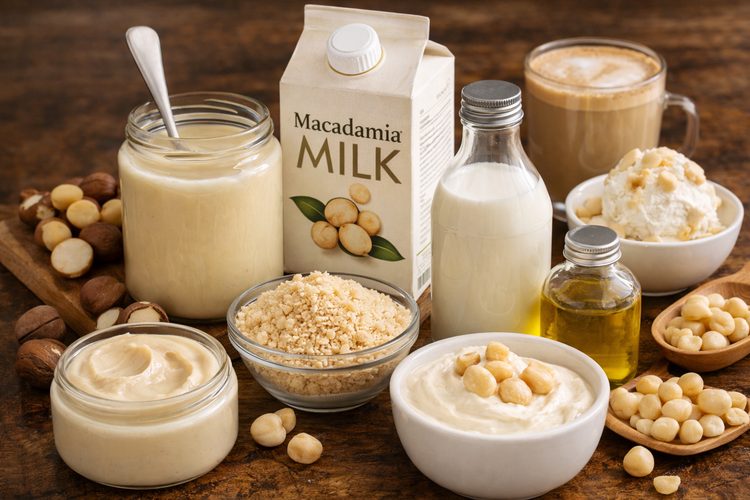
Macadamias for plant-based dairy and creamy systems is really about matching the right macadamia format to the functional goal of the finished product. In many industrial buying discussions, the nut is not being selected only for label value. It is being selected because it can help create a richer base, softer mouthfeel, more rounded flavor and a more premium impression than a commodity-style plant base. The stronger commercial outcome usually comes from aligning ingredient form, process route, packaging and shipment timing before the order is placed.
In practical terms, macadamias are relevant wherever the buyer needs creaminess, body, fat-supported smoothness, controlled nut character or a more indulgent plant-based identity. That may include beverage bases, barista-style systems, plant-based creams, spoonable alternatives, frozen dessert bases, sauces, premium spreads and hybrid formulations where macadamia works alongside other plant ingredients.
Why macadamias are attractive in creamy plant-based systems
Macadamias are often chosen because they naturally suggest richness and softness. Compared with more assertive nuts or leaner plant inputs, they can bring a smoother, more rounded impression that fits premium dairy-alternative positioning well. For brands that want plant-based products to feel less thin, less harsh or less overtly technical, macadamias can serve as an important sensory tool.
Commercially, this is significant because many plant-based products compete not only on claims but on eating quality. A product can check the right formulation boxes and still underperform if it feels watery, chalky, grainy or too strongly flavored. Macadamias are often evaluated precisely because they can help close that gap between functional formulation and indulgent experience.
For plant-based dairy systems, the first practical question is not “Do we want macadamias?” but “What exactly should the macadamia contribute?” In most successful programs, the answer is a combination of creaminess, fat-supported body, premium flavor and commercial differentiation.
How this topic shows up in real buying decisions
In practice, buyers compare raw, pasteurized and processed macadamia formats such as meal, extra fine flour, butter, paste and oil. The right choice depends on the balance between blendability, fat contribution, solids management, emulsion design, label goals and total delivered cost. Unlike direct snacking applications, creamy systems are often less dependent on visual grade and more dependent on how the ingredient behaves in mixing, grinding, homogenization, heating, cooling and filling.
For macadamia buyers, the usable product menu usually includes raw macadamias, pasteurized macadamias, meal, extra fine flour, macadamia butter, macadamia paste and macadamia oil. Which of those makes sense depends on whether the customer is manufacturing further, building a beverage base, creating a cultured or spoonable system, producing frozen dairy alternatives, packing for retail or planning export distribution.
Common application areas
Macadamias can be relevant in several plant-based dairy-adjacent categories. These include beverage bases, cream-style systems, coffee or beverage whitening systems, spoonable alternatives, plant-based frozen dessert bases, cultured alternatives, dessert creams, premium sauces and spreadable creamy products. Some buyers use macadamias as the primary nut base. Others use them in combination with other plant ingredients to improve richness, premium identity or flavor balance.
The key is to identify whether the nut is expected to be the hero base, a texture-modifying component or a premium support note inside a broader formula. That distinction affects both technical selection and quote structure.
Choosing the right macadamia format
The product format determines how much downstream work stays with the buyer. Raw kernels may make sense when the manufacturer wants full control over soaking, grinding, extraction or wet processing. Pasteurized kernels may be more appropriate when the customer needs a controlled input for further conversion. Meal or flour can fit dry-blend and base-building applications where particle size and incorporation speed matter. Butter and paste may be attractive where the goal is richer integration, smoother texture or a more direct route into creamy systems.
Macadamia oil can also play a role when the customer wants the richness and premium character of macadamias without the same level of full nut solids. In some formulas, the best answer is not one ingredient alone but a combination of kernel-derived solids and oil contribution.
Particle size and texture control
For creamy systems, particle size matters because it affects mouthfeel, visual smoothness, sediment behavior and the amount of downstream processing needed to reach the target finish. Coarser meal may work for some industrial routes where the buyer intends to perform additional size reduction. Finer flour or paste-style routes may be more appropriate when the objective is a smoother base or a more efficient conversion path.
From a commercial standpoint, buyers should not simply ask for “macadamia ingredient” if the finished system must be smooth, spoonable, pourable or barista-friendly. The more closely the requested ingredient format matches the actual processing route, the more practical the quotation becomes.
Fat contribution and richness management
Macadamias are often chosen because their richness supports creamy positioning. In plant-based dairy development, fat contribution can be an asset because it helps reduce the sense of thinness and improves lubricity on the palate. However, the exact amount and form of that contribution matter. Some systems need a fuller, richer body. Others need a balanced creamy note without becoming too heavy. Some customers want the fat supplied through whole nut solids, while others need more targeted support from paste or oil.
This is why the sourcing discussion should identify whether the product needs indulgent richness, controlled creaminess, a premium dairy-alternative profile or simply a smoother flavor bridge in a multi-ingredient system.
Emulsion behavior and system stability
In many plant-based dairy formulas, the ingredient is not only supplying flavor. It is part of a broader emulsion and solids-management challenge. Macadamia-derived ingredients can influence perceived body, creaminess and how the system feels under shear, heating or cold storage. That means buyers should think beyond simple ingredient identity and consider how the material is expected to behave in the actual manufacturing environment.
Questions around separation management, smoothness, homogenization needs, solids loading and finished viscosity all become relevant. The quote should therefore reflect not only the ingredient but the real process route the customer plans to use.
Flavor profile and premium positioning
Macadamias are particularly useful in premium plant-based systems because they can contribute a softer, more luxurious flavor direction than some other plant bases. That can be especially valuable in products intended to feel indulgent, culinary, café-oriented or closer to premium dairy in overall perception. In some systems, the goal is a distinct macadamia identity. In others, the goal is a creamier and more rounded profile without strong overt nut dominance.
The buyer should therefore define whether the finished system should taste clearly macadamia-forward or whether the nut should work more quietly behind vanilla, coffee, cocoa, culinary savory notes or fruit flavors.
Where macadamias fit in beverages
In beverage systems, macadamias may be used to support a more premium creamy body, especially in products aiming for better sensory weight than leaner plant bases can provide on their own. In these cases, the ingredient choice is often linked to how smooth the drink must be, what the fat level target is, whether the product is ambient or chilled, and whether it is intended for direct drinking, café use or a value-added culinary role.
Some buyers want a clean premium beverage with a clear macadamia identity. Others are using macadamia as one part of a multi-base beverage strategy to elevate mouthfeel and consumer perception.
Where macadamias fit in spoonable and cultured systems
Macadamias can also work in thicker spoonable or cultured-style plant-based systems where smoothness, body and indulgent flavor are especially important. In these products, the nut can contribute creamy density and premium sensory cues. The correct format depends on how the finished structure is being built, whether the customer needs a fine-smooth base or a richer cream-style foundation, and how the product will be packed and held.
Because these products are often judged very closely on texture, the specification should be especially clear about the target finish and the process stage at which the macadamia ingredient is being introduced.
Where macadamias fit in frozen and dessert-adjacent creamy systems
Frozen dairy alternatives and other dessert-adjacent creamy systems often benefit from macadamias because the premium nut note pairs well with indulgent positioning. In these categories, macadamias may support both flavor and body. Whether the ingredient is used as a primary base, a premium adjunct or a swirl or paste component depends on the final concept.
Commercially, this matters because a plant-based frozen dessert line may justify a more premium ingredient route if it improves the final sensory payoff enough to support the intended retail price.
Blending macadamias with other plant ingredients
Many plant-based dairy systems do not rely on one base alone. Macadamias may be blended with other nuts, seeds, oils, fibers or plant solids to tune cost, body, flavor and processing behavior. This is often the most practical route because it lets the customer use macadamias where they add the most value without forcing the entire formula to depend on them as the only structural ingredient.
The buyer should therefore clarify whether the macadamia ingredient is intended to be the main base, a richness enhancer, a premium flavor support note or one component in a broader creamy system. That one point can materially change the best sourcing route.
Packaging and channel considerations
Packaging matters because plant-based dairy and creamy products may be sold into industrial bulk, foodservice, retail-ready, private label or export-oriented channels. Even when the macadamia ingredient itself is an input rather than a finished consumer product, the eventual channel influences handling, lot structure, storage rhythm and planning assumptions. If the finished line is consumer-facing, pack form may also influence the economics of the ingredient route chosen upstream.
When relevant, the brief should therefore mention whether the program is industrial bulk, foodservice, retail-ready, private label or export-oriented. That clarification often changes packaging, documentation and timing assumptions.
What Atlas would ask before quoting
For macadamia plant-based dairy projects, Atlas would usually recommend translating the product idea into a quote request with five points: target format, application, pack style, destination market and volume rhythm. More specifically, Atlas would usually ask whether the system is beverage, spoonable, frozen, culinary or spreadable; whether the customer needs raw kernels, meal, flour, butter, paste or oil; whether creaminess or macadamia flavor is the main target; and whether the program is for domestic, private label or export channels.
Those inputs help reduce avoidable back-and-forth and improve comparability across California partner options instead of leading to a generic price-only inquiry.
Commercial planning points
Commercially, these projects often develop in stages: trial quantity, validation run, launch volume and repeat replenishment. Atlas uses that logic to guide pack and shipment planning, especially when retail packaging, export retail or private label is part of the conversation. That staged approach is useful because creamy systems often require bench confirmation, line validation and storage review before the supply structure is finalized.
From a trading standpoint, the best programs are built around repeatability. That means clear documentation, agreed packaging, sensible shipment cadence and a commercial structure that supports continuity rather than one-off emergency buying.
Buyer planning note
Atlas Global Trading Co. uses topics like this to move conversations from broad interest to a specification-minded inquiry. If you are evaluating macadamias for plant-based dairy, creamy beverage systems, spoonable alternatives, frozen bases, culinary sauces or other premium creamy applications, the strongest next step is to define exactly what the ingredient must do: deliver creaminess, support a premium visual, contribute nut flavor, improve body or help the finished product feel more indulgent and complete.
If you are evaluating macadamias supply, share the format, pack style, estimated volume and destination using the floating contact form so the next step can be grounded in a real commercial need.
Need help sourcing macadamias for a creamy plant-based system?
Use the contact form to turn this topic into a practical quote request with application, ingredient format, packaging and shipment timing clearly defined.
- State the exact macadamia format and creamy application
- Add target monthly or trial volume and pack style
- Include destination market and target timing
Frequently Asked Questions
What should buyers define first when evaluating macadamias for plant-based dairy systems?
Buyers should define the exact application, the target texture, the required ingredient format, the desired fat contribution, packaging style, destination market and expected volume rhythm. Better quotations usually come from a more precise processing brief.
Which macadamia formats are commonly used in creamy plant-based systems?
Depending on the formula, buyers may use raw kernels, pasteurized kernels, meal, extra fine flour, butter, paste or oil. The right choice depends on whether the finished system needs creaminess, body, emulsified richness, neutral handling or a more visible premium nut identity.
Can macadamia-based creamy systems be developed for both domestic and export programs?
Yes. The same technical logic can apply to domestic, foodservice, industrial, retail-ready, private-label and export-oriented programs, although packaging, labeling, shelf-life planning and freight assumptions may vary by destination.