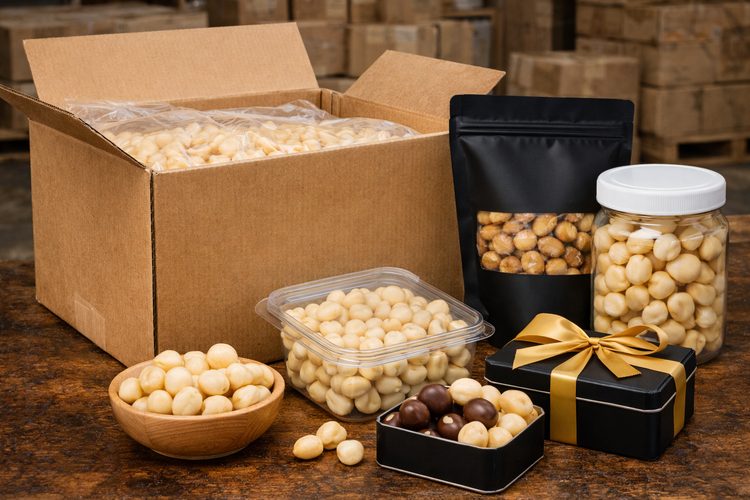
Packaging is one of the most underestimated parts of the macadamia trade. Buyers often begin with product questions such as raw versus roasted, whole versus pieces, or premium grade versus ingredient grade. Those are essential, but they do not complete the sourcing picture. Macadamias are a high-value nut category with a premium sensory profile, strong visual appeal and meaningful freight sensitivity. Because of that, packaging is not only a finishing detail. It is part of the technical specification, part of the commercial offer and part of the delivered quality result.
For many programs, the difference between a smooth supply chain and an expensive correction later comes down to pack format. The same kernel can work very differently in a lined industrial box, a foodservice pouch, a stand-up retail bag or a premium rigid gift pack. Each route changes handling, shelf-life assumptions, label space, freight behavior, unit economics and customer expectations. That is why experienced buyers define packaging at the RFQ stage rather than leaving it as an afterthought.
Why packaging matters so much in macadamia programs
Macadamias occupy a premium position in bakery, confectionery, snack, gifting and culinary categories. Their high oil content, delicate crunch and creamy taste make them desirable, but those same traits demand protection. Packaging influences the degree of physical damage, the level of barrier protection, the visual presentation at shelf, the ease of handling in production and the amount of rework required after receipt. A buyer who chooses the wrong pack format may still receive the correct nut, but not the correct commercial outcome.
In practical terms, packaging decisions affect five major areas at once: product protection, operational usability, presentation value, regulatory and labeling readiness, and landed cost. A format that performs well for domestic industrial use may not be suitable for export retail. A pouch that looks attractive for specialty stores may be too slow for high-volume packing lines. A rigid premium gift format may deliver strong consumer appeal but create very different freight economics than simple bulk carton supply.
Buyer takeaway: macadamia packaging should be selected alongside the product form, target channel, destination market, expected shelf-life window and shipment rhythm. When pack format is defined early, quotations become easier to compare and the final supply program becomes more reliable.
How this topic shows up in real buying decisions
In real commercial workflows, buyers are usually not selecting between packaging styles in the abstract. They are solving for a channel-specific job. A manufacturer may need bulk packed raw or roasted kernels that run efficiently through receiving and batching. A private label distributor may need finished retail pouches with destination-specific artwork and barcode placement. A gourmet brand may need premium cartons, tins or gift boxes that support higher shelf value and seasonal presentation.
The correct answer depends on what the macadamias are expected to do after packing. Are they being packed for further industrial processing, direct consumer sale, hospitality service, gifting or export resale? Will they move through a short domestic route or a longer international shipment? Will the pack sit on shelf for a relatively long window or move quickly through promotional programs? Once those questions are answered, the packaging conversation becomes much more commercial and much less theoretical.
The three main routes: bulk, retail and premium
Most macadamia packaging programs can be grouped into three commercial routes. Each route serves a different business objective and requires different specification thinking.
Bulk packaging
Bulk packaging is typically used for ingredient buyers, contract manufacturers, foodservice repackers and industrial users who need efficiency more than shelf presentation. The goal here is usually product protection, receiving convenience, sensible unit economics and freight practicality. Common bulk formats may include lined cartons, poly-lined corrugated cases or larger bag-in-box arrangements depending on the product form and route.
Bulk packs usually work best when the buyer’s facility has its own batching, weighing, blending or repacking capability. In these cases, the outer packaging does not need to perform a consumer marketing function. It needs to be strong, consistent, easy to palletize and compatible with warehouse handling. Carton durability, liner seal quality and pallet stability matter more than premium visual finish.
Retail packaging
Retail packaging is designed for the shelf. Here the pack has to do more than protect the product. It must carry branding, legal labeling, consumer-facing claims, pack weight identity, barcode space and often shelf presence. Retail formats for macadamias commonly prioritize convenience, visibility, clean presentation and consistent fill appearance. Stand-up pouches, pillow bags, smaller cartons, jars or similar finished consumer units may be considered depending on market position and channel.
For retail programs, the commercial conversation extends beyond the nut itself. Buyers need to think about pack size architecture, case count, shipper format, shelf-fit, replenishment efficiency, promotional flexibility and private label artwork readiness. These details influence not only launch cost but also long-term margin and operational simplicity.
Premium packaging
Premium packaging usually applies when the objective is added value through perception, gifting, specialty retail or upscale merchandising. In this channel, the package becomes part of the product story. Materials, finishes, structure, opening experience and visual hierarchy all contribute to perceived quality. Premium macadamia programs may involve rigid boxes, tins, elevated cartons, gift assortments, ribboned formats, high-end labels or specialty inserts depending on the market.
Because macadamias already carry a premium ingredient image, they often justify a more elevated outer presentation than commodity nuts. However, premium packaging only makes commercial sense when the channel, audience and margin structure support it. A beautiful pack with inefficient cube, weak freight performance or excessive cost can damage the program if the route to market cannot absorb it.
Bulk packaging considerations for industrial macadamia buyers
Bulk packaging is often the most cost-efficient format, but only when it matches the buyer’s internal operation. Ingredient buyers should think beyond pack weight and ask how the product will be received, stored, opened and consumed in the plant. A pack that is technically bulk may still be inefficient if it creates excessive breakage, awkward handling or too much partial-pack exposure.
Typical considerations include:
- Pack weight per case: needs to match warehouse handling limits and production batch practicality.
- Liner structure: important for freshness, contamination control and ease of opening.
- Case strength: influences stacking performance, pallet integrity and export suitability.
- Pallet pattern: affects warehouse fit, freight optimization and container loading.
- Product form: whole kernels may need more protective handling than pieces, meal or flour.
- Post-opening exposure: if cases are opened and resealed over several runs, pack size must match the usage rhythm.
For example, a bakery using macadamia pieces in high-volume dough systems may prefer sturdy industrial cartons that are easy to stage and empty into production. A smaller confectionery plant buying premium whole kernels may prefer more manageable pack sizes to reduce repeated exposure and avoid unnecessary breakage during handling.
Retail packaging considerations for shelf-ready programs
Retail macadamia programs need packaging that works at three levels at once: it must protect the product, communicate the brand and move efficiently through distribution. Shelf-ready packaging decisions are often tied to the target sales channel. A club-style program, a conventional grocery line, an airport premium snack range and an e-commerce-oriented nut brand do not all require the same pack structure.
Important points usually include:
- target consumer pack size and price point,
- resealability and convenience features,
- window versus opaque pack preference,
- artwork area and claim placement,
- case count and shelf replenishment logic,
- barcode and destination language requirements,
- secondary packaging strength, and
- how the pack performs in mixed retail and e-commerce environments.
Because macadamias are a premium nut, pack aesthetics frequently influence the sales result. Clean layout, strong photography or product visibility, balanced typography and premium cues can be commercially important. But retail success also depends on disciplined case configuration and consistent fill appearance. A good-looking pouch that does not ship well or that creates too much variation on shelf can be a hidden operational problem.
Premium packaging: where presentation and margin strategy meet
Premium macadamia packs often sit in gift, gourmet, hospitality, duty-free, specialty food and seasonal channels. In these markets, the consumer is not only buying nuts. They are buying quality signaling, gifting value, perceived indulgence and presentation. That changes how packaging is evaluated. Surface finish, rigidity, closure style, insert quality, unit count, assortment logic and premium detailing may all matter.
However, premium does not always mean complicated. Some programs achieve premium positioning with a simple but well-executed carton or pouch using strong design, controlled material choice and a disciplined color system. Others require more elaborate rigid or multi-component packs for festive or luxury channels. The commercial key is to match the packaging investment to the retail reality. Premium packaging should raise the sales value more than it raises avoidable operational complexity.
Trade note: the right premium format is not necessarily the most elaborate one. It is the format that supports premium pricing, protects the macadamias, fits the channel and travels reliably through the supply chain.
Product form matters: packaging is not the same for every macadamia format
Packaging choices for macadamias should always reflect the actual product form. Whole kernels, halves, pieces, meal, flour, butter and oil do not behave the same way. Whole kernels need stronger protection against breakage and visual downgrade. Pieces may tolerate a more utilitarian structure if the end use is industrial. Meal and flour may demand better control for flow, dust management and reclosure expectations. Macadamia butter or paste introduces different concerns around fill, seal integrity, oil management and pack compatibility.
That is why buyers should describe the product precisely when asking for packaging recommendations. “Macadamias” is too broad. “Dry roasted whole kernels for retail pouch packing,” “raw macadamia pieces for bakery ingredient use,” or “macadamia butter for premium spread line” each imply different packaging logic and quoting assumptions.
Raw, roasted and flavored products each bring different packaging priorities
Process state changes packaging needs. Raw macadamias may prioritize freshness protection and careful transit handling. Roasted macadamias introduce greater sensitivity around aroma retention and finished eating quality. Flavored or seasoned products may require more attention to finish appearance, seasoning stability, headspace logic and final merchandising. A premium honey-roasted retail line and a raw industrial ingredient line are not simply the same nut in different packs. They are different commercial programs with different packaging goals.
For flavored products in particular, buyers often need to think about whether the pack preserves crunch, limits rubbing damage to seasoning, supports attractive presentation and maintains product identity through longer shelf exposure. These questions are especially important when launching into export or specialty retail environments where replenishment speed can vary.
Packaging and shelf-life planning
One of the biggest reasons packaging deserves early attention is that it interacts directly with shelf-life expectations. Macadamias are prized for their creamy texture and rich flavor, so packaging should help preserve those traits through storage, freight and retail handling. The buyer’s real requirement is often not simply “good packaging,” but “packaging that supports the intended shelf-life window under the intended route to market.”
For short domestic programs, a straightforward structure may be commercially sufficient. For export routes, seasonal inventory builds or premium retail programs with longer shelf exposure, buyers may need stronger barrier thinking, better seal discipline and more deliberate secondary packaging. Shelf-life planning should also include the time consumed by production, warehousing, booking, transit, customs clearance and local distribution before the consumer even sees the product.
Case configuration and logistics efficiency
Outer case design and palletization can materially affect landed cost. Even when the consumer unit looks attractive, the master case still needs to stack cleanly, resist compression, survive handling and fit sensible pallet patterns. Buyers sometimes focus heavily on primary packaging while underestimating how much cost and damage risk sits in secondary and tertiary packaging.
In export-oriented macadamia programs, the following can be especially important:
- case dimensions that optimize pallet footprint,
- carton board strength suited to stacking duration and humidity exposure,
- pallet wrap and corner protection where needed,
- container loading efficiency,
- label visibility for warehouse and customs handling, and
- clear batch and date coding for traceability.
For high-value nuts, even a small reduction in damage or freight inefficiency can significantly improve total program performance over time.
Private label and custom-pack requirements
Many retail and premium macadamia programs are private label rather than branded by the packer. In those cases, the packaging discussion extends into artwork workflow, print approvals, market-language requirements, barcode setup, regulatory text layout and finished case coding. These elements can affect lead time and MOQ just as much as the nut itself.
Private label buyers should usually clarify:
- whether they need supply in plain bulk for later local packing or finished consumer-ready packs,
- whether artwork is final or still in development,
- what languages and compliance panels are required,
- whether the line is permanent, seasonal or promotional,
- how many SKUs are involved, and
- whether the order is a pilot run or a repeat replenishment program.
These details directly affect quoting and scheduling. A buyer requesting “retail macadamias” without clarifying private label needs is likely to receive a much less usable offer than a buyer who specifies pack size, market, artwork stage and expected run size.
Foodservice packaging logic
Foodservice sits between bulk industrial and finished retail. In this segment, the buyer usually needs presentation and convenience, but not necessarily fully merchandised consumer packaging. Pack formats may need to work for kitchens, hotels, cafes, caterers or institutional operators. Here the emphasis is often on ease of use, portion practicality, storage convenience and consistent product handling.
For foodservice macadamias used in salad toppers, bakery garnish, dessert finishing or menu inclusions, the most sensible pack may be one that reduces repeated handling and helps maintain consistent quality in back-of-house operations. The pack still needs to protect the nut, but it also has to fit the pace and realities of service environments.
Cost structure: packaging affects more than material cost
When buyers compare packaging formats, it is tempting to focus only on the direct packaging material cost. In reality, the packaging decision affects labor, packing speed, cube efficiency, freight cost, handling loss, breakage risk, shelf impact, returns exposure and even sales conversion. A cheaper package can be the more expensive decision if it lowers visual appeal, increases damage or complicates logistics.
That is especially true in macadamias because the product itself already carries meaningful value. Protecting that value is part of the commercial strategy. Better packaging does not always mean more expensive packaging, but it does mean packaging chosen with the actual route to market in mind.
What Atlas would ask before quoting
Atlas usually encourages buyers to define the packaging brief with the same precision they use for the nut specification. Useful quotation inputs often include:
- product form: whole, halves, pieces, meal, flour, butter or oil,
- raw, pasteurized, dry roasted, oil roasted or flavored status,
- channel: industrial bulk, foodservice, retail-ready, private label or premium gifting,
- target pack size and preferred format,
- case count or master carton expectation,
- destination market and language requirements,
- expected trial volume, monthly volume or container program,
- launch window or target ship date, and
- any specific documentation, barcode or artwork needs.
These inputs help turn a general packaging question into a practical RFQ. They also make it easier to compare domestic and export options on a like-for-like basis.
How this topic changes the final quotation
Packaging can materially influence MOQ, lead time, price structure and freight assumptions. A bulk ingredient quotation may be comparatively straightforward. A finished retail or premium quotation may require extra steps for packaging sourcing, print approval, line setup, case development and shipper testing. That means the buyer should not expect every packaging route to have the same commercial timeline.
In many cases, packaging also changes the best ordering pattern. Bulk ingredient packs may be replenished on a more regular cadence. Retail programs may combine forecast-based production with artwork planning. Premium or seasonal packs may require earlier commitments and more careful inventory timing. For that reason, the packaging decision should be part of the commercial plan, not only the product design discussion.
Commercial planning points
The strongest macadamia packaging programs are built around repeatability. That means the chosen format should work not only for a sample or a launch, but also for ongoing replenishment, warehouse handling and destination market realities. Buyers should think in terms of the full program lifecycle: trial, approval, first shipment, shelf placement, repeat order and scale-up.
In many cases, the smartest commercial path is staged. A buyer may begin with bulk or simple retail packs for market validation, then move into a more developed premium presentation once demand is proven. In other cases, the premium packaging is the business model from the start. Either route can work, but both require clear alignment between the pack, the channel and the commercial objective.
Buyer planning note
Atlas Global Trading Co. uses packaging discussions to move buyers from broad interest to a more specification-minded quote request. For macadamias, packaging should support protection, appearance, handling efficiency and commercial fit at the same time. The best result usually comes when buyers define the nut format, process state, pack size, route to market, destination and timing before asking for a quote.
If you are evaluating bulk ingredient supply, finished retail packs or premium macadamia presentation, Atlas can use the same structure outlined here to help convert the topic into a practical commercial inquiry.
How buyers typically match pack format to application
Although every program is different, macadamia packaging decisions often follow some repeatable logic:
- Industrial bakery and manufacturing: lined bulk cases or practical ingredient packs that support receiving efficiency and predictable batching.
- Foodservice and hospitality: manageable packs that balance product protection with kitchen usability and portion practicality.
- Mainstream retail: shelf-ready consumer units with clear branding, legal labeling and good replenishment economics.
- Premium gifting and specialty retail: elevated packaging with stronger visual storytelling, higher perceived value and carefully managed presentation.
- Export private label: packaging that combines market-language compliance, transport durability and commercially sensible case structure.
This is why a buyer usually gets a better quote by describing the commercial use case instead of only asking for “the best packaging option.” There is rarely one universal best option. There is only the best option for the actual program.
Need help sourcing around this macadamia packaging topic?
Use the contact form to convert packaging research into a practical quote request for bulk, retail, foodservice, private label or premium macadamia programs.
- State the exact macadamia format and process status
- Add pack size, case configuration and target volume
- Include destination market, launch timing and channel
Frequently Asked Questions
What is the main buyer takeaway from “Bulk, Retail and Premium Packaging Options for Macadamias”?
The main takeaway is that macadamia packaging should be selected together with product form, route to market, shelf-life expectations, presentation goals and shipment economics rather than added as a last-step decision.
How do bulk, retail and premium macadamia packs differ commercially?
Bulk packs are usually designed for manufacturing efficiency and freight practicality, retail packs for shelf presentation and consumer convenience, and premium packs for gifting, specialty positioning, higher visual appeal and higher per-unit value.
What should buyers include when requesting a quotation for packaged macadamias?
A practical quote request should include product format, raw or roasted status, target pack size, private label or branded needs, destination market, expected order volume, case configuration, launch timeline and any documentation or shelf-life requirements.