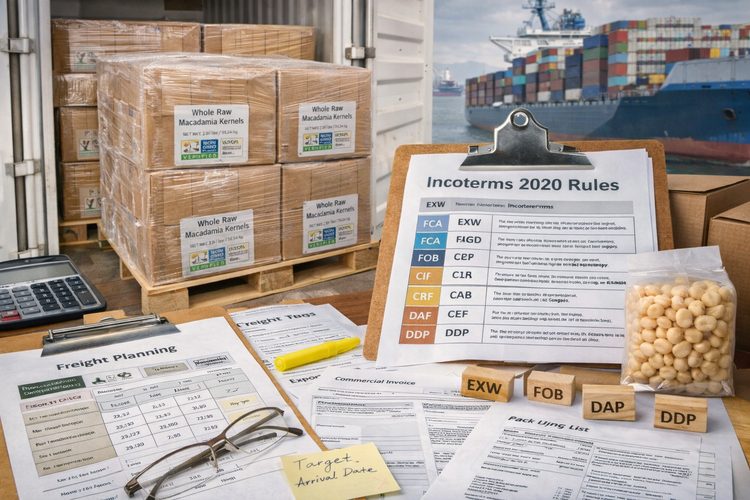
In macadamia trade, freight is not a secondary cost added after the product is selected. It is part of the product decision itself. A buyer may start by asking for raw kernels, roasted kernels, diced macadamias, meal, butter or oil, but the real commercial outcome is determined by how that product form is packed, moved, documented and handed over under the chosen Incoterm. Two offers that look close on nominal product price can produce very different landed cost outcomes once logistics responsibility, port handling, customs coordination, inland delivery and timing risk are included.
This is why freight planning and Incoterms matter so much in macadamia programs. Macadamias are a premium, relatively high-value nut category. That means physical protection, inventory timing, pallet configuration, shipment planning and document readiness have a direct effect on commercial success. A program that is technically well specified but poorly structured logistically can still become expensive through delays, damage, repeated handling, rushed bookings or avoidable confusion over who is responsible for which leg of the shipment.
Why freight planning matters before the quote, not after it
Many buyers first focus on the product itself and only later ask about freight. In practice, that sequence often creates misleading comparisons. A quote for bulk macadamia kernels on one delivery basis is not directly comparable with a quote that includes more freight responsibility or different delivery coverage. The product may be identical, but the commercial obligation is not.
Freight should therefore be treated as part of the quotation design. The buyer needs to know whether the program is domestic U.S. delivery, export container loading, mixed pallet distribution, foodservice replenishment, private label retail shipment or industrial bulk ingredient supply. Each of these routes changes the relevance of trucking, palletization, master carton structure, warehousing assumptions, transit timing and Incoterm selection.
Commercial takeaway: a strong macadamia RFQ usually defines product format, pack style, destination, target shipment size and preferred Incoterm together. That makes supplier offers more comparable and reduces later freight surprises.
How this topic shows up in real buying decisions
In everyday buying workflows, freight planning becomes important when a team realizes that the quoted product price is only part of the final delivered cost. This is especially common when buyers are comparing domestic versus export options, evaluating trial pallets against container programs, or deciding whether they want the supplier to manage more of the logistics chain. Freight planning also becomes critical when shelf-life is sensitive, when launch timing matters, or when the product is moving into retail or private label distribution with tighter delivery windows.
For macadamias, these decisions are closely linked to the product form. Whole kernels often justify stronger packaging and careful handling because breakage affects visual grade. Diced and granular formats may be more operationally forgiving, but still require disciplined pallet and packaging planning. Macadamia butter and oil programs create a different freight logic again because pack configuration, leakage prevention, labeling and warehouse handling change the supply structure. The buyer is not simply buying macadamias; the buyer is choosing a freight and risk model for a specific macadamia product.
Incoterms are a commercial comparison tool, not just legal language
Buyers often encounter Incoterms as trade shorthand, but their practical role is much larger. Incoterms determine who arranges and pays for different transport stages, where risk transfers, which side handles major freight milestones and how much logistics coordination the buyer wants to carry internally. This matters because a quotation can look less expensive while shifting more freight complexity and cost exposure onto the buyer.
From a sourcing standpoint, Incoterms are useful because they make the quotation basis explicit. They help clarify whether the supplier is pricing a factory-side release, a port-side handover, a destination-side delivery or some other defined point. That clarity is essential when the buyer wants to compare offers or decide how much of the shipment should be controlled by their own logistics team.
Why Incoterms affect landed cost, not only invoice structure
For macadamia buyers, the most relevant question is not which Incoterm sounds most familiar. The relevant question is which Incoterm makes the overall commercial structure more efficient for the actual program. A buyer with strong freight control and established importer capabilities may prefer more logistics responsibility. A buyer launching a smaller or more complex program may prefer a more managed delivery structure, even if the nominal unit price appears higher. What matters is the final landed and usable cost, along with risk visibility and timing reliability.
This is particularly important in premium nut trade because a delay or handling problem can affect more than freight expense. It can affect shelf-life allocation, customer launch schedules, retail readiness and inventory continuity. The “cheaper” quote may become more expensive if it requires fragmented coordination or creates preventable delay risk.
Common Incoterm thinking in macadamia trade discussions
Without turning the article into a legal manual, it is useful to understand the commercial mindset behind common delivery structures. Buyers generally choose among three broad approaches:
- Seller-minimal logistics responsibility: useful when the buyer has strong forwarding, customs and inland distribution control and wants to manage more of the chain directly.
- Shared logistics structure: useful when the responsibilities are divided in a way that matches each side’s strengths and gives clearer price visibility for core shipment stages.
- Seller-managed delivery deeper into the route: useful when the buyer values simplified coordination, more complete quote visibility or reduced internal logistics burden.
The right choice depends on the buyer’s operational capability, destination market, urgency and shipment pattern. A repeat importer with mature freight systems may not choose the same delivery basis as a brand launching its first export private label macadamia program.
Freight planning starts with the product format
Freight planning for macadamias should always begin with the actual product being moved. Whole kernels, pieces, meal, flour, butter and oil do not move the same way operationally. Whole kernels usually require more consideration around case strength, liner protection, pallet stability and transit handling because visual quality can materially affect resale value. Diced or granular products may place more emphasis on pack efficiency and consistent containment. Oil and butter lines bring their own issues related to fill format, packaging compatibility and leakage prevention.
Process state also matters. Raw, pasteurized, dry roasted and oil roasted products may require different handling assumptions around shelf-life, moisture protection, packing environment and transit timing. For that reason, a meaningful freight quote should not separate logistics from the product specification. The freight structure must serve the physical reality of the product.
Packaging and freight are part of the same decision
One of the biggest mistakes in premium nut trade is to treat packaging and freight as separate workstreams. In practice, they are directly connected. Carton dimensions affect pallet efficiency. Liner and case design affect protection. Pallet pattern affects warehouse handling and container utilization. Retail-ready packaging can change case count and cube. Premium gift formats can raise delivered cost if the outer logistics structure is not optimized.
For macadamias, this matters because the product has meaningful value per case and can suffer commercial downgrade if the outer logistics system is weak. A freight plan should therefore account for:
- pack size and net weight per case,
- master carton strength,
- pallet footprint and stack height,
- container loading efficiency,
- physical protection during handling, and
- compatibility with the buyer’s receiving and storage system.
Atlas trade note: good logistics planning is often invisible when it works well. The buyer sees it as clean delivered cost, stable arrival condition and fewer surprises. That usually starts with matching packaging structure to the freight route before production is finalized.
Domestic freight versus export freight
Domestic U.S. freight and export freight may involve the same macadamia product but they do not follow the same logic. Domestic programs are often more focused on truck scheduling, warehouse appointments, pallet consistency and replenishment cadence. Export programs add additional layers such as port timing, booking windows, documentation readiness, customs flow, transit duration and destination-side handling.
This is why buyers should state early whether they are sourcing for U.S. delivery, for cross-border trade or for full export distribution. A program designed for domestic replenishment may not automatically be ready for export. Packaging, labeling, case marking, documents and timing assumptions may all need to change. The freight plan should reflect the actual route to market, not a generic logistics assumption.
Trial quantities versus repeat container programs
Shipment planning changes dramatically depending on whether the buyer needs a trial, a launch quantity or a repeat replenishment program. Small trial quantities often carry higher relative logistics cost because they do not benefit from full-scale freight efficiency. That is normal, but it should be recognized at quote stage so the buyer does not mistake a trial cost structure for a long-term landed cost structure.
Repeat container programs create different priorities. Once the program scales, buyers usually care more about load efficiency, predictable booking rhythm, stable delivery basis, documentation repeatability and inventory planning. In those cases, the most important logistics question is often not “What is the freight today?” but “What freight structure will support continuity over time?”
How shipment timing affects commercial performance
Macadamia freight planning is closely tied to timing. A buyer may need product for a production slot, seasonal launch, promotional pack, retail reset or customer commitment. If the logistics basis is unclear, those deadlines become harder to manage. A shipment that is nominally “on time” at one point in the chain may still be late for the buyer’s real commercial need if the delivery responsibility ends earlier than expected.
This is another reason Incoterms matter. They define where the seller’s obligation ends and where the buyer’s responsibility begins. If that handover point is not aligned with the buyer’s actual planning horizon, the schedule can look secure on paper while still exposing the buyer to delay risk in practice.
Key freight cost layers buyers should think about
Professional buyers usually look beyond the product line price and think in terms of freight layers. Depending on the delivery basis, these may include origin handling, inland transportation, booking costs, port-related charges, ocean or air movement where relevant, destination handling, customs clearance, warehousing transfer and last-mile or inland delivery. The exact mix varies by route, but the principle is consistent: the delivered economics of macadamias are shaped by the full logistics chain, not only by the factory or packhouse price.
This matters even more for premium nut products because logistics friction can affect the usability of the goods. If transit is extended, packaging is weak or handovers are poorly coordinated, the resulting cost is not only freight cost. It can also include rework, late customer delivery, reduced shelf-life window or inventory gaps.
What Atlas would ask before quoting
Atlas generally encourages buyers to define a freight-aware brief early so the quotation reflects the actual commercial route. Useful questions include:
- What exact macadamia format is required?
- Is the program domestic U.S., export, foodservice, industrial or retail-ready?
- What packaging and pallet structure is preferred?
- What is the destination city, port or market?
- Is the order a trial, a recurring monthly volume or a container program?
- What delivery basis or Incoterm does the buyer prefer?
- Are there customs, importer or warehouse constraints that should be considered at quote stage?
- What is the needed-by timing in commercial terms, not just the requested ship date?
When these questions are answered early, quote comparison becomes more disciplined and the later logistics conversation is usually much smoother.
How Incoterms change the way buyers compare suppliers
A price comparison only works when the commercial basis is aligned. If one supplier quotes a product on a point-of-origin basis and another includes a deeper delivery commitment, the difference between those numbers does not automatically indicate a product price gap. It may simply reflect different logistics responsibilities. Buyers should therefore normalize supplier offers around the same delivery logic before drawing conclusions.
This is one of the most useful roles of Incoterms in practice. They help prevent false comparisons. They do not remove the need for detailed freight thinking, but they provide a clear starting framework for understanding where cost and risk sit in each offer.
Export documentation and freight readiness
Freight planning also intersects with documentation. Export macadamia programs often move more smoothly when shipping documents, packing details, case markings and approval paperwork are aligned with the freight structure. If the program is export-oriented, buyers should think early about how the document set will match the routing, the packaging format and the importer’s receiving expectations.
That does not mean every order requires a complex custom documentation project. It means the buyer should mention the destination market and the sales route early enough for the supply plan to reflect the real logistics burden.
Commercial planning points
From a trading standpoint, strong freight planning supports repeatability. The best macadamia programs are usually built around stable packaging, clear handover points, sensible shipment cadence and a delivery basis that both sides understand. That is true whether the buyer is sourcing raw kernels for industry, roasted macadamias for retail, macadamia butter for ingredient use or premium packaged goods for export distribution.
In many cases, the program works best when built in stages:
- Trial shipment: validate product fit, documentation flow and routing practicality.
- Validation replenishment: confirm repeat handling, case performance and delivery timing.
- Launch volume: align the agreed Incoterm, pallet structure and commercial timing.
- Repeat supply: stabilize freight rhythm, landed cost visibility and document consistency.
This staged logic helps buyers avoid overcommitting to an untested freight structure while still building toward a durable supply model.
How to build a stronger RFQ for this topic
A weak RFQ says: “Please quote macadamias for export.” A stronger RFQ says: “Please quote dry roasted macadamia kernels in export-ready cartons, destination Dubai, monthly palletized supply, private label retail program, target launch Q4, please advise delivery basis options and freight assumptions.” The second version gives the supplier enough information to respond with a commercially relevant offer rather than a generic price.
The goal is not to overload the inquiry. The goal is to make sure the logistics model matches the product and the market. That is what makes the final delivered cost more predictable.
Buyer planning note
Atlas Global Trading Co. uses freight and Incoterms discussions to help buyers move from broad product interest to a more complete quote request. In macadamia programs, the best commercial outcome usually comes when the product form, packaging, destination, timing and delivery basis are defined together. That structure leads to more realistic quote comparisons and a smoother path from approval to shipment.
If you are evaluating domestic delivery, export supply, trial lots or recurring container-style programs for macadamias, Atlas can use the same framework described here to help organize the next step into a more specification-minded commercial inquiry.
What to include in a freight-focused macadamia inquiry
A more practical freight brief usually includes:
- the exact macadamia format and process state,
- industrial, foodservice, retail-ready or export program type,
- pack style and pallet expectation,
- destination city, port or market,
- trial, monthly or container-scale volume estimate,
- preferred delivery basis or Incoterm,
- target ship window and actual needed-by date, and
- any customs, importer, warehouse or documentation constraints.
These points help turn a basic availability request into a more comparable delivered-cost discussion.
Need help sourcing around this macadamia freight topic?
Use the contact form to turn freight and Incoterms planning into a practical quote request for Atlas.
- State the exact macadamia format and pack style
- Add destination, shipment size and delivery basis
- Include target timing and market route
Frequently Asked Questions
What is the main buyer takeaway from “Freight Planning and Incoterms for Macadamia Buyers”?
The main buyer takeaway is that macadamia freight planning works best when product format, packaging, shipment cadence, destination and Incoterms are defined together before quotation and booking.
Why do Incoterms matter in macadamia purchasing?
Incoterms affect cost visibility, risk transfer, freight responsibility, customs coordination and how buyers compare supplier offers. Two prices are not truly comparable if the delivery basis is different.
What should buyers include in a freight-focused macadamia inquiry?
A practical inquiry should include product form, pack style, destination market, target Incoterm, expected shipment size, needed-by timing, whether the program is domestic or export, and any pallet, customs or documentation constraints.