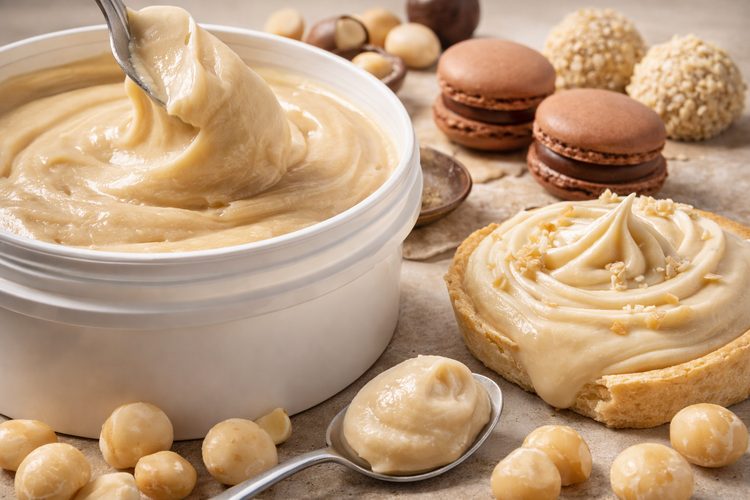
Macadamia butter can move across multiple end uses, but in fillings, ganache and dessert systems the core issue is not simply whether the ingredient is premium. It is whether the butter behaves correctly inside a finished confectionery or dessert structure. The strongest commercial result usually comes from aligning grind style, roast character, oil release, process temperature, packaging and shipment timing before the order is placed.
Atlas generally positions macadamia butter programs by asking what the customer needs the ingredient to do in the finished system. Should it create a smoother praline-like texture, deepen buttery nut flavor, enrich a ganache, soften a center, support a bakery filling, carry cocoa or dairy notes more elegantly, or create a plant-based premium dessert component without slowing production? Those questions determine the correct commercial route more effectively than a generic request for “macadamia butter.”
Core buyer view: Macadamia butter is best sourced as a system ingredient, not just a nut derivative. Its commercial value depends on how well it integrates into the target filling, ganache, coating or dessert base.
Why macadamia butter is attractive in dessert manufacturing
Macadamias are valued for a rich, buttery flavor profile and naturally creamy mouthfeel. When processed into butter, those attributes become commercially useful in premium dessert applications that require smoothness, indulgence and a more distinctive nut character than standard nut pastes or commodity fillings can provide. Macadamia butter can sit comfortably in luxury confectionery, fine pastry, premium ice cream systems, dessert sauces, layered fillings and higher-end plant-based formats.
Unlike piece or meal applications where the nut is mainly a texture component, butter formats become part of the internal structure of the finished product. That means the ingredient affects flow, viscosity, fat behavior, flavor carry, emulsion balance, crystallization interactions and finished eating quality. In practical terms, the butter is not only contributing taste. It is shaping how the system behaves during processing and how it feels in the mouth afterward.
How this topic shows up in real buying decisions
In practice, buyers compare raw, roasted and processed formats such as diced cuts, meal, flour, butter and oil. For dessert systems, the more relevant comparison is often between piece-based nut use and butter-based use, or between one butter specification and another. A macadamia butter that works in a soft layered confection may not be the best fit for a pumpable filling or a ganache structure that has to remain stable through distribution.
For macadamia buyers, the usable product menu often includes raw macadamias, roasted macadamias, diced macadamias, meal, flour, butter and paste-style systems. Which of those makes sense depends on the end use, whether the customer is manufacturing further, building a finished confectionery line, developing premium pastry components, producing frozen dessert variegates or planning export distribution for ready-to-use dessert ingredients.
What macadamia butter is expected to do in fillings and ganache
Create creamy texture
One of the main reasons manufacturers choose macadamia butter is to create a richer, smoother and more luxurious mouthfeel. In fillings and ganache, that can mean softer bite, rounder melt and a less dry perception than some other nut systems or dry solids-heavy formulations can produce.
Deliver premium nut flavor
Macadamia butter contributes a characteristic buttery, rich and often elegant nut profile that can work well with white chocolate, milk chocolate, vanilla, caramel, coffee, honey, fruit, coconut and premium pastry flavors. In some applications, it is used as the main flavor identity. In others, it is used to support or elevate a broader dessert system without dominating it.
Function as a fat-bearing ingredient
Because the butter contains naturally high macadamia oil, it participates directly in the fat structure of the formula. That can be beneficial in some systems and challenging in others. Buyers should therefore think in terms of total formulation behavior rather than ingredient identity alone.
Support premium positioning
In commercial dessert development, macadamia butter can help justify higher-value positioning. Whether the finished product is a filled chocolate, pastry insert, frozen dessert ripple, plated dessert component or bakery filling, the ingredient can signal a more premium concept if it is used correctly and communicated well.
Raw versus roasted macadamia butter
Roast direction matters because it changes both flavor intensity and application fit. A raw or lightly processed butter may be chosen when the formulator wants a cleaner, more delicate base that allows other flavors to lead. A roasted butter is generally more appropriate when the manufacturer wants clearer nut character, deeper aroma and a more developed dessert profile.
In real buying decisions, the question is usually not “raw or roasted” in isolation, but “which roast level supports the finished system?” A soft white chocolate filling may benefit from a gentler roast, while a praline-style center or darker confectionery application may perform better with a more developed nut note. The application should set the roast logic, not the other way around.
Texture, grind and particle profile
Smoothness and mouthfeel
For ganache, confectionery fillings and fine pastry systems, smoothness is often one of the most important technical requirements. A butter that tastes excellent but carries a rough or inconsistent grind can create a lower-quality mouthfeel in the final product. Buyers should therefore define whether they need ultra-smooth, smooth or slightly rustic texture depending on the application and brand style.
Particle profile and finished perception
Particle size influences not only texture but also how the filling behaves under shear, pumping, depositing and enrobing conditions. A very fine system may be preferred for smooth centers and cream-style fillings. A slightly more textured butter may be acceptable in artisanal or rustic-style bakery and pastry formats. What matters is that the grind matches the process and the consumer expectation.
Viscosity and flow behavior
Macadamia butter may be used in spoonable fillings, pumpable systems, layered bars, piped pastry components, molded confectionery centers or further blended dessert compounds. Those routes do not require the same flow behavior. Some buyers need a butter that moves cleanly through production equipment. Others need one that holds body in a finished cream or stable filling. A quote should therefore reflect whether the butter is being purchased as a direct-use ingredient or as a blend component.
Oil behavior and formulation implications
Macadamias are naturally high in oil, so macadamia butter can influence fat migration, filling softness, structural set, mouthfeel and shelf behavior. This is one of the most important commercial and technical realities in the category. The same oil-richness that creates indulgence can also require more careful formulation design if the finished system must hold shape over time or interface cleanly with chocolate shells, wafers, bakery components or layered desserts.
That does not make macadamia butter difficult. It makes it application-sensitive. In a flexible filling, the oil contribution may be part of the advantage. In a center that needs sharper structural control, the formulator may need a tighter system around it. Buyers should therefore source with the full dessert architecture in mind, not just the ingredient name.
Where macadamia butter is commonly used
Chocolate and confectionery fillings
Macadamia butter can be used in praline-style fillings, molded shell centers, layered bars, truffle interiors and luxury confectionery lines. In these products, the buyer typically cares about smoothness, nut flavor intensity, compatibility with chocolate and finished bite. The butter may be used alone or as part of a broader filling system.
Ganache systems
In ganache-style systems, macadamia butter may help bring richness and a premium nut note into cream-based, dairy-free or chocolate-forward structures. Here the critical issue is balance. The ingredient should deepen the system without destabilizing the intended texture or fat behavior. Buyers should be clear whether the target is a soft, pipeable ganache, a slab-set system or an enrobed center.
Bakery and pastry fillings
Pastry manufacturers may use macadamia butter in baked fillings, laminated pastry inserts, tart layers, sandwich cookie creams, croissant-style fillings, macarons, mille-feuille-style creams or specialty dessert inserts. In these applications, the butter is often chosen for its flavor and indulgent texture contribution. Process temperature, water activity strategy and filling set all matter.
Frozen dessert components
Macadamia butter may also be relevant in ripples, swirl systems, frozen dessert bases and premium inclusions. In these applications, viscosity, flavor carry and low-temperature texture matter more than in ambient bakery systems. The buyer should specify whether the butter is going into a frozen process, because the sensory and handling expectations change.
Plant-based dessert systems
Because macadamia butter can help create richness and creamy perception, it may be useful in dairy-free fillings, vegan ganache-style systems, plant-based confectionery and alternative dessert formats. Here the ingredient may support both flavor and body, but the quote should still reflect whether it is playing a leading or supporting role in the formula.
What Atlas would ask before quoting
For macadamia butter projects, Atlas generally recommends translating the product idea into a quote request with five practical points: target format, application, pack style, destination market and volume rhythm. For butter systems, Atlas would also usually ask whether the buyer needs a direct-use butter, a base for further blending, a filling ingredient, a ganache component, a bakery application or a dessert-system ingredient for frozen or ambient use.
Other common quotation questions would include preferred roast direction, target texture, whether ultra-smooth grind is required, how the butter will be processed on line, and whether the system is being validated for pilot scale, launch scale or repeat commercial production. Those details help separate a relevant quote from a generic one.
Typical use cases for macadamias on this website include premium bakery, cookies and confectionery, snack mixes, plant-based dairy, sauces and dips. The product brief should always match one of those concrete end uses. For butter systems, that usually means stating whether the ingredient is intended for fillings, ganache, pastry creams, confectionery centers, frozen dessert swirls or other defined applications.
Commercial planning points
Commercially, these projects often develop in stages: trial quantity, validation run, launch volume and repeat replenishment. Atlas uses that logic to guide pack and shipment planning, especially when confectionery, pastry manufacturing, export retail or private label dessert programs are part of the discussion. Trial-stage development may prioritize flexibility and fast iteration. Repeat supply usually needs tighter alignment around grind, pack size and production rhythm.
When relevant, the brief should also mention whether the program is industrial bulk, foodservice, retail-ready, private label or export-oriented. That single clarification often changes packaging, documentation and timing assumptions. A butter intended for internal factory use is a different commercial program from one being packed into retail dessert kits or export ingredient formats.
Packaging and handling choices
Macadamia butter packaging should reflect how the customer is actually using the material. Industrial users may need larger foodservice or bulk packs suitable for controlled production environments. R&D teams and pastry labs may need smaller pack sizes for validation work. Export and distributor programs may require pack choices that protect the butter through longer transit paths and varied storage handling.
Because the ingredient is fat-rich and application-sensitive, the buyer should not treat packaging as a minor afterthought. Pack style can affect storage convenience, line-side handling and working efficiency, especially when repeated opening, warming or portioning are involved in production.
Cost-in-use versus nominal ingredient price
Macadamia butter sits in a premium ingredient tier, so buyers should evaluate it on cost-in-use, not just headline price. A lower-priced butter that does not match the required grind, oil behavior or flavor target may create more reformulation work and process instability than a higher-priced butter that drops cleanly into the system. In fillings and ganache, where texture and sensory balance are critical, that distinction matters.
The stronger commercial question is usually not “what is the cheapest macadamia butter?” but “which specification lets the finished dessert perform correctly at the intended premium level?” That is a more useful basis for real sourcing decisions.
How this topic shows up in product development
In real buying work, dessert teams often start with a concept such as “macadamia filling” or “macadamia ganache,” but those names are still too broad for procurement. The sourcing conversation becomes more useful when the team identifies what the butter must do structurally and sensorially. Should it soften the filling, dominate the flavor, blend behind chocolate, carry vanilla and caramel notes, support a frozen dessert ripple or create a distinct premium center? Those answers shape both the technical brief and the commercial route.
Buyer planning note
Atlas Global Trading Co. uses topics like this to move conversations from broad interest to a specification-minded inquiry. If you are evaluating macadamia supply for dessert systems, share the format, pack style, estimated volume and destination using the floating contact form so the next step can be grounded in a real commercial need.
For butter-based applications, the strongest sourcing result usually begins when the customer defines not only the ingredient, but the dessert system it must support: texture target, flavor direction, processing method, package size and production stage.
Need help sourcing around this macadamia butter topic?
Use the contact form to turn a dessert concept into a more practical quote request built around texture, flavor, pack style and commercial timing.
- State the exact butter application and target texture
- Add target monthly, trial or launch volume
- Include destination market, pack format and timing
Frequently Asked Questions
What is the main buyer takeaway from “Macadamia Butter for Fillings, Ganache and Dessert Systems”?
The main buyer takeaway is that macadamia butter performs best when grind style, oil behavior, application system, packaging format and commercial timing are defined together before quotation.
What technical details matter most when sourcing macadamia butter for fillings and ganache?
The most important technical details usually include roast level, grind smoothness, viscosity, oil separation tendency, flavor intensity, particle profile, pack format and intended use in fillings, ganache, praline-style systems or dessert bases.
Should buyers choose raw or roasted macadamia butter?
That depends on the finished dessert system. A lighter butter may suit delicate fillings or applications where other flavors lead, while a roasted butter may be preferred when stronger nut identity and deeper aroma are needed. The correct choice depends on the end formulation.
Why is oil behavior so important in macadamia butter applications?
Macadamias are naturally high in oil, so the butter affects softness, structure, melt and compatibility with chocolate, pastry and dessert systems. The ingredient should be sourced around the full formula, not in isolation.
What should a buyer include in an RFQ for macadamia butter?
A strong RFQ should define application, target texture, roast or flavor direction, whether the butter is intended for direct use or further blending, pack size, destination market, expected volume and target shipment timing.