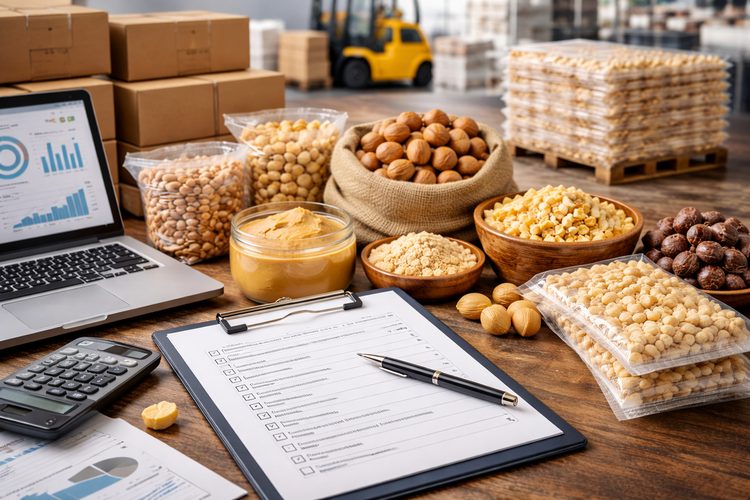
Industrial macadamia buying is rarely a simple price exercise. The stronger commercial result usually comes from defining the exact product form, processing route, pack style, shipment rhythm and quality expectations before comparing offers. Macadamias are a premium ingredient, so specification gaps tend to become expensive quickly. A buyer may think they are comparing equivalent product, while in practice the competing quotations can reflect very different assumptions about size range, style, roasting, breakage tolerance, packaging, usable yield and application fit.
This checklist is intended to help manufacturers, importers, repackers, private label operators and industrial food buyers structure a better macadamia inquiry. Atlas uses this type of framework to move conversations away from generic “price for macadamias” requests and toward specification-minded discussions that are easier to quote, easier to compare and more likely to convert into repeatable supply programs.
Why buyers need a checklist before requesting a quote
Macadamias can be bought in whole kernel form, in different piece styles, as meal or flour, and in processed forms such as butter or oil. They can also be supplied raw, pasteurized, dry roasted or oil roasted, depending on program needs. Each of those choices changes the commercial logic. The correct option depends on what the customer needs the ingredient to do in production: provide visible premium identity, deliver a particular bite, support blending, contribute nut flavor, hold up through manufacturing, meet a label goal or simply fit a cost target without creating unnecessary process loss.
Without a checklist, buyers often end up requesting samples or pricing for a product that sounds close enough on paper but is not actually aligned with the line, the finished product or the destination market. That leads to delays, avoidable revisions and difficulty comparing supplier options fairly. With a stronger brief, the quotation process becomes more practical and the downstream decisions become faster.
Main buyer takeaway: industrial macadamia sourcing works better when application, format, quality targets, packaging and commercial timing are defined together rather than one by one.
Checklist item 1: Define the exact industrial application
The first question is not “what is the lowest market price?” It is “what will this product do in the finished application?” Macadamias used in premium bakery, cookies, confectionery, snack mixes, plant-based dairy, fillings, sauces, dips or retail repacking do not need the same specification. A visible cookie inclusion needs a different size logic than a nut butter program. A confectionery topping needs different appearance control than a macadamia paste intended for blending into a center or spread.
Buyers should state whether the macadamia ingredient is for manufacturing, repacking, foodservice, private label or export redistribution. They should also say whether the nut is a visible inclusion, an internal functional ingredient, a flavor contributor or a processed base material. This single clarification often changes the most appropriate product route and helps reduce quotation noise.
Checklist item 2: Choose the correct product form
Macadamias are not one uniform industrial input. The usable product menu usually includes whole kernels, halves, large pieces, medium pieces, small dice, granulation, meal, fine flour, butter and oil. The more precisely the form is defined, the easier it becomes to evaluate cost and processing fit.
Whole kernels and larger visible formats generally suit premium applications where the nut itself is part of the visual sell. These formats can support high-end bakery, confectionery and certain snack products, but they also require more attention to breakage, line handling and final pack presentation.
Diced and piece formats are often used when the customer needs more controlled distribution, easier mixing or better piece count management. Different cut ranges can materially affect appearance, depositor behavior, mixing results and the feel of nut presence in the finished product.
Meal, flour and fine grind formats are more relevant when the buyer wants particle reduction for blending, texture building or flavor dispersion. These are not interchangeable with coarse piece formats, and the quote should reflect that difference.
Butter and oil formats serve yet another purpose. Buyers interested in creamy texture, fat-phase contribution, nut flavor or smooth system integration should specify these routes clearly because the technical and commercial discussion is different from kernel buying.
Checklist item 3: Specify raw, pasteurized or roasted style
The style of macadamia matters because it affects flavor, processing sequence, label logic and the practical use of the ingredient. Some buyers need raw macadamias because they will roast, bake, enrobe or otherwise process the nuts further. Others need pasteurized material to support a particular handling or quality framework. Still others require dry roasted or oil roasted product because the finished application demands a ready-to-use sensory profile.
Dry roasted and oil roasted products are not identical choices. Roasting method can influence surface feel, flavor expression, downstream handling and how the ingredient behaves in certain mixes or finished retail packs. Buyers should not assume the supplier’s default route matches the intended application. It is better to state whether the product will face additional heat steps and whether roast development is a finished sensory requirement or merely a process stage.
Checklist item 4: Define size, cut and visual expectations
Many industrial nut inquiries fail at this point because the buyer requests “pieces” without defining what that means functionally. A cookie manufacturer may want visible pieces that survive dough mixing and remain apparent after baking. A confectionery customer may want smaller pieces for uniform distribution. A snack mix packer may want a more consistent visual presentation across packs. These are all different size expectations, even if each buyer uses the same word in the inquiry.
A useful brief should describe whether the priority is premium appearance, even distribution, controlled piece count, blendability, feeder behavior or finished product bite. Buyers should also mention whether fines are a concern. In some applications, a modest fines level is commercially acceptable. In visible or top-decorated applications, it may be much less acceptable. A specification that anticipates actual use usually saves time in both sampling and quotation.
Checklist item 5: Align the product with process conditions
Macadamias may pass through conveying, weighing, blending, sheeting, topping, depositing, enrobing, baking, panning, filling or repacking. The chosen specification needs to tolerate those conditions. A format that looks ideal in a sample tray may behave poorly once it is subjected to line vibration, drop height, augers, heat or repeated handling.
Industrial buyers should therefore mention whether the product will be mixed into a dense dough, folded into a confectionery system, included in a sauce, blended into a dairy alternative base, packed directly for retail or used in a private label SKU. They should also note whether the line is sensitive to dust, fines, excess oil release or breakage. Macadamias are a premium ingredient, so small process mismatches can produce disproportionate cost consequences.
Process reminder: the “right” industrial macadamia is the one that works in the customer’s actual process, not merely the one that looks best in a generic sample.
Checklist item 6: Set quality expectations before sampling
Quality discussions are more productive when the buyer states what matters commercially. Depending on the application, the key concerns may include appearance, color range, breakage tolerance, flavor profile, texture, cleanliness, size consistency, visible defect tolerance or overall usability after handling. A repacker working on premium retail presentation may prioritize visual uniformity differently than a manufacturer using the product inside a further-processed formulation.
Quality expectations should be grounded in the end use. If the program involves visible kernels in a premium format, the buyer should say so. If the program is more concerned with performance in blending or filling, that should also be clear. The goal is not to over-specify every parameter without reason, but to identify the criteria that materially affect acceptance, yield and consumer-facing results.
Checklist item 7: Decide the packaging route early
Packaging is often treated as an afterthought, but it affects pricing, warehouse handling, plant convenience, pallet efficiency and export practicality. Some industrial customers want bulk formats for direct plant use. Others need smaller trial-oriented quantities. Retail-ready, foodservice, private label and export-oriented programs each introduce different packaging assumptions.
For example, an industrial bulk user may prioritize efficient receiving and reduced labor in production. A private label or export customer may care more about presentation, secondary packaging, outer-case logic or documentation consistency. Even when the product itself is unchanged, the pack style can alter the commercial conversation meaningfully.
Atlas typically recommends that buyers specify whether the program is industrial bulk, foodservice, retail-ready, private label or export-oriented at the start of the inquiry. That one detail often changes packaging, documentation and timing assumptions immediately.
Checklist item 8: Clarify destination market and commercial route
Domestic and export programs may use the same core product, but the commercial structure is not always the same. Export buyers often need earlier discussion of transit planning, palletization, document requirements, labeling expectations and destination-specific handling considerations. Buyers serving multiple countries may also need consistency across repeated shipments rather than a one-time match to a sample.
Even in domestic supply, the route matters. Is the product shipping to a manufacturing plant, a co-packer, a fulfillment site, a distributor or a repacking operation? The logistics pattern can influence packaging and replenishment planning. Including the destination market in the initial brief helps the supplier respond with more realistic options.
Checklist item 9: State the commercial phase of the project
Not every inquiry is an immediate production order. Many programs begin with a trial quantity, then move into a validation run, then a launch volume, and only later settle into repeat replenishment. Atlas encourages buyers to state which phase they are in because the sourcing discussion changes accordingly.
Trials are often about fit and feasibility. Validation runs focus more on repeatability and line behavior. Launch volumes bring packaging efficiency, shipment timing and commercial structure into sharper focus. Repeat replenishment requires cadence, continuity and a workable forecasting approach. A supplier conversation is much easier when these stages are not blended together.
Checklist item 10: Share realistic volume rhythm
Buyers do not always need to provide a perfect annual forecast, but they should give enough information to distinguish between a sample request, a small trial, a monthly industrial requirement and a container-scale program. The volume rhythm affects how practical different pack styles, sourcing routes and shipment structures may be.
A more useful inquiry states whether the expected demand is one-time, occasional, seasonal or repeatable. If the business includes launch assumptions, replenishment estimates or expansion plans across regions, those are worth mentioning. The goal is not to lock the buyer into an early commitment, but to let the supplier frame the commercial conversation around something more meaningful than a single spot quantity.
Checklist item 11: Evaluate total delivered cost, not only unit price
Nominal price matters, but it is not the full economics of industrial buying. The more accurate comparison includes usable yield, line losses, piece consistency, packaging efficiency, warehouse labor, freight pattern, damage risk, process fit and the cost of avoidable rework. A cheaper product that breaks excessively, creates handling issues or requires more plant labor can easily become the more expensive option in practice.
This is especially true with premium nut ingredients. A quote should be read in the context of what the plant or customer actually receives as usable value. Buyers who focus on delivered program performance usually make better long-run decisions than buyers who compare only nominal cost per unit.
Commercial perspective: the strongest industrial buying decisions compare true usable value, not just headline price.
Checklist item 12: Ask what will affect repeatability
One successful shipment does not automatically create a stable supply program. Buyers should ask what needs to be kept consistent over time: product form, size range, pack style, shipment cadence, documentation flow and quote assumptions. This is particularly important for brands and manufacturers that need repeatable sensory and visual results across multiple production runs.
Repeatability also matters when the macadamia program sits inside a broader product portfolio. A company may begin with one SKU, then expand into additional pack sizes, markets or applications. The earlier the buyer identifies continuity expectations, the easier it becomes to structure a sensible program rather than a series of disconnected purchases.
Typical industrial use cases behind this checklist
On this website, typical macadamia use cases include premium bakery, cookies and confectionery, snack mixes, plant-based dairy, sauces and dips. Each category brings its own technical priorities. Bakery buyers often focus on visible inclusion performance and bite. Confectionery buyers may be more concerned with flavor, appearance and distribution. Plant-based dairy developers may care about grind route, oil release and creamy mouthfeel. Sauce and dip programs can shift attention toward blending, texture and stability in the finished system.
The checklist works best when the buyer links the inquiry to one of these concrete end uses. That makes the supplier response more commercial and less abstract.
What Atlas would ask before quoting
Atlas generally encourages buyers to define the following points before requesting industrial macadamia pricing:
- Application: what the product will do in the finished item
- Format: whole, pieces, meal, flour, butter or oil
- Style: raw, pasteurized, dry roasted or oil roasted
- Quality expectations: appearance, size consistency, flavor, breakage tolerance and practical usability
- Pack style: industrial bulk, foodservice, retail-ready, private label or export-oriented
- Destination: domestic plant, export customer or redistribution route
- Volume rhythm: trial, validation run, launch volume or repeat replenishment
- Timing: required ship window and any urgency or launch deadline
These inputs help reduce back-and-forth, improve quote comparability and give the supplier a better chance of offering the most appropriate California processing or trading route.
Common buyer mistakes this checklist helps avoid
A few patterns regularly slow industrial nut sourcing. One is requesting pricing with no defined application. Another is using a broad format name that could mean multiple practical products. A third is waiting until the end of the process to mention packaging, export destination or commercial timing. Buyers also sometimes overlook the difference between sample suitability and routine production suitability.
The checklist helps avoid those mistakes by forcing the inquiry to reflect actual commercial use. That produces cleaner conversations and more realistic next steps.
Buyer planning note
Atlas Global Trading Co. uses buyer-checklist content like this to help customers move from broad interest to a more specification-minded inquiry. If you are evaluating industrial macadamia supply, the best next step is to share the intended application, required format, pack style, estimated volume, destination market and target timing. That allows Atlas to respond around a real sourcing need rather than a generic request.
Practical industrial inquiry template
A strong starting brief often looks like this:
- Product: macadamias for bakery, confectionery, snack, plant-based dairy, sauce, dip or retail packing
- Format: whole, halves, pieces, meal, flour, butter or oil
- Style: raw, pasteurized, dry roasted or oil roasted
- Pack requirement: trial quantity, industrial bulk, foodservice, private label or export-oriented
- Volume: sample, monthly usage, launch estimate or container program
- Destination: U.S. plant, Europe, Middle East, Asia or other market
- Needed by: target ship window or launch deadline
- Notes: size preference, appearance priorities, process route and any commercial constraints
That kind of brief gives both buyer and supplier a better basis for technical alignment and commercial comparison.
Need help sourcing industrial macadamias?
Use the contact form to turn this checklist into a practical quote request with the format, pack style, destination and timing your program actually requires.
- State the exact macadamia format and application
- Add target trial, monthly or launch volume
- Include destination market, pack style and timing
Frequently Asked Questions
What should an industrial buyer define before requesting a macadamia quote?
A stronger industrial quote request should define format, style, intended application, size requirement, pack style, destination market, expected volume, quality expectations and target timing.
Why is nominal price not enough when buying industrial macadamias?
Nominal price alone does not show true program cost. The better comparison includes usable yield, size consistency, processing fit, pack efficiency, logistics requirements and the repeatability of supply.
Can the same buyer checklist be used for U.S. and export programs?
Yes. The same checklist applies to both, but export programs usually require earlier discussion of documentation, packaging protection, pallet configuration, labeling and shipment timing.