Premium vs cost-balanced mix design
Whole cashews increase perceived value but raise cost. Pieces can reduce cost while maintaining flavor contribution.
Buyer guidance on snack mix formulation, cashew selection, roasting styles, seasoning systems, packaging formats and commercial sourcing strategy.
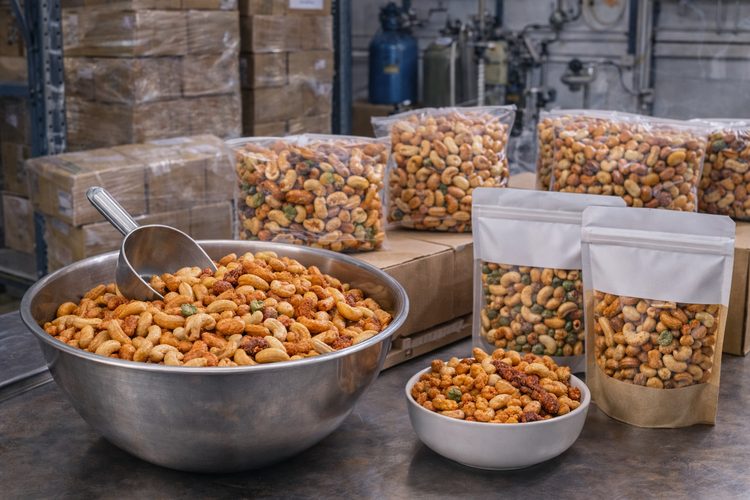
Building a cashew snack mix program is not only about selecting a nut inclusion. It is about designing a finished product system where ingredient behavior, processing conditions, packaging, shelf-life and commercial positioning all align. Cashews often play a central role in snack mixes because they deliver a combination of premium visual appeal, mild buttery flavor and a softer bite compared to harder nuts. That positioning makes them valuable, but also commercially sensitive when cost, breakage, seasoning and shelf stability are considered.
In California-based snack mix programs, the conversation typically includes sourcing raw or roasted cashews, selecting the correct size or style, integrating with other ingredients such as almonds, peanuts, pretzels or dried fruit, and ensuring that the mix performs consistently through blending, packing and distribution. A strong commercial outcome depends on aligning these technical factors with channel requirements such as retail shelf presentation, foodservice handling or export distribution.
Snack mix buyers rarely evaluate cashews in isolation. They evaluate how cashews interact with the full mix system. This includes blend ratio, visual balance, breakage tolerance, seasoning adhesion and cost contribution relative to other components. Whole cashews may be selected for premium positioning, but they increase cost and can break during blending or transport if handling is not optimized. Smaller pieces may reduce cost and improve seasoning coverage but change the perceived value of the mix.
Buyers also consider roast style. Dry roasted cashews are commonly used in snack mixes because they provide a clean flavor and compatible texture with other dry components. Oil roasted cashews may offer stronger flavor and improved seasoning adhesion but introduce additional oil into the system, which can affect mix stability and packaging requirements. Raw or lightly processed cashews may be used in specialized mixes where further processing occurs downstream.
Another key decision is how cashews contribute to the sensory profile. In many snack mixes, cashews are used to soften the overall bite and balance more aggressive textures from pretzels or roasted nuts. They may also act as a neutral carrier for seasoning systems, allowing spice blends to distribute more evenly across the mix.
Format selection is one of the most important technical decisions in snack mix development. Whole kernels, splits and large pieces are typically used in premium retail mixes where visual presentation is important. These formats create a high-value appearance but require careful handling to reduce breakage and maintain consistent pack-out quality.
Medium and small pieces are often used in value-oriented or high-volume programs. These formats improve blend uniformity and reduce cost while still delivering cashew flavor. They also tend to carry seasoning more effectively due to increased surface area. However, they may not provide the same visual impact as whole kernels.
Granulated or meal formats are less common in traditional snack mixes but may be used in coated or clustered snack concepts. In these applications, cashews contribute flavor and texture within a composite product rather than as a visible standalone inclusion.
Roasting is critical in snack mix performance because it defines flavor, texture and compatibility with seasoning systems. Light roasting may preserve a milder flavor and softer bite, while deeper roasting can create a stronger, more pronounced nut profile. The correct roast level depends on the overall mix design and target consumer experience.
Seasoning systems introduce additional complexity. In snack mix production, seasoning adhesion must be consistent across multiple components with different surface properties. Cashews generally accept seasoning well, but oil content, surface condition and roast profile can influence how evenly seasoning distributes. Some systems rely on oil application to improve adhesion, while others use dry seasoning blends with carrier agents.
From a commercial standpoint, seasoning choice also affects shelf-life. Strong flavors may mask minor variation over time, while lightly seasoned or clean-label products require tighter control over ingredient freshness and packaging barrier.
Snack mix production involves blending multiple ingredients with different densities, shapes and fragility. Cashews, especially whole kernels, are more fragile than many other components and can break during mixing, conveying or packaging. Excessive breakage can reduce perceived quality and create fines that affect pack appearance.
Buyers and production teams therefore need to consider blending methods, drop heights, conveyor design and pack filling systems. Gentle handling and appropriate equipment selection can help maintain integrity, especially in premium programs. In some cases, sequencing the addition of cashews later in the blending process can reduce breakage.
Uniform distribution is also important. Consumers expect consistent inclusion ratios in every pack. This requires proper mixing design and ingredient proportioning. Cashews often serve as a visible benchmark for quality, so uneven distribution can lead to negative perception even if the total formulation is correct.
Packaging plays a central role in maintaining snack mix quality. Because mixes contain multiple ingredients with different moisture and oil profiles, the packaging system must protect against oxygen, humidity and physical damage. Cashews are particularly sensitive to oxidation compared to some other mix components, so the packaging barrier should reflect the most sensitive ingredient in the system.
Retail snack mixes often use flexible pouches with barrier films designed to maintain freshness and protect flavor. Foodservice and bulk programs may use larger bags or lined cartons, but these formats require careful handling after opening to maintain quality. Export programs may require enhanced barrier solutions and tighter control of transit conditions due to longer shipping times.
Shelf-life expectations should be aligned with real distribution timelines. A product that performs well in a short domestic supply chain may require adjustments for export or extended warehousing. This can influence ingredient selection, roast level, seasoning intensity and packaging choice.
Snack mix programs are typically built in stages. Initial development may involve small trial quantities to test formulation and processing behavior. This is followed by validation runs to confirm consistency, packaging performance and shelf-life. Once validated, the program moves into launch volume and then into repeat replenishment.
From a commercial perspective, buyers should define whether the program is industrial bulk, foodservice, retail-ready or private label. Each channel has different requirements for packaging, labeling, palletization and documentation. Export-oriented programs add further considerations such as regulatory compliance, language requirements and freight planning.
Cost structure is also influenced by ingredient selection. Cashews are often one of the higher-cost components in a snack mix, so their inclusion level must be balanced against target price points. Some programs use cashews as a premium anchor ingredient while adjusting other components to manage overall cost.
Atlas typically asks buyers to define five key elements: cashew format, application type, packaging style, destination market and volume rhythm. For snack mix programs, additional detail is often helpful, including target blend composition, seasoning profile, pack size and shelf-life expectations.
Understanding whether the program is a short-term promotion, a seasonal product or a long-term SKU also helps structure sourcing and production planning. Buyers that provide a clear brief can receive more accurate and actionable proposals, reducing development time and improving alignment with production partners.
Atlas Global Trading Co. supports snack mix programs by connecting buyers with California-based processing and packing capabilities. This includes sourcing cashews in the appropriate format, coordinating roasting and seasoning where needed, and aligning packaging with the intended market channel.
Snack mix programs are most successful when product design, processing capability and commercial planning are developed together. If you are evaluating a cashew-based snack mix, sharing your target format, blend concept, packaging and destination market will help move the conversation from general interest to a structured sourcing solution.
Whole cashews increase perceived value but raise cost. Pieces can reduce cost while maintaining flavor contribution.
Dry roasted for cleaner systems, oil roasted for stronger flavor and seasoning adhesion.
Cashew inclusion level affects both cost structure and visual balance of the mix.
Retail pouches, bulk bags or foodservice packs each require different shelf-life and handling strategies.
Retail, foodservice and export programs require different specifications and documentation.
Consistent supply planning supports freshness and reduces inventory risk.
Use the contact form to translate your snack mix concept into a structured quote request for Atlas.
The key takeaway is that successful snack mix programs depend on matching cashew format, roast style, seasoning behavior, packaging and supply timing to the intended retail or foodservice outcome.
Whole kernels and large pieces are used for premium mixes, while smaller pieces can improve cost efficiency and seasoning distribution.
Maintaining blend uniformity, minimizing breakage, managing seasoning adhesion and ensuring shelf-life stability across ingredients are key challenges.
Yes. Export programs require additional planning around packaging barrier, labeling, palletization and transit conditions.