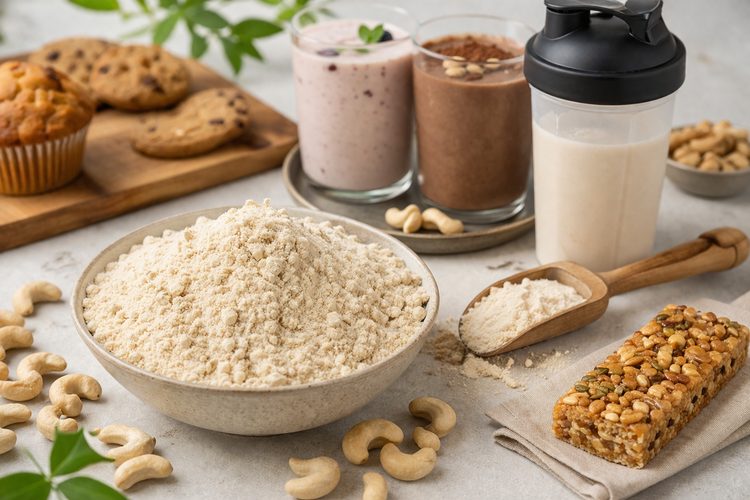
Defatted cashew protein is a more specification-driven ingredient than standard whole-kernel cashews, roasted pieces or conventional cashew flour. Buyers evaluating it for better-for-you product development are usually not looking only for a nut ingredient. They are looking for a powder with a certain protein contribution, a manageable fat level, acceptable flavor, suitable particle size and predictable performance in systems that may also include sweeteners, fibers, starches, cocoa, dairy alternatives, other plant proteins, emulsifiers or hydrocolloids.
That is why sourcing conversations around defatted cashew protein should begin with application logic instead of a generic request for price. In practical terms, the right commercial result comes from aligning product specification, process route, packaging and shipment rhythm before a program moves into larger validation or launch-stage buying.
buyer's perspective: Defatted cashew protein is best treated as a functional formulation ingredient, not just a commodity powder. Its real value depends on how well the protein level, sensory profile, fat reduction, grind size and process behavior match the intended product.
What buyers usually mean by defatted cashew protein
In commercial discussions, defatted cashew protein usually refers to a cashew-derived powder produced after substantial oil reduction from the nut material. Relative to full-fat cashew flour or standard ground cashew ingredients, the defatted version is generally positioned for higher protein concentration, lower fat contribution and improved fit in formulations where buyers want stronger nutrition positioning or more flexibility in macronutrient balancing.
Commercially, this distinction matters because a full-fat cashew flour, a partially defatted powder and a more protein-forward defatted cashew ingredient do not serve the same role. One may be selected for rich mouthfeel and nut flavor, another for improved protein density and reduced oil load, and another for blend economics in a multi-ingredient system. The buyer should therefore define what “defatted” is expected to accomplish in the formula: increased protein, lower fat, less oil migration, drier handling, different flow, or a cleaner path to blend standardization.
Why better-for-you formulators look at defatted cashew protein
Better-for-you product developers often work within multiple constraints at the same time. They may need to raise protein, moderate total fat, maintain recognizable ingredient positioning, support plant-based messaging, avoid a chalky texture, manage sugar reduction, or hold a label architecture that feels less synthetic to the end customer. In that environment, defatted cashew protein may attract attention because it can sit somewhere between a nut ingredient and a dedicated plant protein input.
For some buyers, the appeal is nutritional balancing. For others, it is a sensory compromise: they want more protein than a traditional nut flour provides but do not want the full texture penalty sometimes associated with very high-load legume or isolate systems. For others still, it is a blend tool used in smaller percentages to soften the profile of another protein source or to bring a different flavor dimension into a better-for-you base.
How it differs from standard cashew flour and meal
Standard cashew flour or meal typically carries more native oil and is therefore often chosen when the formulator wants richness, mouthfeel, moisture contribution or stronger nut character. Defatted cashew protein pushes the commercial conversation in a different direction. The buyer is usually asking for more protein contribution per kilogram of ingredient and less reliance on cashew oil as part of the final system.
This can change how the powder behaves. Lower fat content may influence dryness, flow, water interaction, blend handling, dusting tendency and textural contribution. It can also shift the flavor profile toward something less overtly rich than full-fat cashew materials. From a sourcing standpoint, this is why it is important not to substitute one for the other without application review.
How this topic shows up in real buying decisions
In real procurement work, defatted cashew protein usually appears in one of several scenarios. A brand team may want a protein-forward line extension that still sounds closer to food than to sports nutrition chemistry. A bakery customer may want more protein in a better-for-you cookie, brownie, pancake mix or muffin base without making the bite too dense. A beverage or smoothie premix developer may be looking for a nut-linked base note that blends better with cocoa, coffee, vanilla or fruit profiles. A bar manufacturer may want to complement another protein source and soften its sensory edge. A savory developer may want to add solids, protein contribution and mild nut depth to seasonings, soup bases or functional snack coatings.
Each of those cases points toward a different target specification. That is why the same ingredient name can lead to different commercial outcomes depending on whether the application is beverage, bakery, bar, dry blend, confectionery-adjacent or savory.
Typical applications for defatted cashew protein
Protein bars and better-for-you snack bars
Bars are a common use case because formulators often need a balance between protein delivery, chew, binding, shelf stability and flavor. Defatted cashew protein may be used as a primary protein contributor in some concepts or, more commonly, as part of a blend. It can help move the formula toward a nut-linked taste profile while avoiding the full oil load of standard cashew flour. Buyers in this category should think about water activity targets, syrup or binder interactions, compression behavior, bite over shelf life and the risk of hardening in higher-protein systems.
Better-for-you bakery
In cookies, muffins, brownies, pancakes, waffles, donuts, cake mixes and protein-enriched bakery premixes, defatted cashew protein may be chosen to increase solids and protein while still supporting a relatively familiar bakery positioning. The formulator should review batter viscosity, dough tolerance, water absorption, crumb tenderness and flavor carry. In some systems the ingredient may be a protein-supporting component rather than a dominant flour replacement. The question is not only whether it raises protein, but whether it does so without degrading machinability and finished eating quality.
Powdered beverage mixes and smoothie bases
For beverage developers, the main evaluation points tend to be suspension, hydration, flavor fit, sedimentation risk, mouthfeel and compatibility with sweetener systems. Defatted cashew protein may be attractive when the buyer wants a nut-associated platform that can sit between indulgent and functional positioning. However, beverage buyers should be especially clear about particle size, instantization expectations if relevant, blending sequence and whether the powder will be used in ready-to-mix sachets, tubs, multi-serve pouches or industrial base blends.
Plant-based dairy alternatives and cultured systems
Defatted cashew protein can also enter discussions around plant-based yogurt alternatives, drinkable bases, sauces, cream-style systems and protein-fortified dairy-free concepts. Here the buyer is usually balancing protein, fat, creaminess, emulsification support and flavor neutrality. In some formulations, the lower fat position of a defatted ingredient is an advantage because the product developer wants to design the fat system separately. In other cases, reduced native oil means the formulator must rebuild creaminess elsewhere. This is why application-specific trials matter.
Better-for-you confectionery and coated snacks
In clusters, inclusions, coated bites and protein-forward indulgence products, defatted cashew protein may be used to support nutritional positioning while preserving some nut adjacency in the flavor profile. Buyers should think about how the ingredient interacts with syrups, chocolate alternatives, cocoa systems, fibers and sweetener blends, especially where dryness, cohesion and finish are critical.
Savory formulations
Savory snacks, seasoning systems, soup bases and functional savory premixes can use defatted cashew protein in more limited but still commercially relevant ways. A mild nut note, protein contribution and dry-blend compatibility may be useful in some concepts. Here, flavor management and particle consistency are especially important because savory systems tend to expose off-notes quickly.
Technical attributes buyers should discuss before quotation
Because defatted cashew protein is an application-sensitive powder, a useful RFQ should go beyond basic product naming. Below are the technical and commercial variables that typically make the biggest difference in supplier alignment.
Protein range
Some buyers need a higher protein contribution to support formulation claims or internal nutritional targets, while others mainly need an ingredient that improves the protein picture without destabilizing texture. The required protein range should be defined early. A buyer developing an everyday better-for-you bakery mix may not need the same protein density as a protein bar or sports nutrition adjacent product.
Residual fat level
Residual fat affects mouthfeel, flavor richness, powder flow and the ingredient’s role in the overall macro structure of the formula. A lower-fat target may help a buyer create room for separate oil or fat design elsewhere. A somewhat higher residual fat level may be acceptable where flavor roundness matters more than maximum protein density. This is not merely a lab value issue; it is a finished-product design issue.
Particle size and grind profile
Particle size influences mouthfeel, blend homogeneity, hydration and visual character. Fine powder may be preferred in beverages, smoother bakery systems and some bar applications. A slightly more granular profile may be acceptable in hearty mixes, inclusions or certain baked concepts. Buyers should specify whether they need extra-fine, fine or standard powder behavior and whether sieving or mesh expectations are part of the requirement.
Sensory profile
Not every better-for-you concept wants the same flavor expression. Some buyers want mild and relatively neutral. Others want a clear nut note. Others want a powder that can sit behind cocoa, cinnamon, coffee, vanilla or fruit systems without interference. Sensory expectations should be stated in commercial language, even when exact sensory measurement is handled through samples and trials.
Color and appearance
Color matters especially in lighter bakery systems, vanilla drink mixes, pale frosting-style systems, protein icings and dairy-alternative bases. Buyers should define whether slight beige tone is acceptable or whether a cleaner, lighter appearance is commercially important for the finished product.
Water interaction and process behavior
Defatted powders can behave differently from full-fat nut ingredients in terms of hydration speed, water absorption, batter tightening, dough demand and blend viscosity. While exact behavior depends on the formulation, it is helpful to flag whether the application is high-moisture, low-moisture, dry blend, emulsified, baked, extruded, aerated or cold-processed. That gives suppliers a more realistic view of fit.
Functional formulation considerations
Protein contribution versus texture penalty
A frequent challenge in better-for-you development is that protein enrichment can improve the nutrition panel while hurting bite, softness or drinkability. Defatted cashew protein may be reviewed as one tool to reduce that trade-off, but buyers should still treat it as part of a system. Inclusion rate, companion proteins, fibers, sweeteners, humectants and fat design all affect whether the final product feels balanced or dry.
Blend partner logic
Many commercial products do not rely on one protein source alone. Defatted cashew protein may be paired with other plant proteins, dairy-derived proteins or nut-based solids depending on the positioning. From a sourcing perspective, this means the buyer should indicate whether the ingredient is intended to stand alone or work as a blend partner. That single clarification can change what matters most in the spec: high protein, mild flavor, fine grind or cost-in-use.
Label and positioning strategy
Better-for-you buyers often care about how an ingredient reads within a broader brand story. In some concepts, a nut-based protein component supports a more food-centric positioning. In others, the focus is performance nutrition and the ingredient is purely functional. Atlas would want to know which commercial story the customer is building because it changes how trade-offs are evaluated.
Commercial logic: when defatted cashew protein makes sense and when it may not
Defatted cashew protein is generally most relevant when the buyer wants some combination of higher protein concentration, lower fat contribution than conventional cashew flour, a cashew-linked identity, and flexibility in blend design. It can be especially useful when a product team wants something that sits between mainstream food application and high-function protein architecture.
It may be less suitable where the product depends heavily on the richness and oil contribution of whole-ground cashew material, where the formula is highly cost-sensitive and does not reward premium positioning, or where another ingredient already solves the protein problem more directly. The key question is not whether defatted cashew protein sounds attractive in theory, but whether it improves the total formulation outcome enough to justify its place in the bill of materials.
Cost-in-use versus nominal ingredient cost
As with many functional ingredients, buyers should avoid judging the program on nominal price alone. A lower-cost ingredient that requires more masking, more process adjustment or more supporting fat may be less efficient in total use than a higher-cost ingredient that lands closer to the formulation target. Conversely, an ingredient that sounds technically appealing may not be commercially justified if the same product objective can be reached with a simpler blend.
That is why cost-in-use matters. Atlas generally encourages buyers to think in terms of inclusion rate, process implications, shelf-life behavior, handling practicality and finished sensory value, not only unit price per kilogram.
Packaging choices and why they matter
Powder ingredients succeed or fail commercially not only because of formulation, but because of packaging and logistics discipline. Industrial buyers may want multiwall sacks, lined bags or other bulk formats that protect flow and integrity through storage and inland movement. Some customers may require smaller units for R&D and pilot work before stepping into larger pack sizes. Export-oriented programs may also need tighter discussion around moisture protection, pallet stability, documentation and destination handling conditions.
For better-for-you formulation programs, the pack format should match the buying stage. Early-stage development may start with sample and pilot quantities. Validation usually moves toward more representative production packs. Repeat commercial supply should then be structured around sensible shipment cadence, warehouse flow and product protection. Mentioning those stages early helps avoid mismatched offers.
What Atlas would ask before quoting
Atlas would usually begin with the application. Is the ingredient going into bars, bakery, beverage, plant-based dairy, savory dry blend, confectionery or another system? Then Atlas would want to understand whether the customer is looking for a primary protein source, a secondary blend component or a texture-balancing nut-based addition. After that, the practical quotation variables become clearer: protein range, residual fat expectation, grind size, sensory preference, pack style, destination and expected volume.
Just as importantly, Atlas would ask about the buying stage. Is the customer in concept screening, plant validation, launch or repeat replenishment? A buyer asking for commercial pricing while still changing the ingredient role every week is in a different situation from a buyer that already has a locked formula and a destination market.
Useful RFQ direction: “Please quote defatted cashew protein for better-for-you bakery mix application, fine powder, mild nut profile, pilot run followed by monthly volume, bulk packed, destination EU, target validation this quarter.” That type of brief is far more commercially actionable than a simple request for “cashew protein price.”
Commercial planning points for repeat programs
Strong ingredient programs are built around repeatability. That means not only agreeing on the product specification, but also aligning packaging, documentation, volume rhythm and timing expectations. Better-for-you formulations often move from a small R&D brief into repeat production surprisingly fast once a formula is approved. Buyers should therefore think ahead about how the product will be supplied after the initial sample stage.
It is also worth clarifying whether the program is industrial bulk, branded retail ingredient, private label, co-manufacturing support or export-oriented. Each of those routes can change pack choices, forecasting discipline and commercial assumptions.
Where defatted cashew protein can help in blend design
One of the more practical commercial uses of defatted cashew protein is as a blend component rather than a single-ingredient solution. In better-for-you systems, formulators are often trying to combine the strengths of multiple inputs: one for protein concentration, one for texture, one for flavor, one for flow, one for label support and one for economics. Defatted cashew protein may be used in that context to reduce reliance on more aggressive-tasting proteins, soften the overall profile of a blend or create a more differentiated ingredient story.
For buyers, this means the quote request should reflect the intended blend role. An ingredient used at a lower percentage in a layered formula may prioritize flavor fit and consistency over maximum protein concentration. An ingredient used at a higher percentage may need more emphasis on functionality, fine grind and predictable batch-to-batch performance.
Potential fit by commercial category
Nutrition-led consumer brands
These buyers often care about label readability, protein enhancement, indulgence balance and premium story. Defatted cashew protein may be relevant where the brand wants something more differentiated than a generic protein blend.
Co-manufacturers
Co-mans usually care about process reliability, specification clarity and purchasing efficiency across multiple customer briefs. For them, clear tolerances, predictable powder behavior and packaging practicality are often more important than aspirational marketing language.
Foodservice and specialty mix producers
Foodservice is a smaller but possible route, especially for smoothie bases, wellness beverage stations, bakery premixes or prepared dessert systems. Here the emphasis may be on workable mixing performance and easy pack handling.
Export distributors
Export buyers may need additional discipline around destination market requirements, documentation, pallet planning and product protection. If the ingredient is being positioned into premium better-for-you channels abroad, the buyer should align commercial language and packaging expectations early.
Questions buyers should answer internally before they source
- Is the ingredient meant to drive protein, support flavor, improve positioning, or all three?
- Will it act as a primary protein source or as one component in a broader blend?
- Does the formula need lower fat than traditional cashew flour can provide?
- How sensitive is the application to dryness, sedimentation, grittiness or flavor carry?
- What is the acceptable sensory range: mild, moderate nut note, or more obvious cashew character?
- Is the buying stage sample, pilot, launch or repeat monthly supply?
- Does the pack style need to suit industrial production, co-man use, or export distribution?
Buyer planning note
Atlas Global Trading Co. uses academy topics like this to help customers move from concept language to quote-ready specification. Defatted cashew protein is a useful example of why application detail matters. Buyers who define the real formulation role, the target protein and fat direction, the required grind, the pack style and the shipment cadence usually get better commercial outcomes than buyers who request the ingredient by name alone.
If you are evaluating defatted cashew protein for better-for-you bars, bakery, beverages, plant-based dairy, savory systems or hybrid blends, share the application, pack preference, estimated volume and destination market through the quote form. That gives Atlas a better starting point for a practical sourcing discussion grounded in the real product brief.
Need help sourcing around this cashew protein topic?
Use the contact form to turn your formulation idea into a more specification-minded quote request for Atlas.
- State the target application and role in the formula
- Add expected trial volume or monthly program size
- Include pack style, destination market and target timing
What a stronger inquiry looks like
For this category, the best inquiries usually identify the formulation context first and the ingredient second. A short but practical message such as “defatted cashew protein for protein bar blend, fine grind, mild nut taste, pilot quantity now with repeat monthly demand after approval” gives much more sourcing clarity than a broad request for “cashew protein.”
That level of detail helps Atlas compare supply options in a way that reflects real use, not just a nominal product label.
Frequently Asked Questions
What is the main buyer takeaway from “Defatted Cashew Protein in Better-For-You Formulations”?
The main buyer takeaway is that defatted cashew protein should be sourced against a clear application brief covering protein target, particle size, flavor profile, fat level, process route, packaging and commercial timing rather than purchased as a generic powder.
Where does defatted cashew protein usually fit best?
It can fit well in better-for-you bars, bakery mixes, beverages, plant-based systems, nutrition blends and selected savory applications where the buyer wants more protein than conventional cashew flour while still retaining formulation flexibility and some nut-linked positioning.
Is defatted cashew protein the same as regular cashew flour?
No. Regular cashew flour generally retains more native oil and is often used for richness and mouthfeel. Defatted cashew protein is typically evaluated for increased protein contribution, reduced fat load and a different functional role in better-for-you systems.
Can it be used as a standalone protein source?
It can be considered for that role in some concepts, but many commercial formulations use it as part of a broader protein or functional solids blend. The right answer depends on texture targets, nutrition goals, flavor tolerance and cost-in-use.
What should a buyer include in a quote request for defatted cashew protein?
A useful quote request should include target application, protein range, residual fat preference, grind or particle size, sensory expectations, pack format, destination market, trial or monthly volume and target shipment window.