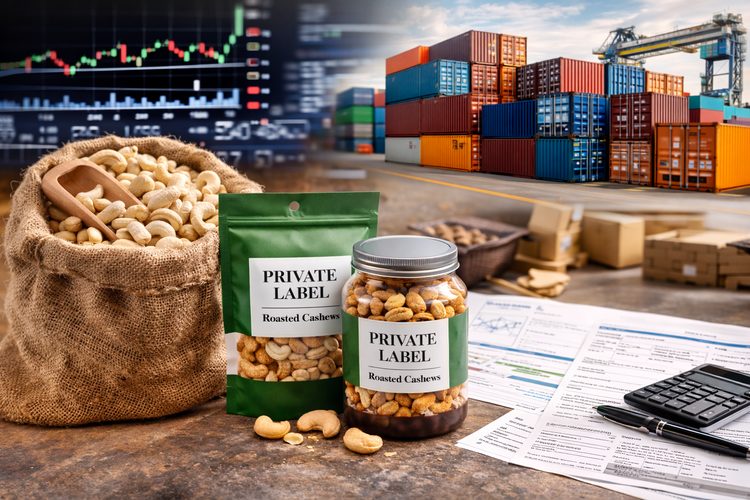
Price discussions in cashew trading can look simple from the outside, but most commercial misunderstandings begin when buyers compare numbers that are not built on equivalent assumptions. A quote for raw whole kernels is not directly comparable with a quote for roasted retail-ready cashews. A price for industrial bulk is not the same commercial proposition as a price for smaller foodservice packs or private label finished goods. In other words, nominal price is only one part of the buying equation. The stronger commercial result usually comes from aligning specification, process route, packaging, logistics and shipment timing before the order is placed.
For that reason, experienced buyers tend to ask a different question from inexperienced buyers. Instead of asking only “what is the current cashew price?”, they ask “what is the delivered cost for the exact format, route and timing we actually need?” That is the difference between a broad market conversation and a quotation that can support real planning.
Core buyer takeaway: Cashew pricing is driven by more than supply availability. Product form, grade, process value-add, packaging, timing, destination market, forecast visibility and risk allocation all influence the final commercial number.
Why cashew prices move more than many buyers expect
Cashew trading sits at the intersection of agriculture, processing, international logistics and downstream application requirements. That means pricing is shaped by both upstream and downstream variables. Upstream, the market may react to raw material availability, processing yields, grade mix, labor intensity, freight conditions and currency effects. Downstream, the price a buyer actually receives will depend on whether the request is for whole kernels, pieces, roasted formats, seasoning programs, retail packing or export-ready documentation.
This is why two buyers speaking about “cashews” may actually be talking about very different commercial products. One may need raw kernels for industrial transformation. Another may need roasted snack-ready product in consumer packs. Another may need diced inclusion material for bakery. Each of those formats carries a different processing path, pack cost, handling profile and margin structure.
How this topic shows up in real buying decisions
For cashews, the quote should reflect the real format and route. Whole or kernel material is different from diced cuts, meal, extra fine flour, butter or oil. The commercial logic also changes when the material is raw, pasteurized, dry roasted or oil roasted. The same underlying nut can therefore produce very different pricing outcomes depending on how far it moves through processing and packaging before delivery.
In practical buying discussions, the usable cashew menu often includes raw kernels, pasteurized kernels, dry roasted cashews, oil roasted cashews, salted snack lines, flavored roasted programs, diced cuts, granulated material, flour, butter and export-oriented finished packs. Which of those makes sense depends on the end use, whether the customer is manufacturing further, packing for retail, building a private label line or planning export distribution. The correct format is also usually the correct starting point for meaningful price comparison.
The biggest price drivers in cashew trading
1. Product form and level of processing
The first major price driver is the degree of processing already included in the offer. Raw kernels are one pricing category. Roasted kernels are another. Seasoned product, diced formats, nut butter, flour or private label finished goods each involve additional labor, handling, yield management, packaging or process steps. Buyers should expect those differences to show up in the quote.
Commercially, this means a cheaper raw quote is not automatically better if the buyer still has to roast, sort, pack, label and transport the material internally. In many cases, the more useful comparison is not raw price versus roasted price, but raw price plus internal conversion cost versus delivered ready-to-use cost.
2. Whole kernels versus pieces and smaller cuts
Kernel style influences price because yield and application value are not the same across formats. Whole kernels often command a different market position than pieces, splits or diced cuts because they are more visually valuable in snack and retail applications. By contrast, pieces and smaller cuts may be more economical for industrial manufacturing, bakery inclusions, cluster systems or nut butter production where appearance is less critical.
Buyers focused on price control often achieve better value by matching the cut size to the application rather than defaulting to whole kernels. A functional snack, bar or bakery system may not need premium whole-kernel visual presentation, and paying for that appearance may not improve the finished product.
3. Raw, pasteurized, dry roasted or oil roasted route
Process route affects flavor, shelf positioning, handling and cost. Raw or pasteurized formats may be priced differently from dry roasted or oil roasted material because the roasting step adds value and changes the product’s commercial readiness. Dry roasted and oil roasted products are also not identical from a pricing standpoint, because they can differ in process inputs, sensory outcome, labeling logic and intended use.
The key planning point is that buyers should request pricing against the actual route they intend to use. Asking for a raw quote when the finished program needs roasted snack-ready material can make the comparison look better on paper while hiding conversion cost in the background.
4. Packaging format
Packaging is one of the most underestimated price drivers in nut trading. Bulk cartons, lined industrial packs, foodservice packs, stand-up pouches, jars, cans and private label retail-ready formats each bring different material costs, packing speeds, case configurations and handling assumptions. Retail packaging can also add complexity through film selection, print runs, pack-size economics, coding requirements and display expectations.
For bulk industrial buyers, packaging may be mainly about product protection and warehouse efficiency. For retail and private label buyers, packaging becomes part of the product itself. That difference matters when evaluating quotations, because a retail-ready offer includes more than nut cost.
5. Destination market and documentation burden
A domestic shipment and an export shipment are rarely equivalent commercial tasks. Export programs may require additional labeling coordination, destination-specific document packages, tighter shipping windows, pallet and case planning, and in some cases different packaging assumptions. Those factors influence both direct cost and supplier workload.
That is why quotes should always be read in the context of destination. A number that looks attractive for domestic distribution may not remain attractive after export-specific requirements are layered in. Equally, a slightly higher quote may reflect real program support rather than unnecessary markup.
6. Volume and buying rhythm
Pricing is also shaped by scale and predictability. A trial order, a validation run, a launch program and a repeat replenishment schedule are different commercial situations. A supplier can usually plan more efficiently around recurring volume than around one-off spot requests. That planning advantage can influence quote structure, pack optimization, inventory positioning and production scheduling.
Buyers who share realistic monthly demand, seasonal peaks or container rhythm often receive more useful commercial feedback than buyers who ask for a generic spot price with no volume context. Forecast visibility is not only helpful for logistics; it can also influence total program economics.
7. Timing and market window
Timing matters in two ways. First, the timing of the inquiry affects whether the quote is being built against calm supply conditions or short-term urgency. Second, the timing of the needed shipment affects what planning tools are available. A supplier generally has more room to optimize around a scheduled future shipment than around an emergency buy needed immediately.
That is why buyers should separate “market check” pricing from “production booking” pricing. The first may be useful for budget direction. The second is what matters when a shipment window, pack format and actual production slot must be secured.
8. Quality expectations and tolerances
Not all cashew programs require the same visual quality, sensory consistency or breakage expectations. Retail snack lines may require more control over appearance and finish than industrial grinding programs. A customer-facing whole-kernel pack will usually carry different value assumptions from a diced inclusion spec that is going into a processed food system. The tighter the quality expectations, the more likely those requirements are to influence commercial terms.
9. Risk transfer and service level
Some buyers want only product supply. Others want sourcing support, pack coordination, export handling, schedule alignment and commercial continuity. The broader the service level, the more the quote may reflect program management rather than commodity movement alone. This is not necessarily a cost penalty. In many programs it reduces risk, planning friction and hidden operating cost for the buyer.
Why the lowest quote can be misleading
A low headline number can become expensive if the format is wrong, if the product arrives in packaging that does not match the line, if the roast route needs to be redone, or if the supplier did not build in realistic shipping or documentation assumptions. Buyers sometimes discover that the “better price” was only better because key commercial details were omitted from the request.
For example, a buyer comparing a bulk raw quote with a retail-ready roasted quote is not really comparing price; they are comparing different stages of value addition. Likewise, a buyer comparing domestic industrial bulk with export private label finished packs is not comparing equivalent landed programs. The number alone cannot answer the question unless the assumptions match.
Cost-in-use versus nominal price
From a trade perspective, cost-in-use is often the more reliable decision tool. Cost-in-use asks whether the delivered format supports the intended application with the least total commercial friction. A slightly higher-priced diced format may be more efficient than a lower-priced whole kernel if it improves depositing, reduces breakage and matches the customer’s formulation. A roasted pack may be better value than raw material if it eliminates an internal roasting step and shortens time to market.
This matters especially for bakery, snack, confectionery, plant-based dairy and foodservice programs, where the ingredient is part of a broader production system. A price that looks cheaper before conversion may become less attractive after labor, yield loss, repacking or process adaptation is considered.
How application affects pricing logic
Snack and retail programs
Retail buyers tend to care more about appearance, roast consistency, pack presentation, shelf-readiness and consumer-facing quality. Their pricing logic usually includes packaging, label execution, retail pack count, case format and shelf positioning. In these programs, a quote is rarely just about the nut.
Industrial manufacturing
Industrial buyers often care more about the functional fit of the format. Piece size, oil release, grind behavior, blendability and cost control may outweigh premium appearance. For them, price optimization often comes from choosing the correct industrial spec, not from chasing the lowest whole-kernel number.
Bakery and confectionery
Buyers in bakery and confectionery frequently balance visual impact, flavor development and line performance. A more economical cut or process route may outperform a premium format if the end use does not require consumer-visible whole kernels. The correct price comparison depends on whether the nut is structural, sensory or decorative in the finished product.
Plant-based dairy, spreads and butter
In these applications, the buyer may be more concerned with grind suitability, oil behavior and flavor profile than with consumer-facing kernel appearance. That shifts price logic toward processing fit and yield efficiency rather than retail-style grading priorities.
Commercial planning points
From a trading standpoint, the best programs are built around repeatability. That means clear documentation, agreed packaging, sensible shipment cadence and a commercial structure that supports continuity rather than one-off emergency buying. Price stability is rarely absolute in commodity-linked products, but buyers usually improve their planning position when they define the program early, share realistic demand rhythm and avoid leaving the entire purchase to last-minute spot exposure.
When relevant, the brief should also mention whether the program is industrial bulk, foodservice, retail-ready, private label or export-oriented. That single clarification often changes packaging, documentation and timing assumptions. It also changes what kind of quote is actually useful.
What Atlas would ask before quoting
Atlas encourages buyers to define intended use, pack style, destination, timeline and quality expectations early. Those inputs help reduce avoidable back-and-forth and improve comparability across California supply options. For a price-oriented inquiry, Atlas would usually want to know:
- Exact product form: whole kernels, pieces, diced cuts, flour, butter or another processed format
- Raw, pasteurized, dry roasted or oil roasted requirement
- Intended application: snack, bakery, confectionery, plant-based dairy, spreads or foodservice
- Packaging style: industrial bulk, foodservice, retail-ready, private label or export pack
- Destination market and shipping basis
- Estimated volume: trial, monthly volume or container program
- Needed-by timing and expected replenishment cadence
Typical use cases for cashews on this website include snacks, bakery, confectionery, plant-based dairy and spreads. The product brief should always match one of those concrete end uses, because application fit is part of the real price discussion.
How buyers can get more useful pricing from the market
The most useful RFQs are the ones that remove ambiguity. Instead of asking for “best price on cashews,” buyers generally get better commercial outcomes by stating the exact format, pack style, destination and expected demand pattern. That helps the supplier quote against a real commercial requirement rather than a theoretical market check.
A stronger inquiry might say: “Please quote dry roasted cashew pieces for snack mix production, packed in bulk industrial cartons, destination EU, initial validation run followed by monthly replenishment.” That brief gives enough structure for a meaningful conversation about price, lead time and supply planning.
A practical framework for evaluating cashew prices
When comparing offers, buyers should ask four basic questions. First, are the products truly equivalent in format and process route? Second, does the quote include the packaging and documentation burden the program actually needs? Third, does the shipment timing reflect real production planning or only a market snapshot? Fourth, does the quoted format reduce or increase downstream conversion cost?
If those four points are clear, the buyer is much closer to comparing real commercial options instead of disconnected numbers.
Buyer planning note
Atlas Global Trading Co. uses topics like this to move conversations from broad interest to a specification-minded inquiry. If you are evaluating cashew supply, share the format, pack style, estimated volume and destination using the floating contact form so the next step can be grounded in a real commercial need. Better pricing conversations usually begin with better commercial definitions.
For buyers planning a recurring program, the goal is not only to find an acceptable quote today. It is to build a purchasing structure that supports continuity, realistic budgeting, workable logistics and a finished product that performs as intended in its target market.
Ready to request a quote with the right details?
Use the contact form to convert a broad market check into a more practical cashew pricing discussion built around format, destination and supply rhythm.
- State the exact cashew format and process route
- Add target monthly, trial or container volume
- Include destination market and target timing
Frequently Asked Questions
What is the main buyer takeaway from “Price Drivers in Cashew Trading and Supply Planning”?
The main buyer takeaway is that cashew pricing should be evaluated in full commercial context. Product form, kernel grade, processing route, packaging, lead time, shipment structure and market timing all influence the real delivered cost.
Why is the lowest quoted cashew price not always the best buying outcome?
A low headline quote may not reflect the true commercial result if the format, roast route, packaging, documentation or delivery timing do not match the actual program. Cost-in-use is often more useful than nominal price alone.
Do whole kernels and pieces follow the same price logic?
No. Whole kernels usually carry a different commercial value than pieces, splits or diced cuts because appearance and end-use expectations are different. The correct choice depends on whether the application rewards consumer-visible premium presentation or industrial efficiency.
How do packaging and destination affect a cashew quote?
Packaging and destination can materially change the quote because they affect material cost, labor, case configuration, compliance requirements, documentation and logistics complexity. Domestic bulk and export retail-ready programs should not be evaluated as if they were the same task.
What should a buyer include in a quote request when asking about cashew pricing?
A strong pricing request should include the exact format, raw or roasted requirement, intended application, packaging style, destination market, expected volume, shipment cadence and target timing. Clearer briefs usually lead to more comparable quotes.