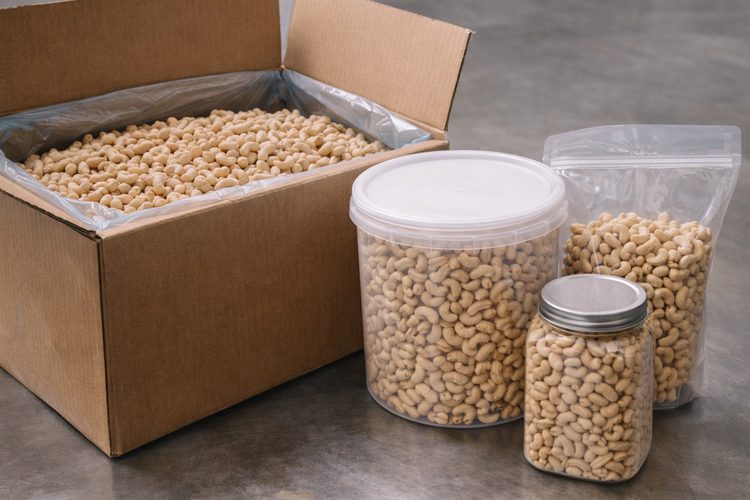
Bulk, foodservice and retail packaging for cashews matters because industrial nut buying is rarely only about nominal price or even only about the kernel specification itself. The stronger commercial outcome usually comes from aligning product form, packaging route, handling method, shelf-life target and shipment timing before the order is placed. In many real programs, packaging is not a secondary detail. It is one of the main factors that determines whether a cashew line performs well in manufacturing, distribution, foodservice operations or retail sale.
Buyers sometimes focus first on grade, roast style or price per kilogram and only later ask how the product should be packed. That sequence often creates inefficiency. A whole cashew program for retail shelf sale has very different packaging needs from diced cashews for bakery production, cashew butter for foodservice kitchens or industrial cashew flour for further blending. The product may be the same nut family, but the commercial logic changes once pack format, channel, labor handling, labeling, pallet configuration and destination are taken seriously.
Why packaging should be discussed early
Packaging influences more than product presentation. It affects line efficiency, warehouse use, freight cost, damage risk, shelf-life stability, pack waste, lot control, label execution and total delivered value. For bulk users, the wrong pack can create excess labor, spillage, inefficient pallet breakdown and avoidable product exposure. For foodservice buyers, a pack that is too large may hurt usability, while one that is too small may increase cost and operational inconvenience. For retail buyers, the pack has to do even more: protect the cashews, communicate the product, fit the shelf, support branding and survive distribution without looking compromised at point of sale.
That is why Atlas encourages buyers to discuss packaging at the same time as the product format itself. A quote for raw or roasted cashews is not fully meaningful until the pack route is also clear. Whole or kernel material is different from diced, meal, extra fine flour, butter or oil, but the commercial route also changes when the same material is packed for bulk processing, foodservice use, retail-ready sale, private label or export distribution.
Buyer shortcut: the useful inquiry is not simply “quote cashews.” It is closer to “quote roasted whole cashews in bulk industrial packaging,” “quote diced cashews in foodservice-ready packs,” or “quote retail-ready cashew packs for export.”
The three main packaging routes
Bulk packaging
Bulk packaging is typically used when the customer is manufacturing further, repacking later or operating at an industrial volume where handling efficiency matters more than consumer-facing presentation. In bulk programs, the pack must protect product quality while also supporting throughput. Buyers in this segment usually prioritize net yield, freight efficiency, pallet stability, lot control and practicality during receiving, storage and production use.
Bulk does not automatically mean one single pack style. Different products and users may prefer lined cartons, larger sacks, industrial bags or pails for processed forms such as butter or paste. The correct bulk route depends on product type, handling environment and how the product will be consumed on line. A flour user may think differently from a whole-kernel roaster, and both will think differently from a buyer sourcing cashew butter for further formulation.
Foodservice packaging
Foodservice packaging sits between industrial bulk and retail-ready sale. It is usually designed for kitchens, cafés, dessert operators, hospitality groups, caterers or chains that need practical service packs rather than industrial master units or consumer shelf packs. The right foodservice route should balance efficiency with convenience. Packs should be large enough to control cost but manageable enough for real back-of-house handling.
In this segment, buyers often care about open-and-use convenience, reclosure options, storage practicality, serving rhythm, product freshness after opening and consistency across locations. A foodservice operator may use whole roasted cashews as toppings, diced cashews in desserts or salads, or cashew butter in sauces and spreads. The packaging brief therefore needs to reflect the actual use case and turnover speed.
Retail packaging
Retail-ready packaging has the most visible commercial burden because it must protect the product and also function as a selling tool. For retail cashew lines, the pack needs to align with brand positioning, shelf dimensions, consumer expectations, declaration requirements and distribution conditions. This route is often more complex because it involves artwork, label compliance, barcode logic, master case planning, display considerations and sometimes private-label execution or export-language requirements.
Retail packaging decisions can also materially affect cost structure. The buyer is not only purchasing cashews; they are purchasing a market-ready item. That means the discussion should include pack size, film or pouch logic, branding route, sealing, labeling, carton packing, pallet pattern and the destination market. A good retail pack protects freshness, survives logistics and still looks commercially credible on shelf.
How this topic shows up in real buying decisions
For cashews, the quote should reflect the real format and route. Whole or kernel material is different from diced, meal, extra fine flour, butter or oil. The commercial logic also changes when the material is raw, pasteurized, dry roasted or oil roasted, because different formats may require different barrier needs, fill methods and handling assumptions.
For cashew buyers, the usable product menu usually includes raw cashews, pasteurized cashews, dry roasted cashews, oil roasted cashews, diced cashews, cashew meal, flour and butter. Which of those makes sense depends on the end use, whether the customer is manufacturing further, using the product directly in foodservice, packing for retail or planning export distribution. In each case, packaging must support the route rather than simply contain the product.
Bulk packaging logic in more detail
When bulk makes the most sense
Bulk packing usually makes sense when the customer is using the cashews as an ingredient rather than as a finished consumer product. Industrial bakery, confectionery, snack manufacturing, nut butter production and plant-based dairy formulation are all examples where bulk routes are common. In these environments, the strongest pack is one that protects product integrity while minimizing labor and waste.
What bulk buyers usually care about
- Net usable weight per pack and per pallet
- Ease of receiving and storage
- Bag or liner integrity
- Pallet efficiency and freight density
- Lot coding and traceability
- Compatibility with production handling
- Reduced damage or breakage during transport
For whole kernels, breakage can matter more. For diced or flour-style products, dust control and containment can become more important. For butter or paste, the discussion shifts toward pails, drums or other formats that support viscosity, scooping, pumping or controlled emptying.
Foodservice packaging logic in more detail
Where foodservice packs are used
Foodservice packs are common in restaurant groups, dessert chains, hotel kitchens, cafés, bakeries and catering operations. These users often need product that is ready to move quickly from storage to service or prep without the handling burden of large industrial packs or the unit-cost disadvantage of small retail packs.
What foodservice buyers usually care about
- Pack size matched to usage rhythm
- Practical storage after opening
- Ease of portioning and reduced mess
- Consistent pack appearance across locations
- Menu or kitchen versatility
- Reasonable shelf-life after opening within normal service flow
Foodservice is especially sensitive to mismatch between pack size and turnover speed. If the pack is too large, the kitchen may lose freshness or create labor inefficiency. If it is too small, cost and replenishment complexity rise. That is why buyers should describe service volume and application early.
Retail packaging logic in more detail
Why retail is more specification-driven
Retail packaging has to combine product protection with merchandising and compliance. That includes primary pack selection, label space, visual hierarchy, sealing method, unit count, consumer convenience and secondary carton logic. Retail-ready lines may also involve private label, promotional formats, club-style sizing or export retail programs with destination-specific label or pack requirements.
What retail buyers usually care about
- Consumer-facing pack size and format
- Shelf appeal and brand fit
- Freshness protection and seal performance
- Case pack and pallet pattern
- Label accuracy and claim space
- Barcode and retail execution needs
- Private-label or export document alignment
Retail buyers often need to decide whether the product is positioned as mainstream, premium, better-for-you, gifting, snackable, culinary or value-oriented. That positioning influences the chosen pack as much as the product itself. A premium roasted whole cashew line may require a very different retail pack strategy from a value-driven snack line or a mixed-use family pack.
Packaging must follow product format
Whole and large kernel formats
Whole cashews usually require packaging that protects appearance and limits unnecessary breakage. This matters for premium retail, gifting, toppings and visible inclusion programs. In bulk, the buyer may prioritize transport integrity and pallet stability. In retail, the buyer may care more about shelf presentation and perceived quality on first view.
Diced, pieces and granulated formats
Diced formats are often more forgiving visually than whole kernels, but they still require sensible pack planning. Industrial users may emphasize clean dispensing and lot control, while foodservice and retail buyers may focus on reseal practicality, ease of measuring and consistency across packs. Smaller particle sizes can also make containment and pack hygiene more relevant.
Meal and flour formats
Meal and flour require packaging that supports dry-flow control, cleanliness and storage stability. In industrial use, buyers often want practical packs that integrate easily into weighing or blending systems. Retail sale of these formats brings additional emphasis on education, labeling space and consumer handling.
Cashew butter and paste
Cashew butter packaging is a separate conversation because the product is viscous and handling-sensitive. Bulk users may want pails or drums that support controlled use in production. Foodservice may need manageable pails or tubs. Retail spreads require consumer-friendly jars or tubs with pack aesthetics, fill integrity and label positioning considered together.
What Atlas would ask before quoting
Atlas encourages buyers to define intended use, pack style, destination, timeline and quality expectations early. For packaging-related cashew projects, Atlas would usually ask for a more detailed quote request so the quote reflects the real route and not only a loose product description.
- What exact cashew format is required: whole, pieces, diced, meal, flour, butter or another processed form?
- Is the route bulk industrial, foodservice, retail-ready, private label or export-oriented?
- What pack size or pack range is being considered?
- Will the product be further processed, used directly in kitchens or sold to consumers as a finished item?
- What destination market and distribution route should the packaging support?
- Are there labeling, language, barcode or shelf-presentation requirements?
- What is the volume stage: trial quantity, validation run, launch volume or repeat replenishment?
- What lead-time and shipment cadence assumptions should be built into the program?
Typical use cases for cashews on this website include snacks, bakery, confectionery, plant-based dairy and spreads. The product brief should always match one of those concrete end uses, because packaging only becomes commercially meaningful when tied to the actual channel and handling route.
Commercial planning points
From a trading standpoint, the best programs are built around repeatability. That means clear documentation, agreed packaging, sensible shipment cadence and a commercial structure that supports continuity rather than one-off emergency buying. Packaging is central to that repeatability because it determines how the product travels, how it is stored, how it is used and how it is presented to the next customer in the chain.
Commercially, these projects often develop in stages: trial quantity, validation run, launch volume and repeat replenishment. Atlas uses that logic to guide pack and shipment planning, especially when retail packaging, export retail or private label is part of the conversation. A small pilot run may justify a different packaging approach from a mature recurring program. The more clearly the buyer states the stage, the more realistic the quotation and packaging discussion becomes.
When relevant, the brief should also mention whether the program is industrial bulk, foodservice, retail-ready, private label or export-oriented. That single clarification often changes packaging, documentation and timing assumptions. Industrial programs tend to emphasize operational efficiency. Foodservice programs tend to emphasize handling practicality. Retail programs tend to emphasize a combination of freshness, presentation and compliance. Export programs layer logistics and documentation complexity on top of all of those.
How packaging affects total delivered cost
Packaging decisions can change freight efficiency, labor costs, warehouse density, spoilage exposure, repack needs and customer acceptance. A bulk pack may reduce unit packaging cost but create inconvenience in smaller kitchens. A foodservice pack may solve usability but reduce freight density relative to a bulk industrial route. A retail-ready pack may support immediate market entry but bring added cost in materials, labeling and case configuration. None of those routes is universally better. The right choice depends on the commercial objective.
That is why buyers often get better results when they compare packaging routes through total delivered value rather than nominal pack cost alone. The right package is the one that suits the product, the channel and the operating reality of the customer.
Buyer planning note
Atlas Global Trading Co. uses topics like this to move conversations from broad interest to a specification-minded inquiry. If you are evaluating cashews supply, share the exact product format, intended pack style, estimated volume, destination and whether the route is bulk, foodservice, retail-ready, private label or export-oriented. That allows the next step to be grounded in a real commercial need and makes the quotation process far more practical than a product-only inquiry.
Need help selecting the right packaging route for cashews?
Use the contact form to turn this topic into a practical quote request with product format, pack style, channel and timing details.
- State the exact cashew format and pack type
- Add target monthly or trial volume
- Include destination market and target timing
Frequently Asked Questions
How should buyers choose between bulk, foodservice and retail packaging for cashews?
Buyers should choose packaging based on end use, handling method, channel, order rhythm, shelf-life expectations and whether the product will be further processed, used directly in kitchens or sold as a finished retail item. The right pack is the one that fits the actual operating route, not just the lowest visible pack cost.
Why does packaging affect commercial performance as much as product specification?
Packaging affects freight efficiency, warehouse handling, shelf-life performance, damage risk, labor requirements, pack cost, labeling and customer acceptance. In many cashew programs, the wrong packaging choice creates more commercial friction than the ingredient itself.
What should be included in a quote request for packaged cashews?
A strong quote request should include the exact cashew format, pack type, net weight, channel, destination market, trial or monthly volume, label requirements and the target ship or delivery window. Those details make offers easier to compare and more practical to execute.