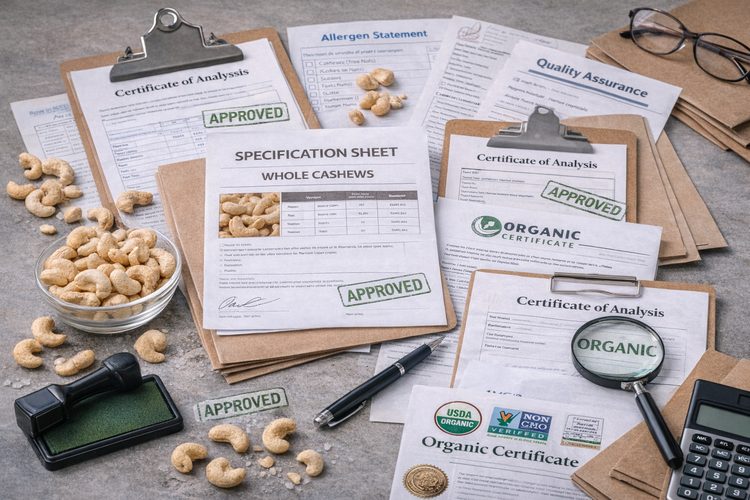
Label claims and quality documents matter in cashew programs because industrial nut buying is rarely only about nominal price or simple product availability. The stronger commercial outcome usually comes from aligning product form, intended application, packaging route, documentation requirements and shipment timing before the order is placed. In many real buyer programs, the decisive factor is not whether a supplier can ship cashews. It is whether the supplier can support the exact paperwork and claim structure the buyer needs to move the product through internal approval, customer review, label creation and market release.
That is why documentation should be discussed as early as grade, roast style or pack size. A whole roasted cashew program for retail export is not documented in the same way as diced cashews for industrial bakery use, cashew flour for plant-based formulations or cashew butter for foodservice. The product may sit in the same family, but the document burden changes when the route changes. Buyers who define claims and quality paperwork too late often create avoidable delays in QA onboarding, artwork development, customer approval and launch scheduling.
Why label claims and documents are commercial issues, not only QA issues
On paper, documentation looks administrative. In practice, it directly affects speed to market. A buyer may have a suitable product and a workable price, but still be unable to move forward if the required specification sheet, allergen statement, ingredient declaration, shelf-life confirmation or pack information is missing or unclear. The commercial route slows down because purchasing, QA, regulatory, sales and private-label teams are not all working from the same approved information.
Label claims create similar pressure. Claims are not simply marketing language. In buyer cashew programs, they can influence which raw material route is acceptable, what processing steps must be disclosed, what ingredient statement appears on pack, what documents must be supplied, and how the product can be positioned in a domestic or export market. A buyer who asks for a claim without defining the actual product, destination and packaging route may receive responses that are technically true but commercially unusable.
Buyer shortcut: do not ask only, “What claims are available?” Ask which claims are relevant to the exact cashew format, customer route, pack style and destination market you are actually planning to supply.
How this topic shows up in real buying decisions
For cashews, the quote should reflect the real format and route. Whole or kernel material is different from diced, meal, extra fine flour, butter or oil. The commercial logic also changes when the material is raw, pasteurized, dry roasted or oil roasted, because product identity, ingredient descriptions, treatment disclosures, handling statements and approval documents can all vary by route.
For cashew buyers, the usable product menu often includes raw cashews, pasteurized cashews, dry roasted cashews, oil roasted cashews, diced cashews, meal, flour, butter and oil. Which of those makes sense depends on the end use, whether the customer is manufacturing further, packing for retail or planning export distribution. Once label claims and quality documents are added to the discussion, the buyer also needs to think about how the product will be named, what support documents are needed, who will review them and whether the route is bulk industrial, foodservice, retail-ready, private label or export-oriented.
What buyers usually mean by “label claims” in cashew programs
In commercial practice, “label claims” can mean several different things at once. Sometimes the buyer is asking about ingredient declaration language. Sometimes they mean processing-related or composition-related positioning. Sometimes they mean customer-required wording that must be supported by specification and document files. And sometimes they are actually asking for confirmation that the supplied product route will fit the claims already planned by their brand or customer.
This is why claim discussions become more efficient when buyers clarify the real purpose of the question. Is the product going into an industrial formulation where the ingredient statement simply needs to be accurate? Is it going onto a retail pack where marketing and QA both need approved wording? Is it part of a private-label line where the customer already has a claim framework? Or is it an export program where packaging and claim expectations may differ by destination? The answer changes which documents matter most.
Core quality documents buyers often review
Product specification sheet
The product specification is usually the anchor document because it defines what the product is in commercial and technical terms. For cashews, that may include format, grade, roast style, cut description, appearance notes, pack style, shelf-life reference and other agreed product details. A strong specification reduces ambiguity and helps purchasing, QA and operations compare offers consistently.
Ingredient statement and product identity language
This becomes especially important when the cashew product is going into a finished label, a private-label program or a customer-facing formulation. The buyer needs clarity on how the ingredient should be declared and whether the language used in the commercial quotation matches the practical label route. Small wording differences can matter if they affect pack development or customer approval.
Allergen statement
In cashew programs, allergen documentation is frequently a basic requirement rather than an optional extra. Buyers may need clear information not only on cashew as a tree nut ingredient but also on broader site-handling context, depending on the route and customer expectations. For many programs, this is one of the first files reviewed during approval.
Certificate of analysis or lot-specific quality release information
Some buyers require lot-linked analytical or release data as part of inbound QA and supplier control. The exact level of detail depends on the program, but the commercial point is straightforward: if the customer requires this paperwork for receiving or release, the document is part of the practical value of the product.
Shelf-life and storage declaration
These documents or specification statements matter because usable shelf life affects inventory planning, packaging choice and commercial timing. Buyers need to know whether the product life fits the actual route, not only the nominal shelf-life claim on paper.
Pack and pallet information
Case count, net weight, pack type, palletization and handling details are often overlooked until late in the process, but they are important for purchasing, warehouse planning, logistics and export preparation. In retail-ready and foodservice routes, pack information can be as commercially important as the product grade itself.
Traceability and lot-identification support
Even when this is not presented as a separate certificate, buyers often want confidence that the product route is traceable from shipment back to the described goods. Clear lot control improves supplier approval and reduces friction in repeat business.
How claims and documents change by product route
Industrial bulk programs
Bulk industrial customers usually focus on practical specification accuracy, lot support, allergen information, pack details and quality documents needed for receiving and repeat procurement. The claims conversation is often more functional here. The buyer may not need consumer-facing packaging language, but they still need documentation that supports internal QA and downstream manufacturing approval.
Foodservice programs
Foodservice routes may require a balance between commercial simplicity and operational clarity. Buyers often want documents that support approval, pack handling, menu consistency and customer expectations without the full complexity of retail artwork files. Still, the moment a foodservice chain or multi-unit customer is involved, the claim and document requirements can become much more structured.
Retail-ready and private-label programs
This is where label claims become especially visible because the product is moving directly into a consumer-facing pack. Here the buyer typically needs stronger alignment between product specification, ingredient statement, allergen wording, packaging data and customer approval documents. If the program is private label, the document flow may also involve artwork review, claim confirmation and a tighter commercial approval calendar.
Export-oriented programs
Export routes add another layer because the documents need to support not only product identity and quality review but also destination-market expectations. Even when the product itself is the same, pack language, document format, supporting files and shipment paperwork can vary by market. Buyers should therefore define export intent at the start, not after specification approval.
Why claims should follow the real product route
A frequent commercial mistake is starting with the desired claim instead of the actual product route. This can lead to misalignment between what the finished label wants to say and what the supply program can reliably support. A better process begins with the physical product: whole, diced, flour, butter, oil; raw, pasteurized, roasted; bulk, foodservice, retail or export. Once that is clear, the buyer can determine which claim language is relevant and which quality documents are required to support it.
This sequencing is particularly important when multiple teams are involved. Purchasing may focus on price and lead time. QA may focus on documents. Marketing may focus on label language. Operations may focus on pack size and handling. The earlier the buyer connects those concerns into a single quote request, the easier the program is to execute.
Practical rule: the more consumer-facing the cashew route becomes, the more closely product specification, claim wording, packaging data and approval documents need to move together.
What Atlas would ask before quoting
Atlas encourages buyers to define intended use, pack style, destination, timeline and quality expectations early. For document-heavy cashew programs, Atlas would also encourage buyers to explain what the documents need to do commercially. That helps turn a broad paperwork request into a practical quote request.
- What exact cashew format is required: whole, pieces, diced, meal, flour, butter or oil?
- Is the route raw, pasteurized, dry roasted or oil roasted?
- What is the intended application: snacks, bakery, confectionery, plant-based dairy, spreads or foodservice?
- Is the program industrial bulk, foodservice, retail-ready, private label or export-oriented?
- Which documents are required for approval: specification, allergen statement, ingredient declaration, COA-style release information, shelf-life information, pack data or customer-specific files?
- Are there specific label claims already planned by the buyer or their customer?
- What destination market will receive the product?
- What is the commercial stage: trial quantity, validation run, launch volume or repeat replenishment?
Commercial planning points
From a trading standpoint, the best programs are built around repeatability. That means clear documentation, agreed packaging, sensible shipment cadence and a commercial structure that supports continuity rather than one-off emergency buying. Label-claim planning and document readiness fit directly into that model. If the documents are incomplete or the claim language is unresolved, even a good product can become commercially slow and difficult to scale.
Commercially, many projects move through the same stages: sample or trial, validation run, launch volume and repeat replenishment. Document expectations usually grow as the project matures. A small R&D trial may need only a limited document set. A private-label retail launch or export program may need far more structured paperwork before it can move forward. Buyers who define the program stage clearly usually avoid both over-requesting and under-preparing documentation.
When relevant, the brief should also mention whether the program is industrial bulk, foodservice, retail-ready, private label or export-oriented. That single clarification often changes packaging, documentation and timing assumptions. It also changes how much weight the customer will place on label claims versus technical specification versus commercial pack execution.
How buyers can make document requests more useful
One of the most effective ways to improve a cashew document conversation is to replace general requests with route-specific requests. Instead of saying “send all documents,” the buyer can say they need a product specification, allergen statement, ingredient declaration, pack details and lot-linked release support for a retail-ready roasted cashew program destined for a specific market. That makes it easier to evaluate whether the route is commercially viable.
The same applies to claims. Instead of asking generally what claims are possible, the buyer can explain the exact finished route and ask whether the proposed supply program supports the label direction they have in mind. That creates a far more practical conversation between sourcing, QA and commercial teams.
Buyer planning note
Atlas Global Trading Co. uses topics like this to move conversations from broad interest to a specification-minded inquiry. If you are evaluating cashews supply, share the exact format, intended application, pack style, estimated volume, destination and any claim or document requirements using the floating contact form so the next step can be grounded in a real commercial need. In many successful cashew programs, the product is only half of the approval. The rest comes from documentation that fits the real route to market.
Need help structuring label claims and document requirements for a cashew program?
Use the contact form to turn this research topic into a practical quote request with product format, channel, destination and approval requirements.
- State the exact cashew format and end use
- Add target monthly or trial volume
- Include destination market and document needs
Frequently Asked Questions
What should buyers clarify before asking for label claims on a cashew product?
Buyers should first define the exact cashew format, intended end use, destination market, packaging route and customer requirement. Label claims only become commercially useful when they are tied to a real product specification and a real sales channel.
Why do quality documents matter as much as product price in cashew programs?
Quality documents matter because they support supplier approval, internal QA review, customer onboarding, export documentation, label development and repeat purchasing. In many buyer programs, incomplete paperwork causes more delay than product availability.
Which documents are commonly discussed in cashew sourcing conversations?
Common documents can include product specifications, allergen statements, ingredient statements, certificates of analysis, pack details, lot traceability information, shelf-life declarations and market-specific commercial or quality paperwork depending on the route.