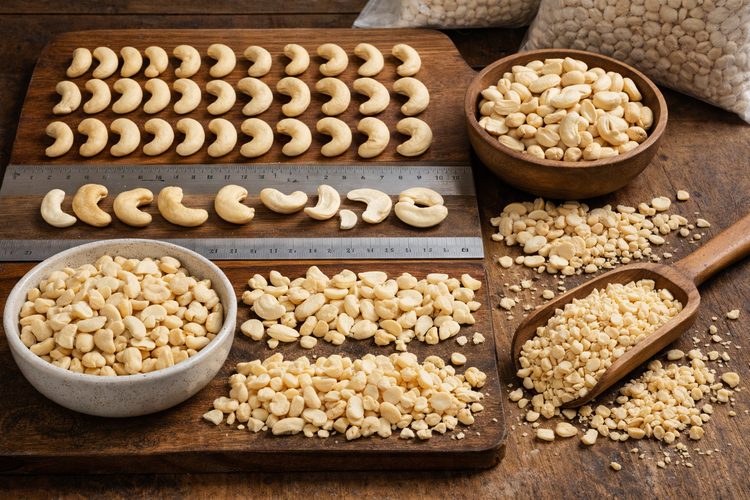
Cashew grades, whole counts and piece selection matter because industrial nut buying is rarely only about nominal price. The stronger commercial outcome usually comes from aligning grade, appearance target, process route, packaging and shipment timing before the order is placed. In practical sourcing, the buyer is not purchasing a generic nut. The buyer is purchasing a format with a defined visual, sensory and operational role inside a finished product or sales channel.
That is why experienced buyers do not treat whole grades and piece grades as simple substitutes. Whole kernels, halves, large pieces, small pieces and finer cuts each carry different value depending on the application. A premium retail snack line may need large, visually impressive whole kernels. A cereal or granola system may benefit more from controlled pieces. A bakery or confectionery route may prefer cuts that balance distribution, bite and cost-in-use. The right grade is the one that performs correctly in the real commercial use case.
Why grade selection affects more than appearance
Grade choice obviously affects how the cashew looks, but it also influences how the product handles on line, how it distributes in the finished application, how much breakage is tolerated in transit, how much premium value the consumer sees and how efficiently the buyer uses ingredient budget. This is why grade choice is both a technical and a commercial decision.
For example, a larger whole grade may justify a premium retail or foodservice position because consumers recognize the kernel immediately and perceive it as more valuable. The same grade may be economically inefficient for a granola line where the kernel is broken during mixing or hidden inside clusters. In that case, the right commercial answer may be halves or pieces rather than visually premium wholes. Sourcing improves when the buyer defines the functional role before asking for the grade.
Buyer shortcut: do not ask only for “best grade” cashews. Ask for the grade or piece style that best fits the intended application, visual target, bite profile and delivered-cost logic.
How this topic shows up in real buying decisions
For cashews, the quote should reflect the real format and route. Whole or kernel material is different from diced, meal, extra fine flour, butter or oil. The commercial logic also changes when the material is raw, pasteurized, dry roasted or oil roasted. A whole grade intended for snack retail does not belong in the same cost conversation as a piece grade for bakery inclusion or a cut used in cereal blends.
For cashew buyers, the usable product menu often includes whole kernels, counts-based whole grades, halves, large pieces, small pieces, diced cuts, meal, flour, butter and oil. Which of those makes sense depends on the end use, whether the customer is manufacturing further, packing for retail or planning export distribution. Once the buyer defines that route clearly, grade selection becomes easier and quote comparisons become more meaningful.
What whole counts mean in a practical buying context
Whole counts are typically used as a practical shorthand for size and appearance expectations in whole-kernel cashew trade. In simple commercial terms, a lower count generally points toward larger kernels and a higher count points toward smaller kernels. The reason buyers care is not only the number itself. It is what that count signals about visual presence, premium positioning, handling value and cost structure.
For premium snack, gifting, hospitality, foodservice garnish or visible topping programs, count logic often matters because the kernel has to be seen and recognized. In those routes, size consistency supports both brand presentation and consumer perception. In more process-heavy applications, the count may matter less than the practical piece or cut format selected for distribution and yield control.
Where whole grades are usually most relevant
Retail snack and premium consumer packs
Whole grades are most visible in retail snack lines where pack appearance, consumer recognition and perceived value are central. Larger and cleaner whole grades may help support a more premium shelf position, while smaller whole grades may fit a more value-led route. The right decision depends on target market, pack size, channel and margin structure.
Foodservice and hospitality
Foodservice buyers often value whole kernels for visual topping, buffet presentation, dessert garnish or premium menu use. Here the grade matters because the customer experience is strongly visual. A whole grade with better appearance may justify its place if the ingredient is functioning as a visible finishing element rather than a hidden inclusion.
Visible inclusion applications
Some bakery, confectionery or cereal applications require visible whole or half kernels to create a premium cue. In those cases, count logic and grade cleanliness remain relevant because appearance drives part of the commercial value of the finished product.
Where halves and pieces often make more sense
Granola, cereal and cluster systems
Granola and cereal applications often benefit from halves or pieces because these formats distribute more evenly, reduce cost-in-use and can still provide visible nut content. Large whole kernels can be unnecessarily expensive or operationally awkward if they break during processing or create uneven fill appearance. In these programs, the correct cut often delivers better commercial performance than the highest whole grade.
Bakery and confectionery
In cookies, bars, brownies, cakes, clusters, coatings and confectionery interiors, buyers often choose halves or pieces to control bite, visual repetition and line performance. The important question is not whether the product contains premium whole kernels, but whether the selected piece size creates the right eating experience and processing result.
Industrial ingredient use
For buyers manufacturing further, pieces may often be the stronger option because they reduce unnecessary appearance cost while still delivering nut flavor, texture and inclusion value. Where the ingredient is not being sold on whole-kernel appearance, the best commercial decision is often the piece route that matches the finished application.
How buyers should think about piece selection
Large pieces
Large pieces can preserve some of the premium visual value of whole grades while improving distribution and cost control. They are often useful in premium bakery, granola, cereal and snack applications where the buyer wants recognizable nut presence without paying for full whole kernels.
Medium pieces
Medium pieces are often the practical middle ground for many industrial buyers. They can provide visible inclusion, more even spread and better process adaptability across a wide range of products. Commercially, this is where many programs find the best balance between premium cue and operational value.
Small pieces and economical cuts
Smaller cuts are often used where the nut is serving a supporting rather than starring role. These grades may make sense in high-volume bakery, cereal, seasoning carriers or more cost-sensitive blended applications. The buyer should still define acceptable fines level, size spread and use conditions so the lower-cost route remains fit for purpose.
Diced and precision-style cuts
Where the application requires more controlled geometry, buyers may move beyond general “pieces” and specify diced styles or tighter cut expectations. This can be relevant in granola, toppings, inclusions or any route where uniform distribution and fill appearance matter more than broad whole-versus-piece categorization.
Raw, pasteurized and roasted routes still matter
Grade selection should not be separated from process route. Whole grades and pieces behave differently when the buyer is evaluating raw, pasteurized, dry roasted or oil roasted material. A whole grade chosen for premium roasted snack use is a different commercial decision from a whole grade purchased raw for further processing. Likewise, a piece grade intended for bakery inclusion may need different review points if it is roasted before arrival rather than after the buyer’s own process.
This is why the grade conversation should always be tied to the real end use. A piece is not just a piece, and a whole is not just a whole. The route, treatment and channel all change what “good” means commercially.
What Atlas would ask before quoting
Atlas encourages buyers to define intended use, pack style, destination, timeline and quality expectations early. For grades and sizing discussions, Atlas would also encourage buyers to explain what role the cashew plays in the finished product so the grade can be selected against performance rather than only against nominal size language.
- What exact application is involved: snack retail, foodservice, granola, cereal, bakery, confectionery, plant-based dairy, spreads or another use?
- Does the application need whole kernels, halves, large pieces, medium pieces, smaller cuts or a more controlled diced format?
- Is premium visual value more important than even distribution and cost-in-use?
- Should the product be raw, pasteurized, dry roasted or oil roasted?
- Will the cashews be visible to the consumer, blended into a system or processed further?
- Is the program industrial bulk, foodservice, retail-ready, private label or export-oriented?
- What is the commercial stage: trial quantity, validation run, launch volume or repeat replenishment?
- What destination market and target ship window should be built into the quote?
Typical use cases for cashews on this website include snacks, bakery, confectionery, plant-based dairy and spreads. Grade selection only becomes commercially useful when it is tied to one of those concrete applications and to the real route to market.
Commercial planning points
From a trading standpoint, the best programs are built around repeatability. That means clear documentation, agreed packaging, sensible shipment cadence and a commercial structure that supports continuity rather than one-off emergency buying. Grade and sizing decisions fit directly into that repeatability because they affect lot-to-lot visual consistency, cost planning, incoming QC and finished-product behavior.
Commercially, these projects often develop in stages: trial quantity, validation run, launch volume and repeat replenishment. Atlas uses that logic to guide pack and shipment planning. In early-stage work, buyers may evaluate multiple grades or cut options to learn the best fit. In repeat programs, the objective usually shifts toward maintaining the chosen route with stable quality and predictable cost-in-use.
When relevant, the brief should also mention whether the program is industrial bulk, foodservice, retail-ready, private label or export-oriented. That single clarification often changes packaging, documentation and timing assumptions. It may also change whether a whole-count-based premium route or a piece-based efficiency route is commercially strongest.
Why the “best” grade is often not the highest grade
Many buyers initially assume the highest whole grade is the best answer. In real commercial programs, that is often incorrect. The best grade is the one that fits the application without paying for performance the customer does not actually need. If the finished product hides the kernel, breaks it, chops it further or treats it mainly as a texture and flavor component, a premium whole route may add cost without adding usable value.
This is why Atlas generally encourages buyers to think in terms of delivered function rather than grade prestige. A correctly selected piece grade can outperform a higher whole grade in the buyer’s actual economics if it gives better distribution, lower waste, easier handling and more realistic cost-in-use.
Buyer planning note
Atlas Global Trading Co. uses topics like this to move conversations from broad interest to a specification-minded inquiry. If you are evaluating cashews supply, share the target application, required grade or piece style, roast route, pack style, estimated volume and destination using the floating contact form so the next step can be grounded in a real commercial need. The practical objective is not simply to buy bigger or smaller cashews. It is to source the grade that best matches the visual, technical and economic role of the ingredient in your finished product.
Need help selecting the right cashew grade or piece style?
Use the contact form to turn this research topic into a practical quote request with application, grade target, pack style and commercial timing.
- State the exact cashew format and end use
- Add target monthly or trial volume
- Include destination market and target timing
Frequently Asked Questions
How should buyers choose between whole grades and pieces in cashew sourcing?
Buyers should choose based on the job the ingredient needs to do. Whole grades usually matter most where appearance and premium visual value are important, while pieces often make more commercial sense where even distribution, controlled bite, process efficiency and cost-in-use matter more.
What do whole counts tell buyers in a practical commercial sense?
Whole counts help indicate size and appearance expectations for whole-kernel programs. They are useful when the buyer needs consistency for premium snack, retail, foodservice or visible inclusion applications where large, recognizable kernels carry commercial value.
What should be included in a quote request for cashew grades or pieces?
A useful quote request should include the intended application, required grade or piece style, roast route, packaging format, destination market, trial or monthly volume and the target ship or delivery window. These details make quotations much easier to compare.