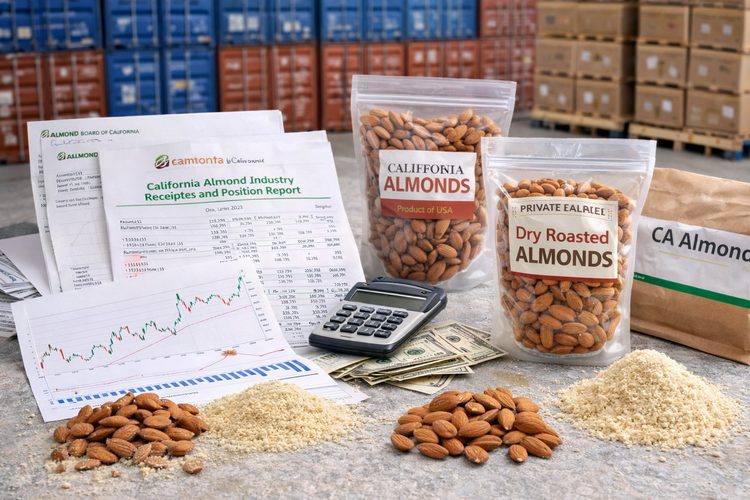
Almond pricing is often discussed as if there is one single market number that automatically defines what a buyer should pay. In real trading, that is rarely how good sourcing decisions are made. The stronger commercial outcome usually comes from understanding which variables are actually moving the quote: format, grade, processing route, packaging method, shipment timing, destination, documentation burden and the buyer's own volume profile. In other words, almond buying is rarely only about nominal price. It is about what the buyer is truly asking the supply chain to deliver.
This is why two almond offers can look far apart even before freight and payment terms are considered. A quote for raw whole kernels intended for industrial use is not equivalent to a quote for dry roasted diced material in export-ready consumer packs. Likewise, a spot inquiry for a short lead-time shipment behaves differently from a structured monthly program. Buyers who understand the underlying price drivers usually compare offers more accurately and avoid the false economy of choosing a lower nominal number that does not actually match the final commercial requirement.
Why almond prices are rarely just about the crop number
In commodity-oriented conversations, it is tempting to reduce pricing to a harvest view or a market headline. Those factors matter, but they do not tell the full story of the delivered cost. Almond trading is shaped by what happens between orchard output and the buyer's finished use. Shelling, sorting, grading, sizing, roasting, cutting, pasteurization, packing, palletizing, storage, documentation and export handling can all shift the final commercial value of the same basic nut raw material.
That is why procurement teams often get stronger results when they stop asking only “Where is the market?” and start asking “Which commercial variables are controlling our true cost?” For many buyers, the biggest savings do not come from chasing the lowest headline number. They come from aligning the specification with the actual application so the quote reflects the right product, the right pack and the right timing from the beginning.
Buyer takeaway: the most useful almond quote is not always the lowest initial figure. It is the quote that correctly matches format, quality, processing, packaging and delivery expectations, so the total landed and usable cost is understood upfront.
How this topic shows up in real buying decisions
For almonds, the quote should reflect the real commercial route. Whole or kernel material is different from diced, sliced, meal, flour, butter or oil. Raw supply behaves differently from pasteurized, dry roasted or oil roasted material. The same product family can also move into industrial bulk, foodservice, retail-ready, private label or export-oriented programs, each with a different cost structure. This is why buyers comparing offers need to look beyond the product name and ask what exactly is being priced.
For almonds buyers, the usable product menu usually includes raw almonds, pasteurized almonds, dry roasted almonds, oil roasted almonds and processed derivatives such as diced cuts, meal, flour, butter and oil. Which of those makes sense depends on the end use, whether the customer is manufacturing further, packing for retail or planning export distribution. Each route introduces a different mix of yield, handling, quality-control and logistics considerations that affect final price.
Driver 1: product form and degree of processing
One of the most immediate price drivers is the product form itself. Whole kernels are not costed the same way as sliced almonds, diced cuts, meal, flour or almond butter. Each additional processing step usually adds operational complexity, yield implications, labor, handling or equipment requirements. That means a buyer asking for a more processed almond format is not only buying almonds. They are buying conversion from one state into another.
A whole-kernel industrial program may be relatively straightforward compared with a specification for extra-fine almond flour, uniform diced cuts for cereal inclusion, or roasted almond butter intended for smooth processing. Each of those formats can carry different tolerance expectations for particle size, appearance, oil expression, roast uniformity or pack behavior. When the requested form becomes more specialized, quote variation between suppliers can widen because the conversion assumptions are no longer identical.
Driver 2: quality grade, sizing and visual specification
Quality expectations materially affect almond pricing. A buyer asking for general industrial input may accept a different tolerance range than a buyer sourcing for premium retail packs, visible inclusions or export shelves. Visual appearance, size consistency, broken-piece tolerance, kernel integrity and surface quality all influence how the lot is valued and how easily it fits the intended application.
In practical terms, size and appearance become more important as the almond gets closer to the consumer. A bakery or ingredient manufacturer may focus on functional performance and yield. A retail-ready pack or private label snack line may care much more about uniformity, premium appearance and fill impression. Even before processing is added, those different expectations can separate two prices that might otherwise look comparable at first glance.
Driver 3: raw, pasteurized, dry roasted or oil roasted status
Processing status is another major driver. Raw material has a different commercial structure than pasteurized almonds, and both differ from roasted products. Dry roasted and oil roasted almonds are not only different in flavor and application. They also reflect different process routes, yield considerations, operational handling and packaging implications.
For some buyers, pasteurization status is a baseline requirement. For others, roast style is what changes the quote most because the finished product must meet a specific sensory profile and retail position. A buyer sourcing roasted almonds for snack packs, foodservice or further inclusion is usually paying for both flavor development and repeatability. That is not directly comparable to a raw industrial ingredient quote, even when both products originate from California almonds.
Comparison rule: a price comparison becomes meaningful only when raw versus pasteurized versus roasted status is aligned. Otherwise the buyer may be comparing different process routes rather than different commercial efficiency.
Driver 4: application-specific tolerance
The end use changes what matters commercially. Almonds destined for bakery, confectionery, snack mixes, granola and cereal, plant-based dairy or sauce systems are not necessarily priced under the same logic. The tighter the application requirement, the more likely it is that specification details will influence cost. Texture goals, blendability, oil release, visual identity, coating performance and label strategy can all shift what the supplier needs to deliver.
For example, a cereal inclusion program may place more emphasis on cut consistency and roast behavior. A plant-based dairy application may focus on grind, flavor cleanliness and process fit. A snack mix may prioritize appearance and bite, while a protein bar application may care more about particle size, fracture behavior and line performance. The more clearly those application needs are defined, the more accurately price can be interpreted.
Driver 5: packaging format and pack architecture
Packaging is one of the most underestimated price drivers in almond sourcing. Bulk ingredient bags, lined cartons, pails, drums, foodservice packs, stand-up pouches, retail-ready snack packs and private label cartons all create different commercial conditions. The same almonds in two different pack structures can produce materially different delivered costs because packaging materials, fill operations, pack-out labor, pallet density and retail-readiness are not the same.
This is especially important for buyers moving between industrial and consumer-facing programs. A bulk almond quote for further manufacturing cannot be directly compared with a retail-ready program that includes finished pack architecture, shelf-ready logic or export presentation. In those cases, the “almond price” is only one component inside a broader packaging and launch cost structure.
Driver 6: volume rhythm and commercial stage
Not all demand is equal in trading. A small trial order, a validation run, a first launch quantity and a repeat monthly program each carry different commercial assumptions. Suppliers price differently when they are looking at irregular spot demand versus a more structured volume rhythm. Repeatable demand generally gives more room for planning around production slots, packaging allocation, logistics coordination and inventory management.
That is why Atlas often encourages buyers to describe the program stage, not just the target product. A request for “price on almonds” becomes far more actionable when the buyer says whether the need is a pilot quantity, a seasonal replenishment line, a retail launch or a long-term industrial program. Volume continuity itself is often a price driver because it changes planning efficiency and commercial predictability.
Driver 7: shipment timing and urgency
Timing matters more than many buyers expect. A product may be available, yet the commercial terms can still shift depending on how quickly the buyer needs shipment, whether the order must fit an immediate production slot and whether the requested window aligns with ordinary planning or forces the supply chain into a more urgent response. Urgency frequently carries an invisible cost because it narrows operational flexibility.
Buyers who can define realistic shipment windows and communicate their forecast earlier are often in a better position than buyers making late-stage emergency inquiries. Even when the underlying product is the same, lead time can change how efficiently the program is packed, documented and moved. In practice, better timing discipline often produces better price comparability.
Driver 8: destination market and logistics route
The destination changes the cost structure. Domestic shipments may be more straightforward than export programs that require longer transit, more documentation, different labeling assumptions, specific palletization logic or extra packaging resilience. Even when the almonds themselves are identical, the route to market can shift the final number materially.
This is why export-oriented buyers should define the destination as early as possible. The relevant cost may include not only product and ordinary packing, but also export documentation, load planning, shipping coordination and in some cases destination-driven packaging adjustments. A quote intended for U.S. industrial delivery should not be compared casually with one intended for containerized export retail supply.
Export planning point: the farther the program moves from local bulk delivery toward export-ready retail or distributor supply, the more packaging, documentation and freight logic begin to influence the true delivered price.
Driver 9: documentation and quality-assurance burden
Quality expectations do not only affect the physical product. They also affect the administrative and verification side of the program. Different buyers may require different forms of documentation, quality review, specification control, pack coding discipline or program traceability. The more structured the documentation expectation, the more it can influence commercial handling and therefore price.
This does not mean better documentation is inherently expensive in a negative sense. It means that buyers should recognize it as part of the commercial requirement. A tightly specified industrial or export program may justify more documentation effort than a simpler domestic spot transaction. The important point is to include those needs in the brief so the quote reflects the real sourcing requirement.
Driver 10: forecast reliability and continuity risk
In almond trading, uncertainty itself can become a cost driver. When suppliers are asked to support a program without clear demand rhythm, with open-ended pack assumptions or with shifting shipment windows, the commercial conversation becomes less efficient. Forecast reliability reduces surprises, and reduced surprises usually improve planning. That does not guarantee the absolute lowest number, but it often improves the usefulness and durability of the quote.
For repeat buyers, one of the best ways to improve commercial outcomes is to communicate how stable the program really is. Is the demand monthly, seasonal, promotional, trial-based or opportunistic? Is the buyer likely to replenish on a rolling basis or only when spot opportunities appear? These answers influence how the supply side thinks about pricing, packaging and inventory exposure.
Why “lowest quote” can be misleading
One of the most common mistakes in almond sourcing is treating a low initial figure as proof of better value without first checking the underlying assumptions. The lower quote may reflect a looser quality tolerance, a different pack style, a different roast route, less documentation, a different shipment window or a product form that is simply not as suitable for the intended application. This is especially common when several suppliers respond to a broad inquiry using different interpretations of what the buyer meant.
The practical lesson is simple: price only becomes comparable after the specification becomes comparable. A buyer usually gets better commercial clarity by tightening the brief before trying to negotiate the final number.
What Atlas would ask before quoting
Atlas encourages buyers to define the practical quote request early, because those inputs directly influence price comparability across California supply options. For example, the most useful starting points usually include:
- Exact product format: whole, raw, pasteurized, dry roasted, oil roasted, diced, meal, flour, butter or another defined form
- Intended application and whether the almonds are for further manufacturing, retail packing, foodservice or export
- Quality expectations such as appearance, cut consistency, visual grade or process performance
- Pack style and pack size, including industrial bulk, retail-ready, private label or export-oriented configuration
- Destination market and shipment route
- Expected timing, including whether the request is urgent, planned, seasonal or ongoing
- Commercial stage such as trial quantity, validation run, launch volume or repeat replenishment
- Estimated volume rhythm, including monthly demand, container program or campaign-based buying
How buyers can improve quote comparability
One of the easiest ways to improve almond sourcing decisions is to stop requesting generic pricing and start requesting matched pricing. That means sending the same commercial brief to each supplier, using the same assumptions for product form, quality tolerance, pack style, destination and timing. When those variables are aligned, price comparison becomes far more useful and negotiation becomes more grounded.
It is also helpful to distinguish between the cost of product conversion and the cost of commercial convenience. Buyers sometimes discover that a lower-cost raw form plus internal processing is preferable in one program, while a more processed ready-to-use form is commercially smarter in another. The decision depends on the buyer's own line capability, labor, packaging setup and tolerance for operational complexity.
Commercial planning points
From a trading standpoint, the best programs are built around repeatability. That means clear documentation, agreed packaging, sensible shipment cadence and a commercial structure that supports continuity rather than one-off emergency buying. Price tends to make more sense when the underlying program is stable enough to quote against. Even if the buyer begins with a trial, it helps to explain what the likely next stage will be.
When relevant, the brief should also mention whether the program is industrial bulk, foodservice, retail-ready, private label or export-oriented. That single clarification often changes packaging, documentation and timing assumptions. In many cases, it also changes what the “best price” really means because the useful measure is not just nominal cost, but fit-for-purpose delivered value.
Buyer planning note: the most productive almond price discussion starts with the real buying need. If you share the format, application, pack style, volume rhythm and destination, the next quote can be built around a practical commercial requirement rather than a broad market abstraction.
Procurement summary
Main price drivers in almond trading and sourcing are rarely isolated to one market headline. Product form, processing status, quality expectations, pack architecture, shipment timing, destination and program continuity all influence the final number. Buyers who understand these variables usually make better comparisons, reduce re-quoting and avoid mismatches between what was priced and what is actually needed.
Atlas Global Trading Co. uses topics like this to move conversations from broad price interest to a specification-minded inquiry. If you are evaluating California almond supply, the most useful next step is to define the real commercial brief: exact format, intended use, packaging, timing, destination and volume pattern. That is what turns a generic price question into a sourcing discussion that can actually support the business.
Ready to request an almond quote with the right details?
Use the contact form to share the format, packaging, shipment timing and destination so Atlas can ground the discussion in the real drivers behind your sourcing cost.
- State the exact almond format and processing route
- Add pack style, destination and timing assumptions
- Include trial, monthly or container-level volume expectations
Frequently Asked Questions
What is the main buyer takeaway from “Main Price Drivers in Almond Trading and Sourcing”?
The main buyer takeaway is that almond pricing is shaped by more than a headline market number. Product form, quality tolerance, pack style, shipment timing, contract structure and destination all influence the real delivered cost.
Why can two almond quotes look very different even when both say “California almonds”?
Two quotes can differ because they may refer to different grades, cuts, roast styles, packaging formats, quality specifications, shipment windows or commercial assumptions. A price comparison only becomes meaningful when the underlying specification is aligned.
What should buyers define before requesting a commercial quote?
Buyers should define format, intended application, processing route, pack style, destination market, target shipment timing, expected volume rhythm and any critical quality or documentation requirements.
Can this topic be applied to both U.S. and export programs?
Yes. The same pricing logic is relevant to domestic and export sourcing, although freight, labeling, documentation and packaging assumptions often have a larger effect in export programs.