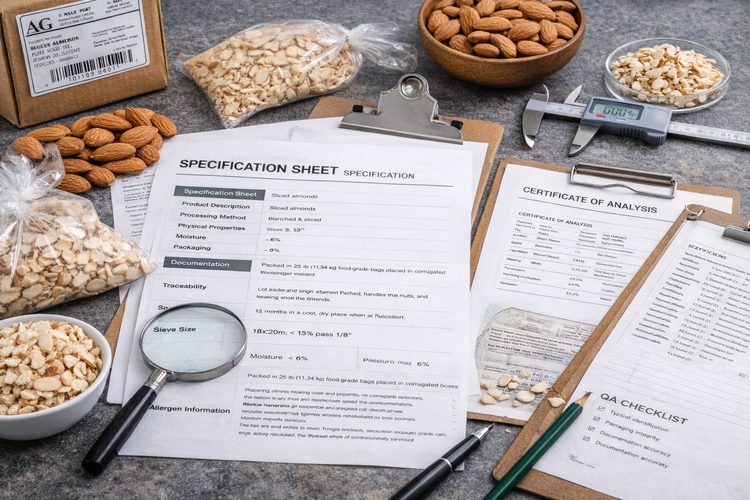
Specification sheets, label claims and QA points for almond buyers matter because industrial nut buying is rarely only about nominal price. The stronger commercial outcome usually comes from aligning product identity, process route, pack format, quality documentation and shipment timing before the order is placed.
In practical buyer almonds sourcing, the quotation stage becomes far more efficient when both buyer and supplier are working from the same commercial description of the product. A whole kernel offer is not equivalent to a diced, sliced, blanched, roasted, meal, flour or butter offer. The same is true for packaging, shelf-life assumptions, document support and any claim-sensitive sourcing expectations. If those details are unclear, the buyer may receive multiple quotations that look similar on paper but are not actually comparable.
This topic is especially important for industrial manufacturers, foodservice buyers, private label programs, retail-ready products and export shipments, because document discipline often drives not only QA approval but also commercial speed, customer onboarding and pack accuracy.
Main buyer takeaway: almond sourcing works better when the product specification, intended application, pack format, documentation requirements and commercial timing are defined together before quotation.
How this topic shows up in real buying decisions
For almonds, the quote should reflect the real format and route. Whole or kernel material is different from diced, meal, extra fine flour, butter or oil. The commercial logic also changes when the material is raw, pasteurized, blanched, dry roasted or oil roasted. Once the product is being evaluated for customer-facing use, export shipment or private label, the discussion expands again: what does the specification say, what can be supported in documentation, what appears on the pack and how is the product approved internally.
That means the buyer is often making several linked decisions at once:
- What exact almond product is being bought?
- What quality or process condition is commercially required?
- What information will appear on the finished label or artwork?
- What QA documents support the product and packaging decision?
- What commercial assumptions should the quote reflect?
When those questions are answered early, a supplier can quote more accurately and the buyer can compare offers with more confidence.
Why specification sheets are central to almond procurement
A specification sheet is more than a technical formality. In commercial practice, it is the document that helps define what the supplier is quoting, what the buyer expects to receive and how the product will be reviewed internally. It often becomes the reference point for procurement, QA, operations, packaging and customer approval teams.
What a useful almond specification sheet usually clarifies
- Product identity — whole, sliced, slivered, diced, chopped, meal, flour, butter, paste or other processed form
- Process condition — natural, pasteurized, blanched, roasted or otherwise converted
- Physical description — cut style, visual appearance, particle type or product form
- Application fit — whether the item is intended as an inclusion, topping, formulation ingredient, snack component or finished packed product
- Packaging description — industrial bulk, foodservice, retail-ready, private label or export-oriented pack logic
- Shelf-life or storage basis — how the commercial product is expected to be handled and reviewed
- Lot and traceability logic — how product identity is tracked operationally
- Document linkage — whether certificates, COAs or supporting declarations are part of the commercial file
For buyers, the practical benefit is simple: the better the specification sheet, the fewer assumptions need to be filled in later by the supplier, the QA department or the customer’s packaging team.
Commercial rule: specification sheets should describe the real saleable item, not just the broad ingredient family. “Almonds” is rarely a complete specification. “Blanched sliced almonds for bakery topping in industrial bulk” is much closer to a quote-ready description.
What buyers should define before comparing almond offers
Atlas encourages buyers to define intended use, pack style, destination, timeline and quality expectations early. Those inputs help reduce avoidable back-and-forth and improve comparability across California supply options. For specification-driven programs, buyers usually get stronger results when they define the following points before asking for price.
1. Exact product form
Whole natural kernels, blanched sliced material, diced almonds, almond flour, almond butter and roasted almonds are not interchangeable commercial items. Each has different process routes, pack assumptions, application fit and documentation needs.
2. Intended application
The same ingredient may be used in bakery, confectionery, snack mixes, granola & cereal or plant-based dairy. The product brief should always match one of those concrete end uses. The supplier does not need a full formula, but application clarity improves quote accuracy.
3. Process condition
The commercial logic changes when the material is raw, pasteurized, dry roasted, oil roasted or otherwise processed. Buyers should make clear whether the process condition is a preference, a requirement or part of a customer-approved specification.
4. Packaging format
Industrial bulk, foodservice, retail-ready, private label and export-oriented formats all imply different packaging, handling and document assumptions. A quote that does not match the real pack route can become misleading quickly.
5. Volume and timing
Sample, trial, launch, monthly use and annual coverage are not the same commercial ask. Shipment cadence affects line planning, packing assumptions and sometimes quote structure.
Which QA points buyers commonly review before first approval
QA review is most effective when it is connected to the real commercial use of the product. A plant ingredient, a customer-facing private label line and an export-ready retail SKU may all use the same almond origin but require different review depth.
Typical QA review categories
- Product identity confirmation — does the product spec match the actual item being quoted?
- Application fit — does the item support the intended use in manufacturing or finished retail?
- Packaging fit — is the pack type appropriate for warehouse, line-side or customer-facing use?
- Document support — are supporting commercial and QA documents available in the level needed for approval?
- Traceability readiness — can lots and pack units be tracked through the commercial flow?
- Customer-specific review — does the downstream customer need additional files, questionnaires or declarations?
- Artwork and label consistency — does the finished pack logic match the approved product description?
These points are often reviewed by procurement, QA and commercial teams together. When they are not aligned, the most common result is delay: the product may be commercially attractive, but the approval process stalls because the required information was not defined early enough.
| QA Review Area | Why Buyers Check It | Main Commercial Impact | Typical Issue If Missed |
|---|---|---|---|
| Product identity | To confirm the quoted item matches the intended use | Improves quote comparability | Different suppliers quote different product bases |
| Packaging fit | To make sure the format supports handling and route to market | Reduces repacking or pack-change surprises | Quote based on the wrong pack assumption |
| Document availability | To support internal approval and customer onboarding | Speeds pre-order review | Commercial start delayed by missing files |
| Artwork or label alignment | To confirm product and pack claims match the approved brief | Protects launch timing and pack accuracy | Last-minute label or artwork revision |
| Traceability logic | To confirm lot and shipment control | Supports cleaner receiving and complaint handling | Confusion over case, pallet or lot identity |
Why label-claim discussions should happen before artwork is finalized
Label claims are one of the most sensitive commercial areas in food ingredient programs because they sit at the intersection of sourcing, documentation, packaging and customer expectations. In practical terms, a buyer should not assume that an ingredient offer automatically supports every label or pack statement the sales team wants to use.
A better process is to treat label claims as a claim-sensitive sourcing topic. That means asking early whether the claim direction affects ingredient choice, document expectations, packaging logic or customer approval timing.
Why claim-sensitive sourcing matters
- The product spec may need to support a narrower commercial description
- Packaging artwork may need extra internal review
- QA may need supporting declarations before customer approval
- Export channels may require more document consistency between pack and shipment files
- Private label customers may request claim support before launch approval
This does not mean every almond program needs a complex claims dossier. It means buyers should identify whether the product is a straightforward industrial input or a more claim-sensitive finished or customer-facing item. That distinction changes the approval workflow materially.
Good commercial practice: decide early whether the product is a standard industrial ingredient, a retail-ready finished item, a private label SKU or an export program with channel-specific labeling expectations. The same almond product may require a different review path in each case.
Which documents almond buyers often request
The exact document package depends on the customer and channel, but buyers commonly ask for a combination of commercial and QA-facing support files. The goal is not always regulatory complexity. Often the goal is simply to ensure that the internal procurement team, QA team and customer-facing team are all working from the same verified product basis.
Common document categories
- Product specification sheet
- Certificate of analysis or lot-level release document
- Shelf-life or storage guidance
- Packaging specification or pack description
- Traceability or lot-identification support
- Facility or allergen disclosure summaries where relevant
- Customer questionnaires or approval forms
- Label or artwork support notes for private label and retail-ready items
- Shipment document pack expectations for export-oriented programs
For many buyers, the right question is not “Which documents exist in theory?” but “Which documents will actually be needed to move this product through our internal approval and into our commercial channel?” That is the document set that matters.
Why certificates and specs do not replace one another
Buyers sometimes treat the specification sheet and lot release documents as interchangeable. They are not. The spec sheet defines the commercial product basis. A certificate or lot document typically supports the shipment or batch. Strong commercial discipline depends on understanding both layers and using them for the right purpose.
How packaging decisions interact with specifications and claims
Packaging is one of the most important bridges between sourcing and the final market presentation. The same almond ingredient may flow through industrial bulk, foodservice, retail-ready, private label or export-oriented routes. Each route changes what the buyer should care about in pack review.
Industrial bulk programs
These generally focus on product identity, pack integrity, lot control and warehouse handling. Label claims may be limited or internal, but the spec still needs to match the actual commercial item precisely.
Foodservice programs
Foodservice packs often need a clearer balance of usability, product identification and channel-ready pack information. In these cases, the spec-to-pack alignment becomes more visible.
Retail-ready and private label programs
These require tighter control over artwork, ingredient description, allergen statement logic, case coding, shelf presentation and consistency between approved documents and finished pack appearance. The more customer-facing the product becomes, the more the packaging review becomes part of the sourcing process.
Export-oriented programs
Export shipments often add another layer: the pack, the pallet label and the shipment documents all need to tell a commercially consistent story. Buyers should consider packaging and document review together rather than separately.
Commercial note: a quote is not fully comparable unless the packaging basis is also comparable. A bulk industrial quote, a retail-ready quote and a private label quote may all refer to almonds, but they are not the same commercial offer.
Questions that usually make almond documentation discussions more efficient
Atlas encourages buyers to define intended use, pack style, destination, timeline and quality expectations early. For documentation-driven programs, we usually also recommend clarifying how the product will be approved and how the finished pack will be presented.
- What exact almond format is required: whole, diced, sliced, meal, flour, butter or another processed form?
- What is the intended application: bakery, confectionery, snack mixes, granola & cereal, plant-based dairy or another use?
- Is the product raw, pasteurized, blanched, roasted or otherwise processed?
- Is the program industrial bulk, foodservice, retail-ready, private label or export-oriented?
- What documents are needed for internal approval or customer onboarding?
- Will the product carry channel-sensitive label language or finished-pack claims?
- Does the buyer need lot-linked shipment documents as part of the normal release process?
- What is the expected volume pattern: trial, launch, monthly replenishment or annual program?
- What is the destination market and target timing?
Those inputs help reduce avoidable back-and-forth and improve comparability across California supply options. They also help distinguish a simple industrial ingredient inquiry from a more documentation-sensitive private label or export project.
How specification and QA complexity changes the commercial structure
From a trading standpoint, the best programs are built around repeatability. That means clear documentation, agreed packaging, sensible shipment cadence and a commercial structure that supports continuity rather than one-off emergency buying.
In practical terms, the more document-sensitive the program is, the more important it becomes to define that complexity early. A trial lot with basic spec review is not the same as a private label launch that requires artwork checks, customer approval forms and export-ready shipment support. The product may be similar, but the commercial workload is not.
| Program Type | Typical Documentation Need | Main Buyer Priority | Commercial Risk If Underdefined |
|---|---|---|---|
| Industrial ingredient buy | Core spec and routine lot support | Operational fit and quote comparability | Wrong product basis or pack assumption |
| Foodservice program | Clear pack identity and support documents | Channel-ready usability | Packaging or pack-info mismatch |
| Private label launch | Spec, artwork and approval support | Pack accuracy and launch readiness | Late-stage label revision or customer rejection |
| Export shipment | Spec, shipment pack consistency and document alignment | Clear route-to-market execution | Document inconsistency or delayed release |
When relevant, the brief should also mention whether the program is industrial bulk, foodservice, retail-ready, private label or export-oriented. That single clarification often changes packaging, documentation and timing assumptions.
Most common mistake: requesting price before defining the exact product format, process condition, pack style, claim-sensitive requirements and documentation expectations. That often leads to quotations that are not truly comparable.
Buyer planning note
Atlas Global Trading Co. uses topics like this to move conversations from broad interest to a specification-minded inquiry. If you are evaluating almonds supply, share the format, pack style, estimated volume, destination and any specification or document requirements using the floating contact form so the next step can be grounded in a real commercial need.
Need help sourcing around this almonds topic?
Use the contact form to share your product, packaging, destination and timing requirements for a practical quotation.
- State the exact almonds format and process condition
- Add target monthly, seasonal or trial volume
- Include destination market and target timing
- Describe packaging, claim-sensitive and documentation needs
Frequently Asked Questions
What is the main buyer takeaway from “Specification Sheets, Label Claims and QA Points for Almond Buyers”?
The main takeaway is that almond sourcing works better when the product specification, intended application, pack format, documentation requirements and commercial timing are defined together before quotation.
Why are specification sheets so important for almond buyers?
Specification sheets help ensure that suppliers are quoting the same product basis. They clarify product form, process condition, quality parameters, packaging, shelf-life assumptions and any claim-sensitive or customer-specific requirements.
What should a buyer review before making label claims on an almond product?
Buyers should review the product identity, ingredient statement logic, allergen statement, claim-sensitive sourcing assumptions, packaging artwork, supporting QA documents and destination-market labeling requirements before finalizing commercial artwork.
What QA documents do almond buyers commonly request?
Depending on the program, buyers often request product specifications, certificates of analysis, traceability details, shelf-life information, allergen or facility disclosures, packaging details and any other commercial support documents relevant to customer approval.
Is a specification sheet enough by itself to approve a commercial almond program?
Not always. The specification sheet defines the commercial product basis, but many buyers also need shipment-linked documents, packaging review, lot-control clarity and customer-specific files depending on the sales channel.
Does Atlas help buyers move from article research to quotation?
Yes. Atlas uses the same specification and QA framework discussed in the academy to help buyers build more practical, specification-minded quote requests.
Can this topic be applied to both U.S. and export programs?
Yes. The same specification and QA logic applies to both domestic and export discussions, although label formats, document packs and packaging details may vary by destination and channel.
What is the most common mistake in almond specification and label review?
A common mistake is requesting price before defining the exact product format, process condition, pack style, claim-sensitive requirements and documentation expectations. That often leads to quotations that are not truly comparable.