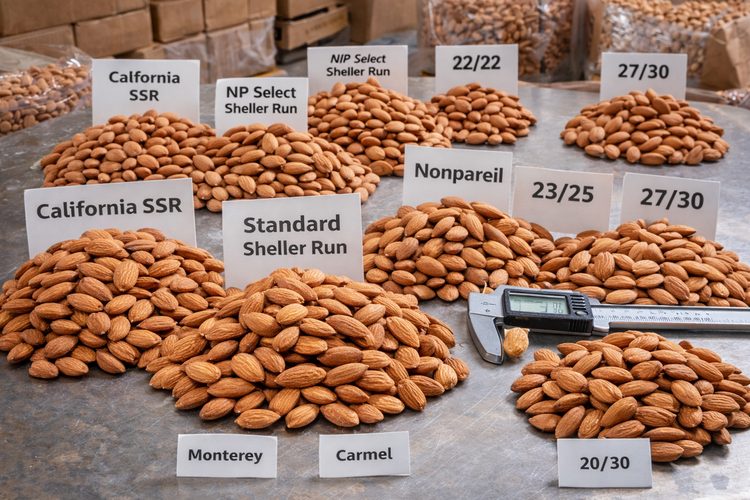
California almond buying gets easier when grade, variety and size are treated as three separate but related decisions. Buyers often ask for “almonds” when what they actually need is a specific kernel appearance, size profile, processing route and commercial standard that fits a real end use. In other words, the most useful almond quotation is not merely a price per pound or kilo. It is a technical-commercial match between the product offered and the product the customer needs to run.
That matters because grade, variety and sizing each affect a different part of the commercial outcome. Grade language usually points toward quality classification and defect tolerance. Variety affects appearance, shape, handling characteristics and sometimes customer preference. Sizing changes visual uniformity, portion presentation, depositor behavior, cut yield and the perceived premium level of the finished product. If those points are not aligned at inquiry stage, price comparisons become misleading and the risk of receiving the wrong product rises quickly.
Who this page is for
Procurement teams, category buyers, ingredient importers, food manufacturers, co-packers, private-label programs and distributors comparing California almond offers for industrial or packaged-food use.
Main buyer challenge
Offers can sound similar while meaning different things commercially. A useful inquiry must define not only product form but also grade logic, variety preference, size expectation, packaging and intended application.
Commercial theme
The best buying decision usually comes from selecting the right almond profile for the finished product, not from choosing the lowest nominal line item price.
Short buyer takeaway: if the application needs tight visual consistency, easy line handling or a specific premium look, size and variety may matter more than a small difference in quoted price. If the product will be diced, milled or further processed, broader commercial options may make more sense.
Contents of this guide
- How this topic shows up in real buying decisions
- What buyers mean by grade, variety and size
- California almond varieties in practical buying terms
- Sizing basics and why count language matters
- How grade and size change by application
- What Atlas would ask before quoting
How this topic shows up in real buying decisions
In practice, almond quotations usually start with a product form such as whole kernels, sliced, slivered, diced, meal, flour, butter or oil. But on whole-kernel and visually sensitive programs, buyers quickly discover that not all whole almonds are commercially interchangeable. A snack packer may care about tight size consistency, attractive appearance and low visible defects. A confectionery manufacturer may care about roasting behavior and enrobing presentation. A granola producer may want a predictable size that survives blending and still looks premium in the pouch. A processor that is going to dice or grind the product may be more flexible on whole-kernel presentation if the economics are better.
That is why grade, variety and size tend to become commercial filters:
- Grade helps define what level of defects, damage or general quality condition is acceptable for the use case.
- Variety helps define the style of kernel the buyer expects, especially where appearance or customer preference matters.
- Size helps define how the almonds look in pack, behave on line and compare visually from lot to lot.
Practical point: many buying problems begin when the inquiry says “whole almonds” but the plant really needs “whole almonds in a specific visual size range, suitable for a premium visible inclusion application, packed for export, with consistent presentation from lot to lot.”
What buyers mean by grade, variety and size
Although these terms are often mentioned together, they do not mean the same thing.
| Buyer term | What it usually refers to | Why it matters commercially |
|---|---|---|
| Grade | Commercial quality language connected to condition, defects, presentation and general acceptability. | Helps buyers define how strict the product standard needs to be for the intended market or process. |
| Variety | The cultivar or varietal type being sold, or a named variety request in the quote. | Can influence kernel appearance, shape, market familiarity, customer preference and sometimes price positioning. |
| Size | The dimensional or count-based sizing of whole kernels or the targeted cut range for processed forms. | Directly affects visual uniformity, portion appearance, depositor performance, cutting yield and premium perception. |
Commercially, buyers often need all three, but not with the same intensity. A high-visibility retail snack program may emphasize all three heavily. A further-processing program may emphasize grade and economics while keeping variety flexible. A diced program may care less about whole-kernel size than a whole-kernel topping application, but it will care strongly about the dimensional consistency of the cut output.
Why buyers should separate the three decisions
Separating grade, variety and size makes quote comparison easier. If a supplier offers a specific variety but the buyer only needs a broad commercial whole-kernel standard, the buyer may be able to access a more flexible and potentially more cost-effective program. On the other hand, if the brand story, customer approval or finished-pack appearance depends on a named variety and a defined size band, then buying too broadly may create inconsistency and later dissatisfaction.
Grade decision
How strict does the product standard need to be for your customer, category and quality system?
Variety decision
Do you require a named variety, a preferred varietal family, or an application-suitable commercial alternative?
Size decision
What size profile supports the target look, processing behavior and cost structure?
Pack decision
What packaging and shipment format preserves product integrity from California to your plant or market?
California almond varieties in practical buying terms
Varietal discussion tends to matter most when the buyer wants consistency in appearance, customer-recognized kernel style or a specific processing expectation. Some buyers ask for a named variety because their market is used to seeing that type. Others simply want a clean, uniform, commercially reliable kernel profile and are open to discussing broader supply options.
In practical trade conversations, buyers may encounter named varieties such as:
The important point for purchasing is not to memorize variety lists. It is to understand whether the application truly requires a specific named variety or whether the commercial need can be met through a wider supply specification. Named variety requests may make sense when:
- The customer approval is tied to a known visual style
- The finished product displays whole kernels prominently
- The brand wants repeatable premium presentation
- The market already buys using variety-specific language
- The buyer wants tighter control over consistency and substitution risk
A broader commercial approach may make more sense when:
- The almonds will be diced, sliced, slivered or ground
- The application is not highly variety-sensitive visually
- Pricing flexibility is important
- Supply continuity matters more than named-variety marketing language
- The program is industrial rather than consumer-visible
Commercial note: a named variety can be useful, but it should be specified for a business reason. If the plant does not actually benefit from that restriction, a broader supply brief may open up more workable sourcing options.
How variety affects commercial outcomes
Variety can influence more than buyer preference. It may affect how the kernels look in bulk, how uniform the lots feel to the customer, how the product behaves in certain roasting or visual applications, and how easy it is to maintain continuity across shipments. Even when the technical differences are not the main issue, the commercial expectations attached to a named variety can influence price, approval and replacement discussions.
Visual presentation
Where whole kernels remain visible, buyers often care about shape, uniformity and general visual impression as much as they care about the nominal variety name.
Approval and substitution
If the customer approved one variety and receives another without clear communication, the issue becomes commercial even if the product is otherwise usable.
Supply planning
Tighter variety requirements can narrow sourcing flexibility. Broader varietal acceptance can improve continuity if the application allows it.
Sizing basics: what buyers should know
Size is one of the most practical buying tools in whole-kernel almond trade. The reason is simple: size can be seen, portioned and priced. In many commercial offers, whole-kernel almonds are described using count-style size language, often tied to how many kernels fall within a standard weight reference. Buyers do not need to memorize every size convention. What they need to know is that a tighter size target usually leads to more consistent visual presentation and often a more premium commercial position.
In basic buyer terms:
- Larger kernels usually create a stronger visible premium impression and may be preferred for snack, gifting or upscale whole-kernel use.
- Mid-range sizes often provide a balance between presentation, availability and cost.
- Smaller kernels may work well when the almonds are further processed, used in blends or selected for more cost-sensitive applications.
Sizing logic: the tighter and more visually uniform the size requirement, the easier it is to create a consistent finished-pack appearance. But tighter sizing can also narrow the supply pool and affect pricing.
Why size matters commercially
Size changes more than the look of a sample tray. It affects how much product fills a windowed pack, how an inclusion looks on bakery or confectionery applications, how evenly material cuts or roasts, and how the finished product communicates value to the end customer. Buyers usually care about size because it connects directly to one or more of the following:
- Premium appearance in retail packaging
- Uniformity in visible applications
- Portion control and pack consistency
- Predictable performance in slicing, slivering or dicing
- Yield expectations during further processing
- Price positioning against target market needs
Whole-kernel sizing versus processed cuts
For whole kernels, size usually refers to the intact almond. For processed formats such as sliced, slivered, diced, meal or flour, sizing becomes a different conversation. The buyer is no longer asking for a kernel count range; the buyer is asking for a cut or particle profile suitable for the process. That is why a strong brief should clarify whether the plant is buying whole kernels for direct use or whole kernels that will later be cut, milled or otherwise processed.
| Product form | How size is usually discussed | Main commercial concern |
|---|---|---|
| Whole kernels | Usually by visual size expectations or count-style sizing language. | Pack appearance, premium positioning, consumer perception and uniformity. |
| Sliced / slivered | By cut profile, thickness expectations or dimensional consistency. | Coverage, presentation, breakage and process repeatability. |
| Diced | By target piece range and fines management. | Blend performance, visual balance and line handling. |
| Meal / flour | By grind or particle expectation rather than kernel size. | Flow, mix behavior and formulation suitability. |
Grade language and defect thinking
Buyers should also keep grade language grounded in the application. In whole-kernel programs, the commercial conversation often involves visual quality and defect sensitivity. In manufactured forms such as sliced, diced or flour, the most important quality points may shift toward cut uniformity, fines, flowability or process suitability. The right grade is therefore not just a “better” grade. It is the grade that matches the intended use without adding unnecessary cost.
Examples of commercially sensitive quality concerns may include:
- General visual presentation
- Broken or chipped kernels
- Shriveled or unattractive material in visible applications
- Shell fragments or foreign material control
- Color uniformity after roasting or further processing
- Cut consistency in sliced, slivered or diced formats
- Dust and fines in manufactured formats
Practical quality note: “best” is not the right question. The right question is whether the grade and visual standard are appropriate for the application, customer expectation and commercial target.
How grade, variety and size change by application
Different end uses place different value on grade, variety and size. The closer the almond is to the consumer’s eye, the more commercial sensitivity there usually is around visual uniformity and size control.
| Application | What usually matters most | Buyer logic |
|---|---|---|
| Retail snack packs | Visual grade, attractive whole-kernel size, repeatable presentation. | Consumers see the kernel directly, so appearance and uniformity strongly influence perceived value. |
| Bakery toppings | Size consistency, cut profile, visual clean-up and predictable bake presentation. | Coverage and appearance on the finished item can matter more than named variety. |
| Confectionery | Whole-kernel or cut size, visual quality, roast suitability and finished-piece consistency. | Premium coated or chocolate applications often need a cleaner visual and more reliable kernel profile. |
| Granola and cereal | Size or cut consistency, blend performance, appearance-to-cost balance. | The right size must support both visual appeal and line efficiency. |
| Ingredient processing | Broad commercial suitability, processing yield, cut or grind compatibility. | If the whole kernel will be transformed, the buyer may not need the strictest whole-kernel presentation standard. |
| Foodservice or bulk distribution | Specification clarity, packaging fit, continuity and usable quality level. | The application mix may vary, so a clear, fit-for-purpose spec matters more than overspecifying a premium trait no one pays for. |
Export and domestic buying logic
The basic commercial thinking stays the same across domestic and export programs, but the operational consequences can differ. Export programs may require more conservative packaging, stronger pallet execution, more disciplined documentation and tighter communication about substitutions or deviations. Domestic programs may move faster, but they still benefit from clear size and variety language because receiving, QA and customer-facing teams need to evaluate the lot against something concrete.
- Domestic programs often prioritize continuity, truckload efficiency and fast replenishment.
- Export programs often place more pressure on packaging durability, labeling accuracy and pre-shipment clarity.
- In both cases, variety and size need to match what the end customer or plant expects to receive.
When broader specifications are commercially smarter
Some buyers unintentionally over-specify. They ask for a named variety, a tight size band and a premium visual standard even though the almonds will be diced, blended or milled before reaching the customer. That can narrow sourcing options, slow quoting and add cost without improving the finished product. A broader commercial brief may be the better choice when the application does not truly monetize those stricter requirements.
Good reasons to broaden the spec
Further processing, cost-sensitive programs, flexible industrial use, mixed application channels or cases where a wider supply pool improves continuity.
Good reasons to tighten the spec
Visible premium retail use, customer-approved named variety programs, tight visual merchandising standards, export claims sensitivity or pack formats where appearance drives conversion.
How buyers usually build a workable quote request
A useful almond inquiry normally combines technical and commercial details. Atlas generally encourages buyers to go beyond the category name and define the actual need in one structured brief.
- Define the product form. Are you buying whole kernels, sliced, slivered, diced, meal, flour, butter or oil?
- State the application. Snack, bakery, confectionery, cereal, ingredient manufacturing, private label or export resale.
- Clarify the grade expectation. What quality or appearance standard is actually needed for the use case?
- Clarify variety preference. Named variety required, preferred, or commercially flexible?
- Clarify size target. Whole-kernel size or processed cut profile, depending on format.
- Add packaging and destination. Domestic industrial bulk, retail-ready, foodservice or export-oriented.
- Add volume and timing. Trial, monthly program, contract schedule or container-based replenishment.
What Atlas would ask before quoting
To reduce avoidable back-and-forth and improve the quality of quotations, Atlas would usually want the following points defined early.
Product form
Whole kernels, sliced, slivered, diced, meal, flour, butter or another processed almond format.
End use
Whether the almond stays visible, gets roasted, coated, blended, cut or milled after receipt.
Grade expectation
The commercial quality standard needed for the application, rather than a generic request for “good quality.”
Variety preference
Required, preferred or flexible, based on actual business need.
Size target
The whole-kernel size or cut profile that matches the finished product and plant process.
Packaging and destination
Pack style, pallet format, domestic or export route, and any documentation sensitivities.
Those points make it easier to compare California supply options honestly. They also reduce the risk that the quote, the purchase order, the shipped lot and the receiving expectation all describe slightly different products.
Commercial planning points
From a trading standpoint, the strongest almond programs are built around repeatability. That means clear documentation, agreed packaging, sensible shipment cadence and a specification that is realistic enough to support continuity. Grade, variety and size decisions all affect that continuity. Tighter requirements can be justified, but only when the finished product or customer truly benefits from them.
When relevant, the brief should also say whether the program is industrial bulk, foodservice, retail-ready, private label or export-oriented. That single clarification often changes the right packaging, documentation package and timing assumptions.
Buyer planning note
Atlas Global Trading Co. uses topics like this to move conversations from broad interest to a more specification-minded inquiry. If you are evaluating California almond supply, the most useful next step is to share the product form, size expectation, variety preference if any, estimated volume, packaging style and destination using the contact form. That allows the discussion to focus on real commercial options instead of a generic price-only comparison.
Better inquiry, better quotation: when buyers define grade, variety and size in business terms rather than only commodity terms, the sourcing process becomes more efficient and the resulting offers are far easier to compare.
Need help sourcing around this almonds topic?
Use the contact form to turn this research topic into a practical quote request for Atlas. Share the almond form, grade logic, variety preference, size target, volume and destination.
- State the exact almond format and end use
- Add variety preference or note if flexible
- Include size target, volume and shipment timing
- Specify destination market and packaging style
Frequently Asked Questions
What is the main buyer takeaway from “California Almond Grades, Varieties and Sizing: Buyer Basics”?
The main buyer takeaway is that grade, variety and size should be specified together because each one affects application fit, visual outcome, yield, pack presentation and final delivered cost.
What is the difference between almond grade, variety and size?
Grade generally refers to quality or defect-related commercial classification, variety refers to the cultivar or varietal type being offered, and size usually refers to kernel dimensions or count-based sizing language used for whole-kernel trade.
Why does almond sizing matter to buyers?
Sizing matters because it influences visual uniformity, portion appearance, process behavior, line dosing, breakage exposure and the perceived premium level of the finished product. Tighter sizing can improve consistency but may also narrow supply flexibility.
Do all buyers need a named California almond variety?
No. Some applications benefit from a named variety requirement, especially visible premium uses or customer-approved programs. Other applications can use a broader commercial specification if the product will be further processed or if continuity and cost flexibility matter more.
Does Atlas help buyers move from article research to quotation?
Yes. Atlas uses the same topics covered in the academy to structure more practical and specification-minded quote requests around variety preference, size target, product form, packaging and commercial timing.
Can this topic be applied to both U.S. and export programs?
Yes. The commercial logic is relevant to both domestic and export programs, although packaging protection, labeling, documents and acceptance language may vary by destination.