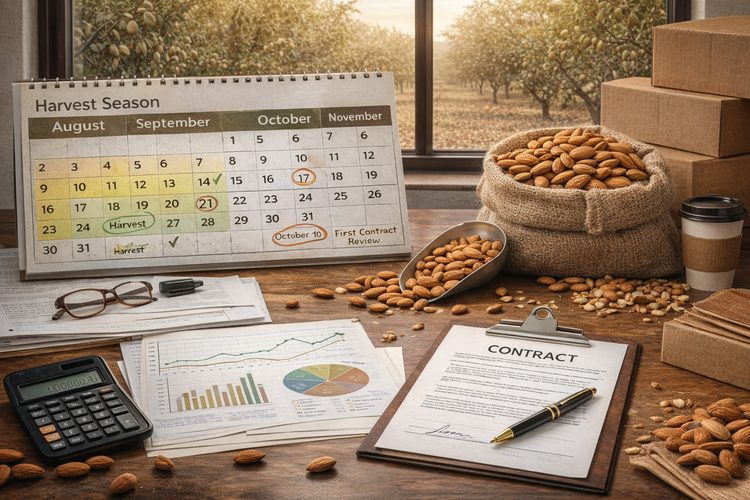
How Harvest Timing and Contract Structure Affect Almond Procurement is ultimately a question of execution discipline. In industrial nut buying, the best commercial result rarely comes from chasing a headline price alone. It usually comes from matching crop timing, product form, process route, packaging, logistics and payment structure to the buyer’s real operating needs before the order is placed.
That matters because almonds are not traded as a single, uniform item. A buyer asking for whole kernels for snack packing is not buying the same commercial product as a beverage manufacturer buying almond flour, a confectionery producer buying diced material, or a foodservice customer buying roasted and seasoned packs. Even when the raw agricultural origin is the same, the manufacturing path, yield expectations, quality tolerances, packaging logic and shipment timing can be very different.
Buyer takeaway: A usable almond RFQ should define the product form, intended application, process condition, pack style, destination, shipment cadence, quality expectations and commercial window together. When those variables are aligned early, quotes become more comparable and supply execution becomes more predictable.
What changes when harvest timing changes
Harvest timing affects more than crop availability. It can influence how quickly new crop material can be cleaned, sorted, pasteurized, blanched, sliced, milled, packed and released into the channels relevant to your program. For buyers, that means the quote window is not just a commercial event. It is also a supply chain positioning decision.
From a procurement standpoint, the market can behave differently depending on whether the buyer is planning around:
- Pre-harvest planning, when buyers may want to secure supply continuity and reserve manufacturing capacity before the physical flow is fully normalized.
- Crop transition, when old crop and new crop commercial assumptions may overlap and execution risk must be managed carefully.
- Early post-harvest execution, when fresh availability may improve but processing queues, packaging reservations and logistics lead times still matter.
- Mid-season replenishment, when buyers usually focus on cadence, quality consistency and freight coordination rather than only initial placement.
- Late-season coverage, when continuity of exact spec, carryover planning and replacement cost assumptions may become more important.
The practical implication is simple: a buyer who only asks, “What is the price today?” may get a number, but not necessarily a procurement answer. A useful commercial answer should clarify which crop position, shipment period, process route and packaging logic the quote is built around.
Why contract structure matters as much as price
Many almond programs fail to perform well because they are bought on the wrong commercial structure. A one-time spot purchase may be suitable for urgent replacement stock, qualification trials or market testing, but it is often not the best approach for a production line that needs monthly continuity. Similarly, a forward position may help protect supply continuity, but it can become inefficient if the buyer has not stabilized its real monthly usage, packaging plan or product spec.
In practice, contract structure determines how risk is shared between buyer and supplier. It shapes the treatment of volume tolerance, shipment releases, manufacturing reservations, packaging commitments, freight timing, payment terms and market exposure. The right structure depends on what the buyer is trying to optimize:
- Budget visibility and landed cost planning
- Supply continuity for a recurring plant or pack line
- Flexibility for evolving product launches or seasonal demand
- Logistics efficiency for domestic distribution or export consolidation
- Specification consistency for validated formulations and QA approval
Common almond product forms and why they change the buying strategy
Commercial alignment begins with the exact product form. For almonds, the quote should reflect not only the raw material family but the actual manufactured format and process state. A correct inquiry may involve one of the following categories:
- In-shell almonds for selected wholesale or trading channels
- Whole natural kernels for repacking, further processing or snack applications
- Pasteurized almonds where a validated treatment step is commercially or operationally required
- Blanched almonds where skin removal matters for color, texture or downstream milling
- Sliced or slivered almonds for bakery, confectionery and topping applications
- Diced or chopped almonds where particle size distribution affects line performance and visual appearance
- Almond meal or flour for bakery, gluten-free, confectionery and formulated food applications
- Almond butter or paste where roast condition, grind profile and oil separation behavior matter
- Dry roasted or oil roasted almonds for snack and seasoned product programs
Each of these product types implies different processing steps, manufacturing yields, line scheduling needs, packaging formats and quality checkpoints. That is why the same buyer may receive very different commercial offers depending on whether the inquiry is framed as raw kernels, blanched sliced material, extra-fine flour or roasted snack grade.
At-a-glance: what sophisticated buyers define before they ask for price
- Exact product form and process condition
- End use: bakery, confectionery, plant-based dairy, snack, cereal, foodservice or ingredient manufacturing
- Whether the product will be used as-is or processed further
- Cut, size, particle range or texture target
- Raw versus pasteurized requirement
- Moisture, defects, color or sensory expectations
- Microbiological or validation requirements
- Bulk industrial pack, foodservice pack or retail-ready format
- Destination market and documentation needs
- Trial volume, MOQ assumptions, monthly usage and annual estimate
- Shipment cadence and target ship or arrival window
- Commercial preference: spot, forward, call-off or program buying
How timing windows change the commercial conversation
A practical almond procurement discussion usually becomes more effective when the buyer can identify which timing window applies to the program. The same product may be commercially workable across multiple windows, but the contract logic may not be the same.
| Buying Window | What Buyers Usually Prioritize | Main Commercial Benefit | Execution Risk to Watch | Typical Best-Fit Structure |
|---|---|---|---|---|
| Pre-harvest planning | Coverage, budget visibility, continuity planning, capacity alignment | Early supply positioning and better planning discipline | Demand forecast error or premature specification changes | Forward program or framework agreement |
| Crop transition | Replacement timing, old crop versus new crop clarity, QA continuity | Reduced disruption between procurement cycles | Confusion over crop position, lead time or release readiness | Staggered contract with confirmed shipment windows |
| Early new crop execution | Availability, process scheduling, packaging reservation, faster replenishment | Timely entry into fresh production flow | Processing queue pressure or overly optimistic shipment assumptions | Short forward or release-based contract |
| Mid-season program | Steady monthly supply, landed cost control, logistics repeatability | Operational consistency and easier purchasing administration | Underestimating packaging, freight or inventory buffers | Monthly call-off under annual or semiannual framework |
| Late-season coverage | Continuity of exact spec, risk control, transition planning for next cycle | Protection against disruption in validated products | Spec tightness, replacement cost shifts, limited flexibility | Short-term coverage agreement or disciplined spot buys |
Buyers do not need a complex financial instrument to improve procurement performance. They usually need a contract structure that accurately reflects how the material will actually be consumed. That is why realistic volume releases, sensible shipment windows and clearly defined specification tolerance are often more valuable than trying to optimize only the opening price line.
Almond contract structures buyers commonly evaluate
There is no single “best” contract type for almonds. The right choice depends on the buyer’s demand stability, inventory tolerance, financing posture, approved supplier strategy and logistics model. Below are the most common commercial structures used in practice.
1. Spot purchase
A spot purchase is usually appropriate when the buyer needs immediate coverage, a formulation trial, a new vendor test or a one-time tactical replenishment. It offers flexibility and limited commitment, but it may expose the buyer to current market replacement cost and shorter planning horizons. It also provides less control over future capacity and less assurance for repeated monthly execution.
2. Fixed-volume forward contract
This structure is commonly used when the buyer has predictable demand and wants defined coverage for a future period. The advantage is stronger planning discipline and supply continuity. The drawback is that inaccurate demand forecasting can create over-coverage or awkward stock timing if releases are not matched to real consumption.
3. Framework agreement with call-off releases
Many industrial buyers prefer a framework structure that fixes the product definition, commercial rules and broad volume expectations, while allowing operational releases by month or shipment window. This can work well for customers who need repeatability but still want some flexibility on exact shipment timing. It is often the most practical structure for recurring production programs.
4. Staggered shipment program
Here the total commitment is broken into pre-agreed shipment lots across a defined period. This approach can help balance warehouse capacity, cash flow and freight planning. It is particularly useful when the buyer wants to smooth arrivals and reduce the operational burden of repeatedly renegotiating each lot.
5. Trial-to-program conversion
For new buyers or new applications, the most commercially sensible route is often a staged approach: qualification sample or small trial lot first, operational review second, program discussion third. This is especially useful when the customer is validating cut, color, texture, grind profile, process tolerance or shelf-life behavior before committing to recurring tonnage.
6. Value-added processed item program
When the product is not a raw kernel but a processed item such as flour, blanched sliced, roasted or butter, the contract must account for processing capacity, yield losses, packaging lead times and line changeovers. In such cases, the structure should reserve not only raw material but also a realistic manufacturing pathway.
Commercial note: For recurring demand, buyers often obtain better results when they define a “program architecture” first and negotiate price inside that framework, rather than trying to fix price before the structure, volume release logic and technical assumptions are settled.
What a quote-ready almond specification should include
The stronger the specification package, the better the quote. In many cases, pricing delays or execution problems are not caused by a shortage of supply. They are caused by an incomplete product brief. A supplier can only price accurately when the buyer states which technical variables are commercially binding and which are flexible.
Product identity and process state
- Whole, sliced, slivered, diced, chopped, meal, flour, butter or roasted format
- Natural, blanched, pasteurized, roasted or seasoned condition
- Whether the product is an ingredient input or a consumer-ready pack
- Whether the buyer accepts standard commercial production or needs custom conversion
Physical and sensory requirements
- Size, cut definition or particle distribution where relevant
- Color expectation for natural or blanched material
- Texture requirement for sliced, slivered, roasted or butter applications
- Flavor profile, roast profile or oil level for snack-oriented products
- Flowability or grind behavior for flour and meal applications
Quality parameters
- Moisture target or maximum
- Defect tolerance expectations
- Foreign material control requirements
- Microbiological requirements where relevant
- Any customer-specific QA protocol beyond standard commercial release
Food safety and compliance inputs
- Pasteurization requirement and whether it must be validated in a specific manner
- Need for certificates, declarations or supporting QA documentation
- Market-specific compliance needs for export or private label channels
- Allergen labeling considerations, customer documentation and traceability expectations
Commercial and logistics inputs
- Bulk pack size, carton, bag, liner or tote preference
- Palletization logic and warehouse handling constraints
- Domestic truckload, LTL, containerized export or mixed-load requirement
- Target Incoterms or commercial delivery expectation if the buying organization works that way
- Lead time tolerance, shipment cadence and desired arrival profile
Without these details, two quotations may look comparable on the surface while actually describing different products, different process routes or different supply assumptions. That is one of the most common reasons buyer almond buying becomes inefficient.
How end use changes the procurement brief
Almonds are sold into many channels, but the product brief should always begin with the actual application. This is not only a technical question. It changes commercial priorities, line tolerance and risk allocation.
Bakery
Bakery buyers may focus on size consistency, visual appearance, cut uniformity, moisture control and packaging that supports controlled usage on production lines. Toppings, inclusions and almond flour applications each require different handling assumptions. Sliced or diced material usually needs tighter thinking around breakage, dust and particle consistency than a general whole-kernel purchase.
Confectionery
Confectionery buyers often prioritize flavor cleanliness, appearance, roast uniformity where applicable and consistency in conversion pieces used inside bars, clusters, coatings or dragées. If the almonds are visible in the final product, color and shape can become more commercially important than in hidden inclusion uses.
Plant-based dairy and beverage
These applications can require closer attention to blanching, grind profile, suspension behavior, oil expression, filtration performance and batch consistency. A beverage-oriented almond input may need a different process path than a bakery flour, even if both are milled products.
Snack mixes and retail packing
Retail-oriented snack programs usually place more emphasis on appearance, roast profile, seasoning adhesion, shelf-life support, packaging presentation and lot-to-lot consistency. The commercial brief may also require stronger clarity on label claims, pack count, display format or private label workflow.
Granola and cereal
These applications often balance cost, cut size, roasting behavior, durability in mixing and visual presence in the finished pack. Breakage tolerance and bulk packaging efficiency can matter as much as the base ingredient cost.
Typical use cases on this website: bakery, confectionery, snack mixes, granola & cereal and plant-based dairy. Buyers normally get stronger quotes when their inquiry clearly maps to one of these end uses rather than using only a generic product name.
Why process route changes cost, lead time and MOQ logic
Processed almond products are not simply raw kernels with a markup. Every added transformation step may affect yield, labor, scheduling, QA controls, cleaning standards and packaging complexity. Buyers who understand this usually write more practical RFQs and evaluate quotes more fairly.
Raw or natural kernels
This is often the simplest commercial starting point, especially when the buyer has its own internal conversion or a co-manufacturing arrangement. The quote logic is usually more direct, but the buyer may assume more responsibility for later processing, QA handling and final application performance.
Pasteurized kernels
Where pasteurization is required, the commercial brief should state it clearly. This can affect process sequencing, validation support, release timing and sometimes packaging considerations. Buyers should not assume all kernel offers are quoted on the same process basis.
Blanched, sliced or slivered material
These items introduce additional process steps and line scheduling considerations. They may also have tighter expectations around appearance, breakage, dust and particle consistency. Because these are more manufactured than raw kernels, planning ahead generally improves commercial execution.
Diced, chopped, meal and flour
Conversion products require clear size or particle expectations. For flour or meal, the intended application matters because “flour” can still imply different commercial assumptions around fineness, oil behavior and handling. A better RFQ states what the powder must do in the recipe or on the line, not just the product name.
Almond butter, paste and roasted products
These formats require even more alignment. Roast profile, grind texture, oil separation behavior, filling temperature, packaging format and shelf-life expectations can all influence pricing and feasibility. Buyers should also clarify whether they want industrial bulk handling, foodservice packing or consumer-ready presentation.
Quality controls that should be discussed before contracting
In a well-run almond procurement program, quality is not handled after pricing. It is built into the quote logic from the start. That does not mean every RFQ needs an excessive technical appendix, but it does mean that buyers should identify which quality points are commercially decisive.
- Specification ownership: Is the product being bought to an internal buyer spec, a customer-approved finished spec or a general commercial description?
- Tolerance clarity: Which quality attributes are hard limits and which are commercial targets?
- Sampling and approval: Is the first shipment subject to pre-approval, retained samples or line trial sign-off?
- Release documentation: What paperwork is required for each lot or shipment?
- Traceability: What lot identification and record retention logic does the buyer require?
- Shelf-life alignment: Is the buyer evaluating shelf life from production, shipment or receipt?
These points become especially important when the program involves export destinations, private label retail, contract manufacturing or tightly validated food production. The goal is not to make the RFQ heavy. The goal is to prevent mismatch between what the buyer expects and what the supplier priced.
How packaging and logistics affect almond procurement
Packaging is often underestimated in ingredient buying. Yet it can materially affect warehouse handling, freight efficiency, product protection, labor usage and even quote validity. Bulk industrial users usually care about loading efficiency and line handling. Foodservice and retail programs may care more about presentation, pack count, coding and final distribution logic.
Key packaging and logistics questions include:
- Is the product for industrial bulk, foodservice distribution, repacking or direct retail sale?
- Does the buyer require a specific bag, carton, liner or pallet pattern?
- Must the packaging fit existing warehouse, racking or automation constraints?
- Is shipment domestic truckload, mixed pallet, LTL or export containerized?
- Does the destination require special labeling or documentation handling?
- Is the buyer planning single-shipment intake or phased monthly arrivals?
Many procurement teams focus on the ex-warehouse or FOB-style number first, but the landed operational fit is what determines whether the quote is truly attractive. The most competitive offer on paper may become inefficient if it introduces avoidable internal handling costs, repacking steps or documentation delays.
Main commercial risks buyers should actively manage
Almond procurement is usually more stable when the buyer treats the program as a combination of agricultural timing, manufacturing capacity and logistics execution. The key risks are often manageable, but only if they are named early.
1. Specification drift
When the spec evolves after pricing, the quote may no longer reflect the real item required. This is common when a buyer initially asks for “almond flour” and later specifies roast condition, micron expectation, packaging type or destination market. Strong procurement practice is to lock the commercially binding parameters before comparing offers.
2. Forecast error
Forward buying works best when the buyer has a credible demand picture. Overcommitting volume can create awkward inventory and cash flow pressure. Undercommitting can leave the buyer exposed to replacement buying at the wrong time. A good structure often includes realistic release schedules rather than optimistic headline annual numbers.
3. Crop transition confusion
During transition periods, buyers should be explicit about whether a quotation is expected against current coverage, next-cycle positioning or a mixed continuity strategy. Ambiguity here can create problems in timing, QA approval or commercial comparability.
4. Processing lead-time mismatch
A buyer may assume that all almond formats are equally available. They are not. Value-added forms often require additional scheduling and process coordination. If the product is blanched, sliced, milled, buttered or roasted, the manufacturing route should be reflected in the RFQ timing.
5. Freight and documentation underplanning
Export programs and distributed domestic programs usually require more than a product quote. They need a delivery architecture. Packaging, documents, palletization, transit mode and shipment cadence all influence the real outcome.
6. Internal misalignment
Sometimes the procurement team, QA team and production team are not buying the same thing in practical terms. One team may optimize cost, another quality, another line fit. The best RFQs are built after those internal requirements are reconciled into one commercial brief.
Good procurement discipline: define what must be fixed, what can be flexible and what can be phased. That alone often improves quote quality more than another round of broad supplier outreach.
What Atlas would normally ask before quoting
Atlas encourages buyers to define the commercial brief early so that the quotation reflects the real requirement rather than a generic almond category. Typical questions include:
- What exact almond item is needed: whole, blanched, sliced, diced, flour, butter, roasted or another format?
- What is the intended application and is the material used as-is or further processed?
- Does the program require raw or pasteurized material?
- What pack style is needed: industrial bulk, foodservice, retail-ready or private label?
- What is the destination market and are there any market-specific labeling or documentation needs?
- Is the requirement a trial lot, short-term coverage buy or recurring monthly program?
- What is the estimated volume by shipment, by month or by year?
- What is the required timing: immediate, forward, scheduled releases or campaign-based?
- Are there any special quality, QA or compliance requirements beyond standard commercial release?
Example of a stronger almond RFQ
A stronger inquiry is not necessarily longer. It is simply more decision-ready. For example:
Example RFQ structure:
Product: blanched almond flour
Application: gluten-free bakery mix
Processing: pasteurized, extra-fine milling suitable for dry blending
Packaging: industrial bulk bags on pallets
Volume: initial trial lot plus recurring monthly demand if approved
Destination: domestic U.S. plant or export destination as applicable
Timing: first shipment needed within a defined window, then scheduled monthly releases
Notes: share QA documents, lot traceability expectations and any packaging constraints
This type of inquiry is more actionable because it gives the supplier enough information to price the item against a real operational requirement. It also reduces the risk that different suppliers quote different assumptions under the same product name.
Buyer planning note
Atlas Global Trading Co. uses academy topics like this to move discussions from broad market interest to a specification-minded procurement conversation. For buyers evaluating almonds from California, the most useful next step is to share the exact format, pack style, volume profile, timing and destination. That allows the conversation to shift from generic availability to a more commercially grounded quote request.
Need help sourcing around this almonds topic?
Use the contact form to turn this research topic into a practical quote request for Atlas. The more precisely the requirement is defined, the more useful the commercial response can be.
- State the exact almonds format and process condition
- Add target trial, monthly or annual volume
- Include destination market and target shipment timing
- Note pack style, QA requirements and end use
Frequently Asked Questions
Why does harvest timing matter so much in almond procurement?
Harvest timing affects availability, manufacturing lead times, transition risk between crop years, freight planning, packaging schedules and price exposure. Buyers who align their quote timing with their actual production window usually get clearer commercial comparisons and fewer execution issues.
Which contract structure is best for recurring almond demand?
For recurring demand, many buyers prefer a framework or forward program that fixes the specification and shipment cadence while aligning pricing and releases to a practical production schedule. The right structure depends on whether the priority is budget certainty, flexibility, supply continuity or freight coordination.
What details should a buyer define before requesting an almond quote?
A strong RFQ should define product form, process route, intended application, particle size or cut, packaging format, destination, shipment cadence, estimated volume, quality expectations, food safety requirements and any market-specific documentation needs.
Can the same almond specification work for bakery, beverage and snack applications?
Not usually. Bakery, beverage, confectionery and snack applications often require different particle size control, oil performance, roast profile, microbiological controls, packaging and shelf-life expectations.
How does processing route change the commercial offer?
Raw, pasteurized, blanched, sliced, diced, flour, butter and roasted almond products each have different yield assumptions, process losses, line scheduling requirements and packaging needs. Those differences can materially change price, lead time and minimum order logic.
Does Atlas support both domestic and export almond programs?
Yes. Atlas structures inquiries for both U.S. and export programs, with attention to packaging, labeling, palletization, shipping documents and destination-specific documentation requirements.
What is the biggest mistake in almond procurement RFQs?
One of the most common mistakes is requesting price before defining the real commercial brief. If the buyer does not specify format, application, pack style, destination, quality tolerances and timing, different suppliers may quote different assumptions and the offers will not be truly comparable.
Can Atlas help move from article research to a quote-ready quote request?
Yes. Atlas uses the same technical and commercial framework discussed in the academy to help buyers turn a broad inquiry into a structured quote request that is easier to price, compare and execute.