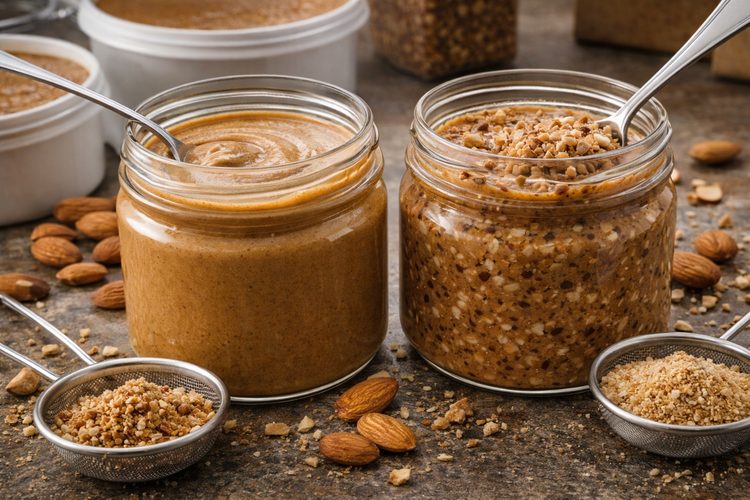
How to Specify Almond Butter Texture and Grind Profile matters because buying almond butter for industrial or export use is rarely only about nominal price. The stronger commercial outcome usually comes from aligning texture target, grind profile, roast condition, oil behavior, packaging format and shipment timing before the order is placed.
Almond butter is not a single uniform product. One buyer may need a highly smooth, pumpable butter for sauces or fillings. Another may need a thicker, more structured paste for bakery inclusions. A third may need a retail-style crunchy butter with suspended particulates and a specific spoon feel. Even when the raw ingredient family is the same, the finished commercial item may differ materially in mouthfeel, flow behavior, processing stability, sensory profile and pack logic.
That is why strong buyer almond butter procurement starts with the question: what must the butter do in the customer’s process and finished product? Once that is clear, it becomes much easier to discuss grind profile, roast level, packaging and commercial structure in a practical way.
Main buyer takeaway: almond butter sourcing works better when texture target, grind profile, roast condition, packaging format and commercial timing are defined together before quotation.
How this topic shows up in real buying decisions
For almonds, the quote should reflect the real format and route. Whole or kernel material is commercially different from diced, meal, extra fine flour, butter or oil. The commercial logic also changes when the material is raw, pasteurized, dry roasted or oil roasted. Once the product becomes almond butter, the conversation shifts again, because the buyer is no longer only buying almond origin. The buyer is now also buying grinding result, texture profile, dispersion behavior, fill performance and sensory consistency.
For almond butter buyers, the usable product menu often includes smooth almond butter, medium-texture butter, crunchy almond butter, more structured almond paste-style systems, and application-specific variants built around roast preference or process fit. Which of those makes sense depends on the end use, whether the customer is manufacturing further, packing for retail, using the product in foodservice, or planning export distribution.
Why almond butter should be specified by performance, not by name alone
One of the most common commercial mistakes is requesting “almond butter” as if that phrase fully defines the item. It does not. In practice, the same product name can cover very different commercial realities:
- A very smooth butter intended for premium retail spreads
- A slightly textured butter for foodservice or spoonable use
- A pumpable almond base for fillings or sauces
- A thicker system for bakery deposit or inclusion use
- A crunchy style with visible almond particulates
- An export-oriented packed product with different packaging and handling assumptions
That is why the better RFQ is built around application behavior. Does the butter need to spread cleanly, deposit consistently, remain stable in a filling, blend into a formulation, retain visible nut particles, or support a premium consumer mouthfeel? These details determine whether the supplier should quote a fine grind, medium grind, crunchy profile or a more paste-like system.
Practical rule: if the buyer can describe how the almond butter should behave on line, in the jar, in the filling, or in the finished product, the supplier can structure a more useful quote.
What “texture” usually means in almond butter buying
Texture is not just smooth versus crunchy. In buyer discussions, texture can include several overlapping characteristics:
- Perceived smoothness on the palate
- Residual particulate feel after grinding
- Body and firmness at room temperature
- Spreadability for consumer or foodservice use
- Pumpability or flow behavior for manufacturing lines
- Suspension of particulates in crunchy styles
- Oil release and separation tendency during storage
- Consistency from lot to lot across recurring production runs
How grind profile changes the finished commercial result
Grind profile is one of the most important variables in almond butter specification because it directly affects mouthfeel, viscosity, process handling and the buyer’s perception of product quality. Two almond butters made from similar raw material can behave very differently depending on how they are ground and finished.
Fine grind
A fine grind is usually chosen when the buyer wants a smoother mouthfeel, lower perceptible grit, more uniform spread and a more polished finished presentation. This is often relevant for premium retail spreads, smooth fillings, sauces, dressings and applications where visible or tactile particulates are undesirable.
Medium grind
A medium grind can provide more body and a more natural nut character while still remaining commercially manageable in many processes. It is often a good fit where the buyer wants some sensory substance without the stronger visual or textural signal of a crunchy system.
Crunchy or particulate profile
Crunchy almond butter is not just smooth butter with random pieces added. Commercially, the buyer should think about particle visibility, suspension stability, spoon feel, bite consistency and whether the larger particles are part of the almond butter system itself or an added inclusion phase. This matters for retail, foodservice and some bakery or confectionery uses.
Paste-like or high-body profile
In some industrial systems, the buyer may want an almond butter that functions more like a dense paste than a free-spreading spread. This can be relevant in bakery fillings, bars, nut centers, confectionery phases or formulations where flow must be controlled more tightly.
| Grind Style | Typical Use | Main Technical Benefit | Main Watchpoint | Commercial Note |
|---|---|---|---|---|
| Fine / smooth | Retail spreads, sauces, fillings, premium applications | Smoother mouthfeel and cleaner appearance | May require tighter expectation around flow and oil behavior | Often preferred where finish quality is highly visible |
| Medium texture | Foodservice, ingredient blends, spreadable industrial use | Balanced body and natural nut character | Needs clear alignment on acceptable particulate feel | Useful where performance and sensory character must balance |
| Crunchy | Retail jars, spoonable systems, selected bakery or topping use | Strong texture signal and visible nut identity | Particle suspension and consistency need more planning | Should be quoted against a defined texture brief, not only a name |
| Paste-like / structured | Bakery fillings, nut centers, controlled-deposit systems | Higher body and more process control | Can behave differently in warm or high-shear environments | Usually more application-specific than general retail butter |
The intended application should drive the almond butter specification
Atlas encourages buyers to define intended use early because the same butter profile will not fit every application equally well. The product brief should always match a real operational use case rather than a general category label.
Retail spreads
Retail-oriented almond butter usually requires closer attention to spoon feel, spreadability, visual texture, roast flavor, oil separation expectations and consumer perception. The buyer may also care about the difference between a premium smooth finish and a deliberately natural, more textured profile.
Foodservice packs
Foodservice buyers often care about consistency, ease of handling, portionability and pack practicality. Depending on the channel, a slightly more robust body may be acceptable if the product remains easy to use and consistent across pack openings.
Bakery fillings and inclusions
Bakery systems may require controlled body, limited free oil, reliable deposit behavior and stability inside a dough or filling system. Here the butter is often judged less by spoon feel and more by how it behaves during processing and after bake or storage.
Confectionery and nut center applications
Confectionery buyers may focus on smoothness, flavor intensity, fat phase behavior and whether the almond butter contributes to a creamy, premium nut profile or a more structured center. A paste-like system may be more appropriate than a free-spreading butter.
Sauces, dressings and blended systems
These applications may prioritize fine grind, consistent dispersion and manageable flow behavior. A butter that works well in jars may not always be ideal in a blended industrial liquid system without clearer viscosity and grind alignment.
Typical use cases for almonds on this website include bakery, confectionery, snack mixes, granola & cereal and plant-based dairy. For almond butter, the buyer should go one step further and state whether the item is for spread, filling, blend, topping, sauce or packed finished product.
Texture and grind cannot be separated from roast character
In almond butter, texture and flavor planning are linked. Buyers often think of grind profile first, but roast condition can materially change how the finished butter is perceived. A very fine grind with a deeper roast may feel richer and more assertive than a similarly ground but milder product. A more neutral roast may suit applications where the almond note should support, not dominate, the finished formula.
Questions buyers should answer
- Should the finished almond butter taste light and clean, or more roasted and nut-forward?
- Is the butter a hero flavor, a supporting background ingredient or a functional nut phase?
- Does the application require a more polished premium profile or a rustic, natural nut character?
- Will the almond butter be blended with cocoa, dairy notes, sweeteners, savory ingredients or fruit systems?
Commercially, this means the quote should not stop at “smooth almond butter.” It is often more useful to define whether the butter should be smooth and mild, smooth and roasted, medium-textured and natural, or crunchy with visible particulate character. That gives the supplier a more realistic starting point for product alignment.
Why viscosity and oil behavior matter in almond butter RFQs
For industrial users, the buying discussion often moves beyond consumer-style language such as creamy or crunchy. The buyer may need to describe how the butter behaves under handling conditions. Even without providing laboratory specifications, it is commercially useful to explain whether the butter needs to be easily pumpable, spoonable, depositable, blendable or shape-holding.
Key performance themes
- Spreadability: important for retail, foodservice and consumer-style usage
- Pumpability: relevant for industrial transfer and automated lines
- Deposit control: relevant in bakery, snack and confectionery systems
- Oil separation tolerance: important for shelf-life perception and pack performance
- Stability over time: important in recurring programs and export shipments
One buyer may accept a more natural system with some visible oil rise if the product is sold as a premium minimally processed spread. Another may need a more controlled visual appearance because the end market or channel expects a more uniform pack presentation. Those are different commercial briefs and should be quoted accordingly.
Useful RFQ language: instead of only writing “need almond butter,” specify whether the product should be free-flowing, spoonable, thick-bodied, deposit-friendly, or retail-smooth with limited visual oil separation.
Packaging should match the handling method
Packaging is one of the most commercially important parts of almond butter buying because the product is not only sensitive to texture expectations but also to handling, filling, warehousing and shipment conditions. A pack style that works for a retail program may not be suitable for factory transfer. A foodservice pack may not be suitable for export retail or private label.
Common pack logic for almond butter
- Industrial bulk for manufacturing and ingredient handling
- Foodservice-oriented packs for kitchens, operators or intermediate use
- Retail-ready jars or finished packs for consumer sale
- Private label formats where fill size, label and presentation matter
- Export-oriented packaging where transit protection, palletization and document accuracy become more important
Buyers should also clarify whether the pack is intended for direct line use, intermediate storage, repacking, distributor handling or export container loading. That single point can change the supplier’s assumptions about packing strength, unit format and shipment planning.
Export considerations for almond butter
For export programs, the same texture and grind logic still applies, but the buyer often also needs to consider packaging durability, labeling logic, document handling and shipment timing. Export-oriented almond butter programs may require more planning around pack style and route than a domestic supply program using the same base item.
How almond butter programs usually develop commercially
From a trading standpoint, the best programs are built around repeatability. That means clear documentation, agreed packaging, sensible shipment cadence and a commercial structure that supports continuity rather than one-off emergency buying.
For almond butter specifically, projects often develop in stages:
- Trial stage to validate texture, roast note and application fit
- Pilot or validation run to confirm line behavior and finished product performance
- Launch phase where packaging, shipment timing and recurring quality matter more
- Repeat replenishment where lot-to-lot consistency and operational comparability become central
When relevant, the brief should also mention whether the program is industrial bulk, foodservice, retail-ready, private label or export-oriented. That single clarification often changes packaging, documentation and timing assumptions.
Commercial points buyers should define early
- Is this a sample-led evaluation, a one-time buy or a recurring program?
- What is the expected volume pattern: trial, monthly, seasonal or annual?
- Is the timing immediate, scheduled or tied to a launch window?
- Does the buyer need a standard commercial item or a more application-specific butter profile?
- Will the product be sold domestically or shipped into export markets?
| Program Type | Typical Buyer Priority | Best Specification Focus | Main Commercial Risk |
|---|---|---|---|
| Trial run | Technical fit and sensory approval | Texture, roast note and application behavior | Assuming trial material automatically defines the long-term spec |
| Launch order | Execution timing and packaging readiness | Pack format, approval path and repeatability | Forecast uncertainty |
| Industrial repeat program | Continuity and lot-to-lot consistency | Grind profile, flow behavior and shipment cadence | Specification drift across orders |
| Export retail or foodservice | Packaging, documents and presentation | Pack style, texture consistency and route fit | Documentation or packing mismatch |
What a quote-ready almond butter brief should include
Atlas encourages buyers to define intended use, pack style, destination, timeline and quality expectations early. Those inputs help reduce avoidable back-and-forth and improve comparability across California supply options.
- Is the product smooth, medium-textured, crunchy or more paste-like?
- What is the intended application: spread, filling, bakery, sauce, confectionery, foodservice or retail?
- Should the flavor be mild, balanced or more roasted and nut-forward?
- Does the buyer need free-flowing behavior, spoonability, deposit control or a thicker structured system?
- What pack style is required: industrial bulk, foodservice, retail-ready, private label or export?
- What is the estimated volume: trial, monthly program, seasonal run or annual usage?
- What is the destination market and target timing?
- Are there any documentation, approval or shipment-specific requirements?
That level of clarity helps the supplier quote the real commercial item instead of making assumptions around a generic almond butter label.
Most common buyer mistake: requesting almond butter pricing without clearly defining smooth versus crunchy style, roast level, grind character, packaging format and application. That often results in quotes that are not truly comparable.
Buyer planning note
Atlas Global Trading Co. uses topics like this to move conversations from broad interest to a specification-minded inquiry. If you are evaluating almond butter supply, share the target texture, grind profile, pack style, estimated volume and destination using the floating contact form so the next step can be grounded in a real commercial need.
Need help sourcing around this almonds topic?
Use the contact form to share your product, packaging, destination and timing requirements for a practical quotation.
- State the target texture and grind profile
- Add target monthly, seasonal or trial volume
- Include destination market and target timing
- Describe the application and pack format
Frequently Asked Questions
What is the main buyer takeaway from “How to Specify Almond Butter Texture and Grind Profile”?
The main takeaway is that almond butter sourcing works better when texture target, grind profile, roast condition, packaging format and commercial timing are defined together before quotation.
What should a buyer specify when requesting almond butter?
A strong RFQ should define whether the butter is smooth or crunchy, the target grind character, roast profile, intended application, viscosity expectations, packaging format, estimated volume, destination and any food safety or documentation requirements.
Why is grind profile important in almond butter?
Grind profile affects mouthfeel, spreadability, pumpability, depositor behavior, oil release, visual texture and performance in fillings, sauces, bakery systems and consumer packs.
Is smooth almond butter always the best choice for industrial use?
No. Some industrial applications need a highly smooth butter, but others perform better with more body, controlled particulate feel or a more structured paste-like system. The right choice depends on how the product must behave in the process and finished application.
Does Atlas help buyers move from article research to quotation?
Yes. Atlas uses the same technical and commercial framework discussed in the academy to turn broad almond butter inquiries into more practical, specification-minded quote requests.
Can this topic be applied to both U.S. and export programs?
Yes. The same specification logic applies to both domestic and export discussions, although packaging, palletization and documentation details may vary by destination and channel.
What is the most common mistake when buying almond butter?
A common mistake is requesting almond butter pricing without clearly defining smooth versus crunchy style, roast level, grind character, packaging format and application. That often results in quotes that are not truly comparable.