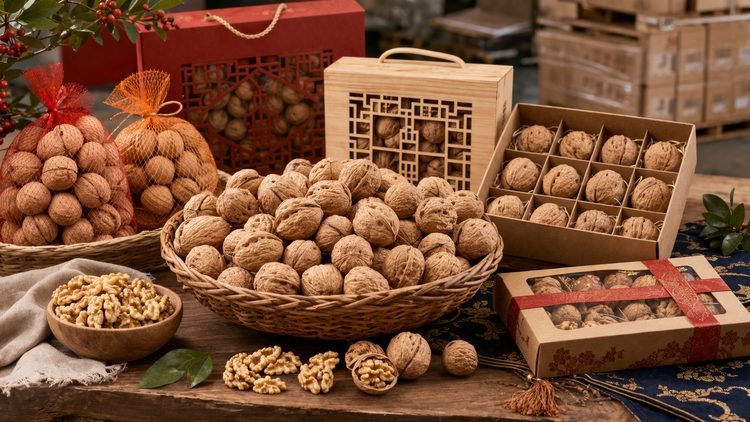
In-shell walnuts occupy a unique position in global nut trade. Unlike kernel-focused industrial ingredients, in-shell walnuts are strongly tied to cultural consumption patterns, seasonal gifting traditions and visual presentation. In many markets, they are not only a food product but also a symbolic or ceremonial item associated with festivals, hospitality and premium seasonal offerings.
This means that sourcing in-shell walnuts is less about processing functionality and more about appearance, size consistency, shell quality, cleanliness and packaging format. For Atlas, in-shell walnut programs are structured around how the product will be presented to the end consumer, not just how it will be priced or shipped.
How this topic shows up in real buying decisions
In-shell walnut buyers typically evaluate a different set of parameters compared to kernel buyers. Instead of focusing on grind size or oil content, they prioritize shell integrity, size calibration, visual uniformity and overall presentation quality.
Key buying considerations include:
- size range and calibration (large, extra large, jumbo),
- shell color (natural vs. bleached),
- cleanliness and dust levels,
- percentage of intact shells versus defects,
- moisture and storage condition,
- packaging format and presentation.
In gifting markets, even small variations in shell color or size distribution can significantly impact perceived value. As a result, in-shell walnut programs are often more specification-driven than commodity-driven.
Natural vs. bleached in-shell walnuts
One of the first commercial decisions in traditional walnut trade is whether to source natural or bleached shells. Natural walnuts retain their original shell color, which may vary from light tan to darker tones. These are often preferred in markets where authenticity and natural appearance are valued.
Bleached walnuts, by contrast, are processed to achieve a more uniform light shell color. This creates a cleaner and more consistent visual presentation, which can be advantageous in premium gifting packs or retail displays where uniformity signals higher quality.
The choice between natural and bleached is rarely technical—it is primarily market-driven. Buyers should align this decision with the expectations of their destination market and retail channel.
Seasonality and timing in walnut trade
In-shell walnut programs are highly seasonal. Demand peaks are often tied to cultural or religious events, gifting periods and retail cycles. This creates a compressed commercial window where product must be sourced, packed, shipped and positioned correctly ahead of peak demand.
From a sourcing perspective, this means:
- planning procurement around harvest windows,
- aligning packing schedules with shipping timelines,
- allowing buffer time for export documentation and customs clearance,
- ensuring product arrives in market before peak retail periods.
Missed timing can significantly reduce commercial value, even if product quality is high. For this reason, timing is often as critical as specification in in-shell walnut programs.
Seasonal insight: in-shell walnut programs are time-sensitive. A well-specified product delivered late can lose much of its market value.
Packaging strategies for gifting and traditional trade
Packaging plays a central role in in-shell walnut programs because it directly affects both product protection and consumer perception. Unlike industrial bulk kernels, in-shell walnuts are often sold in formats where visual presentation is part of the value proposition.
Typical packaging approaches include:
- bulk cartons for wholesale distribution,
- mesh bags or sacks for traditional markets,
- printed retail cartons for branded programs,
- gift boxes or premium packaging for seasonal promotions.
For export markets, packaging must also account for transit conditions. This includes protection against moisture, mechanical damage and long shipping durations. Buyers should specify whether the program is bulk trade, retail-ready or gift-oriented, as this directly affects packaging design and cost structure.
Commercial structure and program planning
In-shell walnut programs often follow a structured commercial path. Buyers typically begin with a trial or sample evaluation focused on size, color and presentation. This is followed by a validation stage where packaging and logistics are tested. Final orders are then aligned with seasonal demand and shipment schedules.
Because these programs are tied to fixed calendar events, repeatability and planning are critical. Unlike continuous industrial demand, seasonal walnut trade requires precise coordination between supply, packing and shipping.
What Atlas would ask before quoting
For in-shell walnut inquiries, Atlas typically structures the discussion around:
- target size range and grade,
- natural or bleached shell preference,
- packaging format (bulk, retail, gift),
- destination market and seasonal timing,
- volume expectations and shipment schedule.
This allows Atlas to match the inquiry with appropriate California supply partners and propose realistic commercial options rather than generic pricing.
Buyer planning note
Atlas Global Trading Co. approaches in-shell walnut programs as presentation-driven trade rather than purely commodity supply. If you are planning a seasonal or traditional walnut program, the most effective starting point is to define the visual, packaging and timing requirements clearly.
With those inputs, the sourcing discussion can move quickly from general interest to a structured commercial proposal aligned with your market and season.
Need help sourcing in-shell walnuts?
Share your size, packaging and seasonal timing requirements with Atlas.
- Specify size and shell type
- Include destination and timing
- Define packaging format
Frequently Asked Questions
What is the main buyer takeaway from in-shell walnut gifting programs?
The key takeaway is that in-shell walnut programs are driven by presentation, size, color and packaging—not just price.
What matters most when sourcing in-shell walnuts?
Size calibration, shell appearance, cleanliness, packaging and timing are the most critical factors.
Are export programs different?
Yes. Export programs require additional planning around packaging, documentation and transit time.