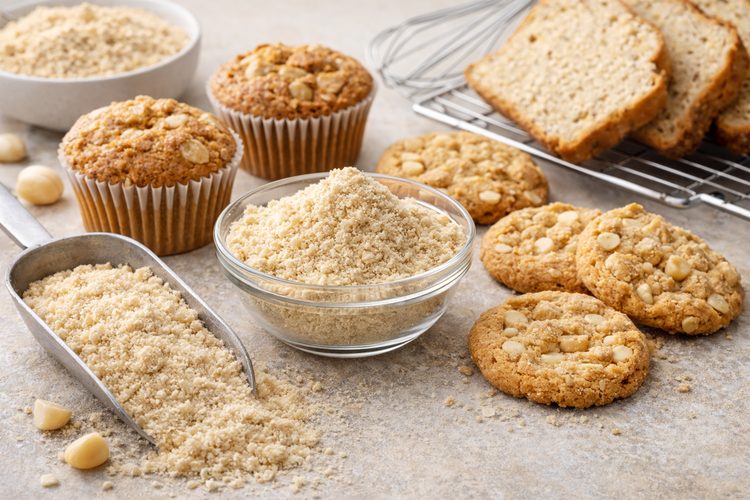
Macadamia flour is not a direct replacement for wheat flour. It is a functional ingredient that brings fat, flavor, density and moisture into gluten-free and specialty baking systems. For buyers, the commercial challenge is not simply sourcing “macadamia flour,” but defining the right grind, fat behavior and application context so the ingredient performs consistently in production.
Functional role in gluten-free systems
Macadamia flour is naturally gluten-free and contributes richness, softness and a premium nut profile. However, unlike cereal flours, it contains a high oil fraction and low structural protein. This means it does not provide the same binding or structure as wheat flour and is typically used as part of a formulation system rather than as a standalone base.
In gluten-free baking, macadamia flour is often blended with starches such as tapioca or rice flour, and sometimes fibers or gums, to balance structure and moisture. The macadamia component improves mouthfeel, extends shelf softness and supports premium positioning.
Particle size and grind specification
Particle size is one of the most important technical variables in macadamia flour sourcing. A finer flour will integrate smoothly into batters and doughs, while a coarser meal may provide texture but less uniformity.
- Extra fine flour: used in smooth batters, cake systems and delicate bakery items.
- Standard flour: suitable for cookies, muffins and general gluten-free baking.
- Coarse meal: adds texture in rustic bakery or specialty formulations.
Buyers should align particle size with processing method. High-speed industrial mixing may require finer flour, while artisanal or specialty baking may tolerate broader particle distribution.
Fat content and oil release behavior
Macadamia flour is naturally high in fat compared to almond or cereal flours. This fat contributes to softness and richness but also affects processing. Excess oil release can impact dough handling, shelf life and packaging.
From a sourcing perspective, buyers should consider:
- defatting level (full-fat vs partially defatted),
- oil migration during storage,
- interaction with other ingredients,
- impact on shelf stability.
Commercial note: higher fat content improves eating quality but may require tighter packaging control and shorter shelf life planning.
Application-specific performance
Cookies and biscuits
Macadamia flour contributes richness and a softer bite. It is often blended with starches to control spread and structure.
Cakes and muffins
Fine macadamia flour improves moisture retention and mouthfeel but must be balanced to avoid excessive density.
Gluten-free blends
Used as a premium component rather than the main base. Supports clean label positioning and improved sensory quality.
Specialty and keto baking
Macadamia flour is often used in low-carb formulations where fat content is desirable and grain-free positioning is important.
Processing and sourcing considerations
Macadamia flour production depends on the input kernel quality, grinding method and handling conditions. Heat generation during grinding can influence oil release and final texture. Buyers should consider:
- raw vs roasted input material,
- grinding temperature control,
- particle size consistency,
- moisture level and stability,
- packaging to protect against oxidation.
Packaging and shelf life
Due to its fat content, macadamia flour is more sensitive to oxidation than low-fat flours. Packaging choices such as vacuum packs, nitrogen flushing or high-barrier materials can significantly influence shelf life.
Industrial buyers should align packaging with distribution model:
- bulk industrial bags for fast turnover,
- foodservice packs for intermediate use,
- retail-ready packaging for premium positioning.
Commercial planning points
Macadamia flour programs often follow staged development:
- trial formulation and testing,
- validation in production conditions,
- launch volume,
- repeat supply.
Pricing depends on kernel input cost, processing yield, grind specification and packaging. Buyers should define realistic expectations around cost vs functionality rather than comparing directly to commodity flours.
What Atlas would ask before quoting
- What is the target application?
- What particle size is required?
- Is full-fat or partially defatted flour preferred?
- What is the blend ratio in formulation?
- What packaging format is needed?
- What is the destination market and timeline?
Buyer planning note
Atlas Global Trading Co. approaches macadamia flour as a functional ingredient rather than a generic commodity. The strongest outcomes come when particle size, fat behavior, application and commercial planning are aligned from the start. Buyers who define these parameters clearly typically achieve better product performance and more reliable supply programs.
Need help sourcing macadamia flour?
Turn this technical topic into a practical quote request.
- Define flour type and particle size
- Add volume and application details
- Include destination and timing
Frequently Asked Questions
What is the main buyer takeaway?
Macadamia flour sourcing works best when particle size, fat content and application are aligned early.
Why is particle size important?
It directly affects texture, mixing behavior and product consistency.
Is macadamia flour used alone?
Usually it is blended with other gluten-free ingredients to balance structure and performance.